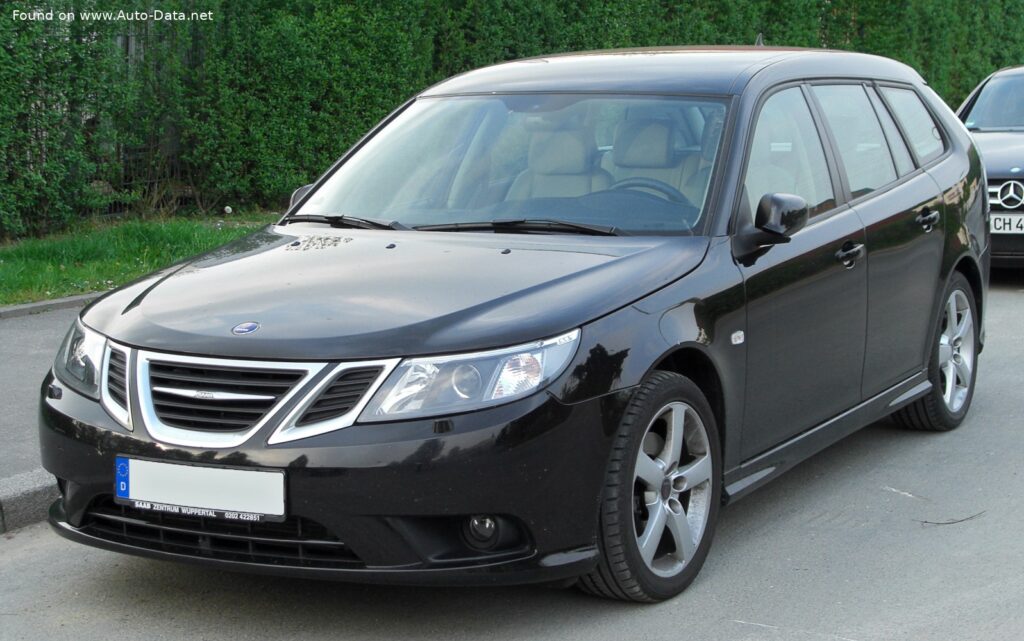
The Saab 9-3 Sport Combi II, specifically the facelifted version introduced in September 2007 and produced through December 2010, represents a refined iteration of Saab’s compact executive car. Positioned as a five-door, five-seat station wagon (estate), the 9-3 Sport Combi aimed to blend practicality with Saab’s characteristic Scandinavian design and engineering. This version, powered by a 1.9 TiD diesel engine producing 150 horsepower, was primarily sold in the European market, offering a balance of fuel efficiency and performance within the competitive station wagon segment. The facelift brought subtle styling updates and improvements to interior trim and equipment levels.
Saab 9-3 Sport Combi II (2007-2010) 1.9 TiD
The 9-3 Sport Combi II facelift continued Saab’s tradition of offering a distinctive alternative to mainstream European and Japanese competitors. While Saab never achieved the sales volumes of brands like BMW or Audi, the 9-3 cultivated a loyal following attracted by its unique design, focus on safety, and driver-centric approach. The Sport Combi body style, in particular, appealed to buyers needing a versatile vehicle without sacrificing style or driving enjoyment. The 1.9 TiD engine option provided a compelling choice for those prioritizing fuel economy and lower running costs.
Engine & Performance
The heart of the 2007-2010 Saab 9-3 Sport Combi II 1.9 TiD is a 1.9-liter inline four-cylinder diesel engine, designated Z19DTH. This engine utilizes a common rail direct injection system and is equipped with a turbocharger and intercooler to enhance power and efficiency. It produces 150 horsepower at 4,000 rpm and a substantial 320 Nm (236.02 lb.-ft.) of torque available between 2,000 and 2,750 rpm. This torque output provides strong acceleration and effortless cruising, particularly beneficial for a wagon intended for carrying loads. The engine’s 17.5:1 compression ratio is typical for a diesel engine, contributing to its thermal efficiency.
Performance figures include a 0-100 km/h (0-62 mph) acceleration time of 10.2 seconds, and a 0-60 mph time of 9.7 seconds. The vehicle achieves a maximum speed of 200 km/h (124.27 mph). Fuel economy is a strong point, with combined cycle consumption rated at 5.9 l/100 km (39.9 US mpg, 47.9 UK mpg, 16.9 km/l). CO2 emissions are rated at 157 g/km, meeting Euro 4 emission standards. The engine is transversely mounted at the front of the vehicle, driving the front wheels through a six-speed manual transmission.
Design & Features
The Saab 9-3 Sport Combi II is a five-door station wagon characterized by its sleek, aerodynamic profile. The facelifted model features subtle revisions to the front fascia, including a redesigned grille and headlights, and updated rear taillights. The interior maintains Saab’s minimalist and functional design philosophy, with a focus on ergonomics and driver comfort. The cabin offers seating for five passengers and provides a generous 419 liters (14.8 cu. ft.) of trunk space with the rear seats up, expanding to 1273 liters (44.96 cu. ft.) when the rear seats are folded down.
Safety features are a key aspect of the 9-3, including ABS (Anti-lock Braking System). The vehicle’s chassis utilizes independent suspension – McPherson struts at the front and a multi-link setup at the rear – providing a comfortable ride and responsive handling. Hydraulic power steering offers precise control. Standard tire sizes range from 215/65 R16 to 235/40 R19, depending on the trim level. The 9-3 Sport Combi II also includes a particulate filter to reduce emissions, reflecting growing environmental concerns at the time of its production.
Technical Specifications
| Brand | Saab |
| Model | 9-3 |
| Generation | 9-3 Sport Combi II (facelift 2007) |
| Type (Engine) | 1.9 TiD (150 Hp) |
| Start of production | September, 2007 |
| End of production | December, 2010 |
| Powertrain Architecture | Internal Combustion engine |
| Body type | Station wagon (estate) |
| Seats | 5 |
| Doors | 5 |
| Fuel consumption (economy) – urban (NEDC) | 7.8 l/100 km (30.2 US mpg, 36.2 UK mpg, 12.8 km/l) |
| Fuel consumption (economy) – extra urban (NEDC) | 4.8 l/100 km (49 US mpg, 58.9 UK mpg, 20.8 km/l) |
| Fuel consumption (economy) – combined (NEDC) | 5.9 l/100 km (39.9 US mpg, 47.9 UK mpg, 16.9 km/l) |
| CO2 emissions (NEDC) | 157 g/km |
| Fuel Type | Diesel |
| Acceleration 0 – 100 km/h | 10.2 sec |
| Acceleration 0 – 62 mph | 10.2 sec |
| Acceleration 0 – 60 mph | 9.7 sec |
| Maximum speed | 200 km/h (124.27 mph) |
| Emission standard | Euro 4 |
| Weight-to-power ratio | 11 kg/Hp, 90.9 Hp/tonne |
| Weight-to-torque ratio | 5.2 kg/Nm, 193.9 Nm/tonne |
| Power | 150 Hp @ 4000 rpm |
| Power per litre | 78.5 Hp/l |
| Torque | 320 Nm @ 2000-2750 rpm (236.02 lb.-ft. @ 2000-2750 rpm) |
| Engine layout | Front, Transverse |
| Engine Model/Code | Z19DTH |
| Engine displacement | 1910 cm3 (116.56 cu. in.) |
| Number of cylinders | 4 |
| Engine configuration | Inline |
| Cylinder Bore | 82 mm (3.23 in.) |
| Piston Stroke | 90.4 mm (3.56 in.) |
| Compression ratio | 17.5:1 |
| Number of valves per cylinder | 4 |
| Fuel injection system | Diesel Commonrail |
| Engine aspiration | Turbocharger, Intercooler |
| Valvetrain | DOHC |
| Engine oil capacity | 4.6 l (4.86 US qt | 4.05 UK qt) |
| Coolant | 7.4 l (7.82 US qt | 6.51 UK qt) |
| Kerb Weight | 1650 kg (3637.63 lbs.) |
| Max. weight | 2100 kg (4629.71 lbs.) |
| Max load | 450 kg (992.08 lbs.) |
| Trunk (boot) space – minimum | 419 l (14.8 cu. ft.) |
| Trunk (boot) space – maximum | 1273 l (44.96 cu. ft.) |
| Fuel tank capacity | 58 l (15.32 US gal | 12.76 UK gal) |
| Max. roof load | 100 kg (220.46 lbs.) |
| Permitted trailer load with brakes (12%) | 1600 kg (3527.4 lbs.) |
| Permitted trailer load without brakes | 750 kg (1653.47 lbs.) |
| Length | 4670 mm (183.86 in.) |
| Width | 1762 mm (69.37 in.) |
| Width including mirrors | 2038 mm (80.24 in.) |
| Height | 1496 mm (58.9 in.) |
| Wheelbase | 2675 mm (105.31 in.) |
| Front track | 1524 mm (60 in.) |
| Rear (Back) track | 1506 mm (59.29 in.) |
| Front overhang | 981 mm (38.62 in.) |
| Rear overhang | 1014 mm (39.92 in.) |
| Ride height (ground clearance) | 127 mm (5 in.) |
| Minimum turning circle (turning diameter) | 10.8 m (35.43 ft.) |
| Drive wheel | Front wheel drive |
| Number of gears and type of gearbox | 6 gears, manual transmission |
| Front suspension | Independent, type McPherson with coil spring and anti-roll bar |
| Rear suspension | Independent multi-link spring suspension with stabilizer |
| Front brakes | Ventilated discs, 302 mm |
| Rear brakes | Ventilated discs, 292 mm |
| Assisting systems | ABS (Anti-lock braking system) |
| Steering type | Steering rack and pinion |
| Power steering | Hydraulic Steering |
| Tires size | 215/65 R16; 225/50 R17; 235/45 R17; 225/45 R18; 235/45 R18; 235/40 R19 |
| Wheel rims size | 6.5J x 16; 7J x 17; 7.5J x 17; 7.5J x 18; 8J x 19 |