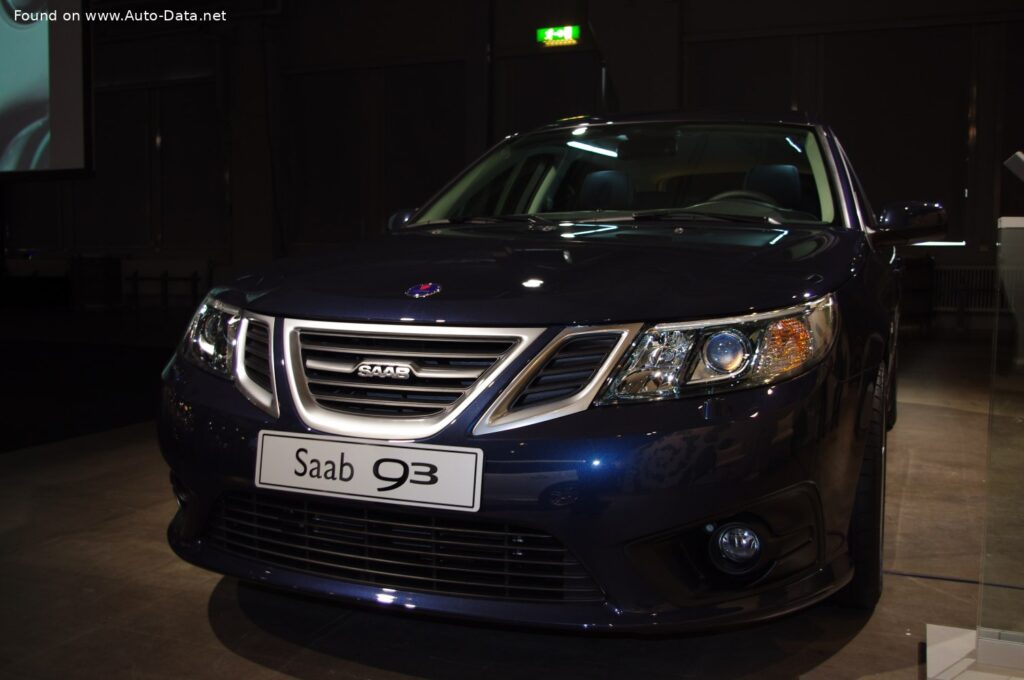
The Saab 9-3 Sport Combi II Griffin, specifically the 2.0t BioPower (220 Hp) XWD Sentronic variant, represents a final iteration of Saab’s popular compact executive car before the brand’s unfortunate demise in December 2011. This model, a facelift of the second-generation 9-3, was primarily aimed at the European market, offering a blend of practicality, performance, and Scandinavian design. While Saab never achieved mainstream success in the United States, the 9-3 was briefly sold here, and the Sport Combi (wagon) body style was highly regarded for its spaciousness and driving dynamics. The “Griffin” designation denoted a higher trim level with enhanced features. This particular version stood out with its BioPower engine, capable of running on both gasoline and E85 ethanol, and its XWD all-wheel-drive system, providing enhanced traction and stability.
Saab 9-3 Sport Combi II Griffin: An Overview
The 9-3 Sport Combi II Griffin occupied the compact executive wagon segment, competing with vehicles like the Audi A4 Avant, BMW 3 Series Touring, and Volvo V60. The 2011 facelift brought subtle styling updates, including revised front and rear fascias, and interior enhancements. The 2.0t BioPower engine, coupled with the Sentronic automatic transmission and XWD system, aimed to deliver a balance of fuel efficiency and engaging performance. The BioPower capability was a key feature, reflecting Saab’s commitment to alternative fuels and reducing environmental impact, particularly in markets where E85 was readily available.
Engine & Performance
The heart of the 9-3 Sport Combi II Griffin 2.0t BioPower is a 1.998-liter (121.93 cubic inches) inline-four cylinder engine. This engine utilizes direct fuel injection and a twin-scroll turbocharger with an intercooler to produce 220 horsepower at 5300 rpm and 350 Nm (258.15 lb.-ft.) of torque between 2000 and 4000 rpm. The BioPower designation indicates the engine is optimized to run on gasoline or a blend of up to 85% ethanol (E85). When running on E85, the engine’s output can be slightly increased due to the fuel’s higher octane rating and cooling effect. Power is delivered to all four wheels via Saab’s XWD all-wheel-drive system, which employs an electronically controlled multi-plate clutch to distribute torque between the front and rear axles as needed. The Sentronic 6-speed automatic transmission provides smooth and responsive gear changes. Performance figures include a 0-100 km/h (0-62 mph) acceleration time of 9.1 seconds and a top speed of 225 km/h (139.81 mph). The 0-60 mph time is calculated at 8.6 seconds.
Design & Features
The Saab 9-3 Sport Combi II Griffin is a five-door station wagon (estate) offering seating for five passengers. Its exterior design is characterized by clean lines, a distinctive Saab grille, and a sloping roofline that contributes to its aerodynamic profile. The Sport Combi body style provides a generous cargo capacity of 477 liters (16.85 cubic feet) with the rear seats up, expanding to 1331 liters (47 cubic feet) when the rear seats are folded down. Inside, the Griffin trim level features comfortable seating, a well-appointed dashboard, and a range of standard equipment. Safety features include ABS (Anti-lock Braking System), ventilated disc brakes on all four wheels (302mm front, 292mm rear), and a robust chassis designed for stability. The car’s suspension utilizes an independent McPherson strut setup at the front and an independent multi-link setup at the rear, providing a comfortable ride and responsive handling. Other notable features include electric power steering, and available options like leather upholstery, premium audio systems, and parking assist.
Technical Specifications
| Brand | Saab |
| Model | 9-3 |
| Generation | 9-3 Sport Combi II Griffin (facelift 2011) |
| Type (Engine) | 2.0t BioPower (220 Hp) XWD Sentronic |
| Start of production | 2011 |
| End of production | December, 2011 |
| Powertrain Architecture | Internal Combustion engine |
| Body type | Station wagon (estate) |
| Seats | 5 |
| Doors | 5 |
| Fuel consumption (urban) | 12.6 l/100 km (18.7 US mpg, 22.4 UK mpg, 7.9 km/l) |
| Fuel consumption (extra urban) | 6.9 l/100 km (34.1 US mpg, 40.9 UK mpg, 14.5 km/l) |
| Fuel consumption (combined) | 9 l/100 km (26.1 US mpg, 31.4 UK mpg, 11.1 km/l) |
| CO2 emissions | 209 g/km |
| Fuel Type | Petrol / Ethanol – E85 |
| Acceleration 0 – 100 km/h | 9.1 sec |
| Acceleration 0 – 62 mph | 9.1 sec |
| Acceleration 0 – 60 mph | 8.6 sec |
| Maximum speed | 225 km/h (139.81 mph) |
| Emission standard | Euro 5 |
| Weight-to-power ratio | 7.4 kg/Hp, 135.4 Hp/tonne |
| Weight-to-torque ratio | 4.6 kg/Nm, 215.4 Nm/tonne |
| Power | 220 Hp @ 5300 rpm |
| Power per litre | 110.1 Hp/l |
| Torque | 350 Nm @ 2000-4000 rpm (258.15 lb.-ft. @ 2000-4000 rpm) |
| Engine layout | Front, Transverse |
| Engine Model/Code | A20NFT |
| Engine displacement | 1998 cm3 (121.93 cu. in.) |
| Number of cylinders | 4 |
| Engine configuration | Inline |
| Cylinder Bore | 86 mm (3.39 in.) |
| Piston Stroke | 86 mm (3.39 in.) |
| Number of valves per cylinder | 4 |
| Fuel injection system | Direct injection |
| Engine aspiration | Twin-scroll turbo, Intercooler |
| Valvetrain | DOHC |
| Engine oil capacity | 6 l (6.34 US qt | 5.28 UK qt) |
| Coolant | 7.5 l (7.93 US qt | 6.6 UK qt) |
| Kerb Weight | 1625-1765 kg (3582.51 – 3891.16 lbs.) |
| Max. weight | 2220 kg (4894.26 lbs.) |
| Max load | 455-595 kg (1003.1 – 1311.75 lbs.) |
| Trunk (boot) space – minimum | 477 l (16.85 cu. ft.) |
| Trunk (boot) space – maximum | 1331 l (47 cu. ft.) |
| Fuel tank capacity | 61 l (16.11 US gal | 13.42 UK gal) |
| Max. roof load | 100 kg (220.46 lbs.) |
| Permitted trailer load with brakes (12%) | 1600 kg (3527.4 lbs.) |
| Permitted trailer load without brakes | 750 kg (1653.47 lbs.) |
| Length | 4691 mm (184.69 in.) |
| Width | 1762 mm (69.37 in.) |
| Width including mirrors | 2038 mm (80.24 in.) |
| Height | 1492 mm (58.74 in.) |
| Wheelbase | 2675 mm (105.31 in.) |
| Front track | 1524 mm (60 in.) |
| Rear (Back) track | 1506 mm (59.29 in.) |
| Front overhang | 1002 mm (39.45 in.) |
| Rear overhang | 1014 mm (39.92 in.) |
| Drivetrain Architecture | All wheel drive (4×4). ICE drives front wheels, rear wheels driven by clutch. |
| Number of gears and type of gearbox | 6 gears, automatic transmission Sentronic |
| Front suspension | Independent, McPherson with coil spring and anti-roll bar |
| Rear suspension | Independent multi-link spring suspension with stabilizer |
| Front brakes | Ventilated discs, 302 mm |
| Rear brakes | Ventilated discs, 292 mm |
| Steering type | Steering rack and pinion |
| Power steering | Electric |
| Tires size | 235/45 R17; 225/45 R18; 235/45 R18; 235/40 R19 |
| Wheel rims size | 7.5J x 17; 7.5J x 18; 8J x 19 |