
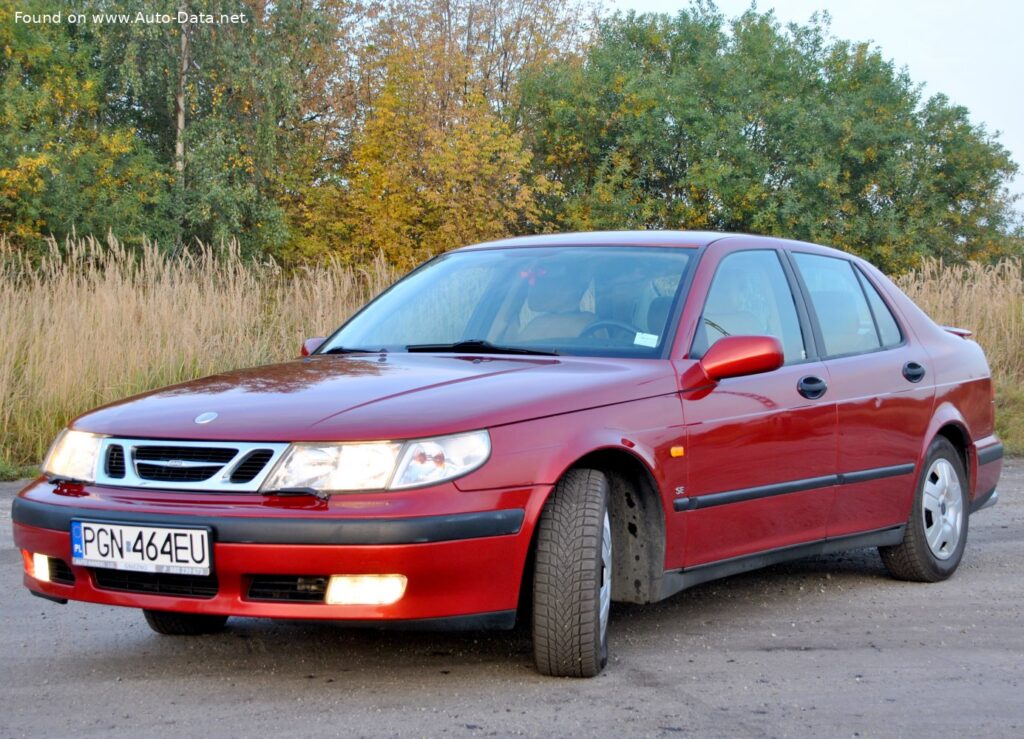
The Saab 9-5 2.0 T represents a significant entry in the mid-size executive car segment, produced by the Swedish manufacturer Saab between 1997 and 2001. This generation, known internally as the 9-5, was Saab’s attempt to compete directly with established German rivals like the BMW 5 Series and Mercedes-Benz E-Class, offering a unique blend of Scandinavian design, innovative safety features, and turbocharged performance. The 2.0 T variant, equipped with a 2.0-liter turbocharged engine producing 150 horsepower, served as a popular entry point into the 9-5 range, balancing performance with fuel efficiency.
The Saab 9-5 2.0 T: A Scandinavian Contender
The first-generation Saab 9-5 was a pivotal model for the brand, replacing the aging 9000. It aimed to elevate Saab’s image and appeal to a broader audience. While Saab never achieved the sales volumes of its German competitors, the 9-5 established a loyal following, particularly among those seeking a distinctive and well-engineered vehicle. The 2.0 T model, with its relatively accessible price point, played a crucial role in attracting new customers to the Saab brand. It was primarily sold in Europe, where Saab maintained a strong presence, and in limited numbers in other markets.
Engine & Performance
The heart of the Saab 9-5 2.0 T is its B205E 2.0-liter inline-four cylinder engine. This engine is characterized by its turbocharging, a technology Saab pioneered and heavily utilized. The turbocharger forces more air into the engine, significantly boosting power output. The 2.0 T produces 150 horsepower at 5500 rpm and 240 Nm (177.01 lb.-ft.) of torque at 1800 rpm. This torque delivery provides strong acceleration from low engine speeds, making it a responsive and enjoyable driving experience. Acceleration from 0 to 100 km/h (0-62 mph) takes 9.8 seconds, while 0 to 60 mph is achieved in approximately 9.3 seconds. The engine’s power-to-weight ratio is 9.9 kg/Hp, and the torque-to-weight ratio is 6.2 kg/Nm. The engine features multi-port fuel injection and a double overhead camshaft (DOHC) valvetrain, contributing to its efficiency and performance. The engine displaces 1985 cm3 (121.13 cu. in.) and boasts a compression ratio of 9.3:1.
Design & Features
The Saab 9-5 2.0 T is a four-door sedan with a distinctive and aerodynamic design. Its styling, while understated, is instantly recognizable as a Saab, featuring clean lines and a focus on functionality. The interior is spacious and comfortable, offering seating for five passengers. Saab prioritized safety in the 9-5, incorporating features like Anti-lock Braking System (ABS) as standard equipment. The car’s body dimensions are 4805 mm (189.17 in.) in length, 1792 mm (70.55 in.) in width, and 1449 mm (57.05 in.) in height. The wheelbase measures 2703 mm (106.42 in.). The trunk offers a generous 500 liters (17.66 cu. ft.) of cargo space. The 9-5’s hydraulic power steering provides precise and responsive handling. The vehicle rides on 185/65 R15 tires. The fuel tank capacity is 75 liters (19.81 US gal).
Technical Specifications
| Brand | Saab |
| Model | 9-5 |
| Generation | 9-5 |
| Type (Engine) | 2.0 T (150 Hp) |
| Start of production | 1997 |
| End of production | 2001 |
| Powertrain Architecture | Internal Combustion engine |
| Body type | Sedan |
| Seats | 5 |
| Doors | 4 |
| Fuel consumption (urban) | 13.5 l/100 km (17.4 US mpg) |
| Fuel consumption (extra urban) | 7.3 l/100 km (32.2 US mpg) |
| Fuel Type | Petrol (Gasoline) |
| Acceleration 0 – 100 km/h | 9.8 sec |
| Acceleration 0 – 62 mph | 9.8 sec |
| Acceleration 0 – 60 mph | 9.3 sec |
| Maximum speed | 215 km/h (133.59 mph) |
| Weight-to-power ratio | 9.9 kg/Hp |
| Weight-to-torque ratio | 6.2 kg/Nm |
| Power | 150 Hp @ 5500 rpm |
| Torque | 240 Nm @ 1800 rpm (177.01 lb.-ft. @ 1800 rpm) |
| Engine layout | Front, Transverse |
| Engine Model/Code | B205E |
| Engine displacement | 1985 cm3 (121.13 cu. in.) |
| Number of cylinders | 4 |
| Engine configuration | Inline |
| Cylinder Bore | 90 mm (3.54 in.) |
| Piston Stroke | 78 mm (3.07 in.) |
| Compression ratio | 9.3:1 |
| Number of valves per cylinder | 4 |
| Fuel injection system | Multi-port manifold injection |
| Engine aspiration | Turbocharger |
| Valvetrain | DOHC |
| Engine oil capacity | 4 l (4.23 US qt | 3.52 UK qt) |
| Coolant capacity | 7.4 l (7.82 US qt | 6.51 UK qt) |
| Kerb Weight | 1485 kg (3273.86 lbs.) |
| Max. weight | 2020 kg (4453.34 lbs.) |
| Max load | 535 kg (1179.47 lbs.) |
| Trunk (boot) space – maximum | 500 l (17.66 cu. ft.) |
| Fuel tank capacity | 75 l (19.81 US gal | 16.5 UK gal) |
| Length | 4805 mm (189.17 in.) |
| Width | 1792 mm (70.55 in.) |
| Height | 1449 mm (57.05 in.) |
| Wheelbase | 2703 mm (106.42 in.) |
| Front track | 1522 mm (59.92 in.) |
| Rear track | 1522 mm (59.92 in.) |
| Drivetrain Architecture | Front wheel drive |
| Number of gears and type of gearbox | 5 gears, manual transmission |
| Front suspension | Spring Strut |
| Rear suspension | Spring Strut |
| Front brakes | Ventilated discs |
| Rear brakes | Disc |
| Assisting systems | ABS (Anti-lock braking system) |
| Steering type | Steering rack and pinion |
| Power steering | Hydraulic Steering |
| Tires size | 185/65 R15 |
The Saab 9-5 2.0 T, while not a sales leader, remains a fondly remembered vehicle for its unique character, strong performance, and commitment to safety. It represents a high point in Saab’s engineering and design philosophy, offering a compelling alternative to the mainstream executive cars of its time.
