
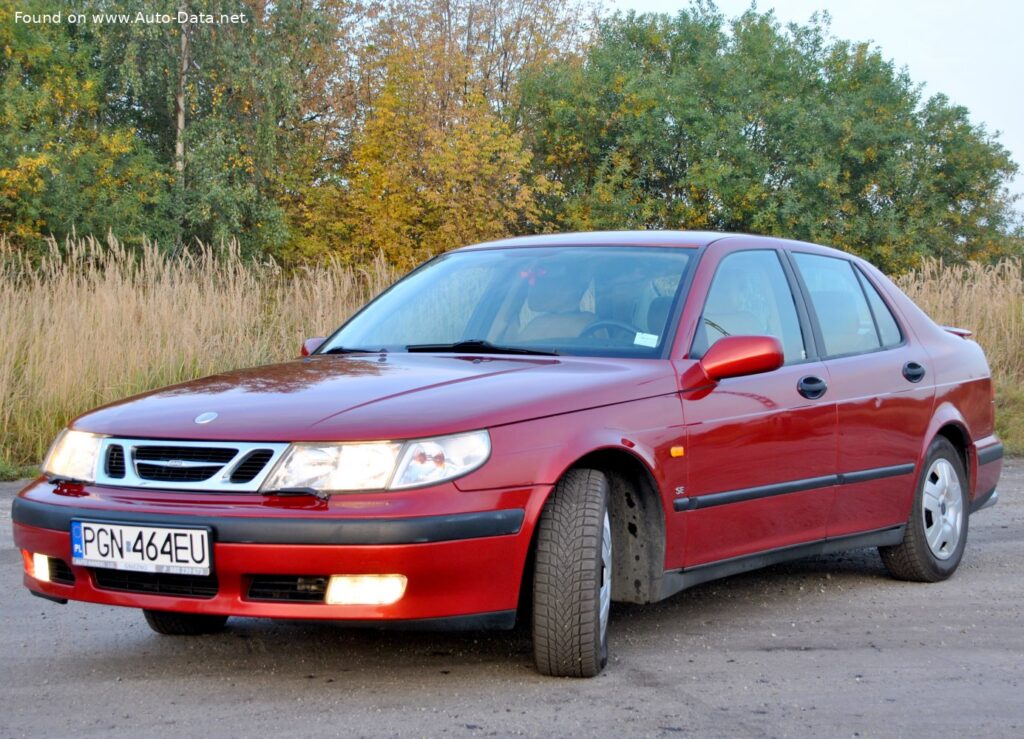
The Saab 9-5 2.0 T, produced between 1997 and 2001, represents a significant evolution in the Swedish automaker’s lineup. Positioned as a mid-size executive car, the 9-5 aimed to blend Scandinavian practicality with a touch of sporting character. This generation, the first to bear the 9-5 designation, was a crucial model for Saab, intended to replace the aging 9000 and compete with established rivals like the BMW 5 Series, Audi A6, and Mercedes-Benz E-Class. While Saab never achieved the same sales volumes as its German competitors, the 9-5 distinguished itself through its innovative design, robust engineering, and a loyal following attracted to the brand’s unique ethos.
The Saab 9-5 2.0 T: A Detailed Overview
The 9-5 2.0 T, specifically, offered a compelling combination of performance and efficiency. It was a key variant within the 9-5 range, providing a balance between the more powerful V6 options and the base 2.0-liter non-turbocharged engine. The model was primarily sold in Europe, where Saab maintained a strong presence, and in limited numbers in other markets. The car’s appeal lay in its turbocharged engine, comfortable ride, and distinctive styling, all hallmarks of the Saab brand.
Engine & Performance
At the heart of the Saab 9-5 2.0 T lies the B205E, a 2.0-liter inline-four cylinder engine equipped with a turbocharger and multi-port fuel injection. This configuration allowed the engine to produce 150 horsepower at 5500 rpm and 240 Nm (177.01 lb.-ft.) of torque at 1800 rpm. The turbocharger significantly enhanced the engine’s responsiveness, providing strong acceleration across a wide range of engine speeds. Power per liter was a respectable 75.6 hp/l. The engine’s output was delivered to the front wheels via a five-speed automatic transmission.
Performance figures for the 9-5 2.0 T were competitive for its class. Acceleration from 0 to 100 km/h (0-62 mph) took 9.8 seconds, while the 0-60 mph sprint was achieved in approximately 9.3 seconds. The car boasted a maximum speed of 215 km/h (133.59 mph). The weight-to-power ratio of 9.9 kg/Hp and weight-to-torque ratio of 6.2 kg/Nm contributed to a reasonably agile driving experience. Fuel economy was rated at 13.5 l/100 km (17.4 US mpg) in urban conditions and 7.3 l/100 km (32.2 US mpg) on the extra-urban cycle.
Design & Features
The Saab 9-5 2.0 T is a four-door sedan with a distinctive and aerodynamic design. The car’s styling, penned under the direction of Björn Envall, was characterized by clean lines, a wraparound windshield, and a sloping rear deck. The design prioritized both aesthetics and functionality, with a focus on minimizing drag and maximizing interior space. The car’s interior was known for its ergonomic design and comfortable seating.
Safety was a key consideration in the 9-5’s design. The car featured ABS (Anti-lock Braking System) as standard, and ventilated disc brakes were fitted to the front wheels, with discs also used at the rear. The chassis employed a spring strut suspension system at both the front and rear, providing a comfortable ride and predictable handling. The steering utilized a hydraulic power steering rack and pinion system. The car offered a trunk capacity of 500 liters (17.66 cu. ft.), providing ample space for luggage and other cargo. Standard tire size was 185/65 R15.
Technical Specifications
| Brand | Saab |
| Model | 9-5 |
| Generation | 9-5 |
| Type (Engine) | 2.0 T (150 Hp) Automatic |
| Start of production | 1997 |
| End of production | 2001 |
| Powertrain Architecture | Internal Combustion engine |
| Body type | Sedan |
| Seats | 5 |
| Doors | 4 |
| Fuel consumption (urban) | 13.5 l/100 km (17.4 US mpg) |
| Fuel consumption (extra urban) | 7.3 l/100 km (32.2 US mpg) |
| Fuel Type | Petrol (Gasoline) |
| Acceleration 0 – 100 km/h | 9.8 sec |
| Acceleration 0 – 62 mph | 9.8 sec |
| Acceleration 0 – 60 mph | 9.3 sec |
| Maximum speed | 215 km/h (133.59 mph) |
| Weight-to-power ratio | 9.9 kg/Hp |
| Weight-to-torque ratio | 6.2 kg/Nm |
| Power | 150 Hp @ 5500 rpm |
| Torque | 240 Nm @ 1800 rpm (177.01 lb.-ft. @ 1800 rpm) |
| Engine layout | Front, Transverse |
| Engine Model/Code | B205E |
| Engine displacement | 1985 cm3 (121.13 cu. in.) |
| Number of cylinders | 4 |
| Engine configuration | Inline |
| Cylinder Bore | 90 mm (3.54 in.) |
| Piston Stroke | 78 mm (3.07 in.) |
| Compression ratio | 9.3:1 |
| Number of valves per cylinder | 4 |
| Fuel injection system | Multi-port manifold injection |
| Engine aspiration | Turbocharger |
| Valvetrain | DOHC |
| Engine oil capacity | 4 l (4.23 US qt | 3.52 UK qt) |
| Coolant capacity | 7.4 l (7.82 US qt | 6.51 UK qt) |
| Kerb Weight | 1485 kg (3273.86 lbs.) |
| Max. weight | 2020 kg (4453.34 lbs.) |
| Max load | 535 kg (1179.47 lbs.) |
| Trunk (boot) space – maximum | 500 l (17.66 cu. ft.) |
| Fuel tank capacity | 75 l (19.81 US gal | 16.5 UK gal) |
| Length | 4805 mm (189.17 in.) |
| Width | 1792 mm (70.55 in.) |
| Height | 1449 mm (57.05 in.) |
| Wheelbase | 2703 mm (106.42 in.) |
| Front track | 1522 mm (59.92 in.) |
| Rear track | 1522 mm (59.92 in.) |
| Drivetrain Architecture | Front wheel drive |
| Number of gears and type of gearbox | 5 gears, automatic transmission |
| Front suspension | Spring Strut |
| Rear suspension | Spring Strut |
| Front brakes | Ventilated discs |
| Rear brakes | Disc |
| Assisting systems | ABS (Anti-lock braking system) |
| Steering type | Steering rack and pinion |
| Power steering | Hydraulic Steering |
| Tires size | 185/65 R15 |
The Saab 9-5 2.0 T, while discontinued in 2001, remains a fondly remembered vehicle for its blend of Scandinavian design, turbocharged performance, and practical features. It represents a high point in Saab’s engineering and design capabilities, and a testament to the brand’s commitment to creating unique and driver-focused automobiles.
