
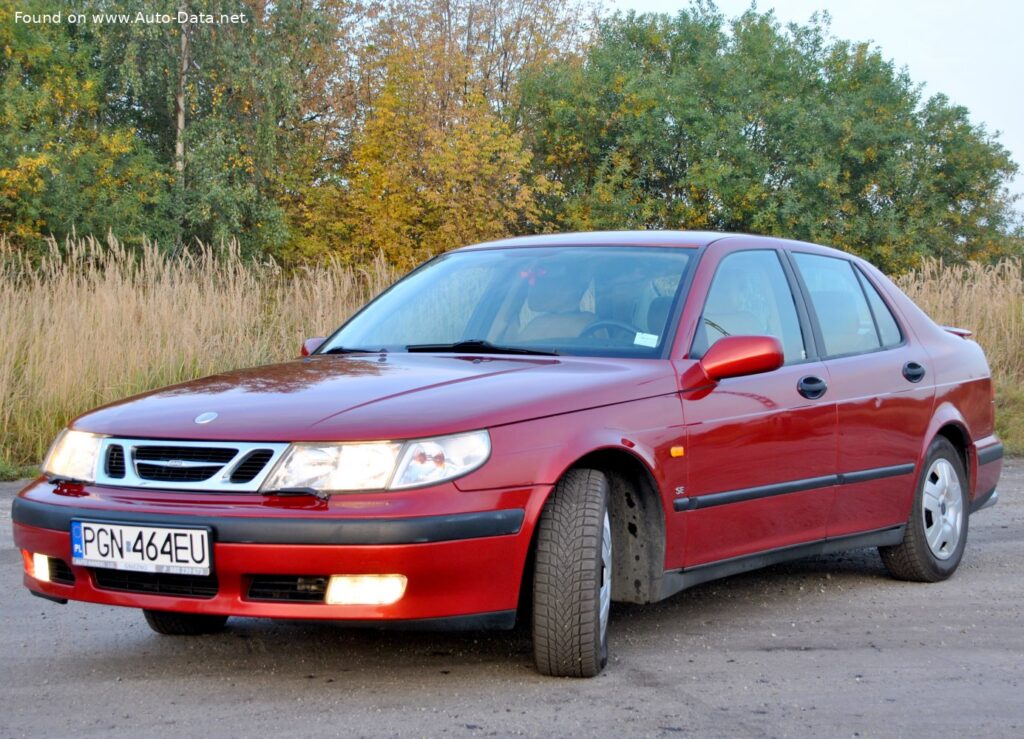
The Saab 9-5 2.0 T 16V, produced between 1999 and 2001, represents a significant iteration in Saab’s mid-size executive car lineage. This generation, known simply as the 9-5, aimed to blend Scandinavian design principles with a focus on driver-centric ergonomics and turbocharged performance. Positioned as a competitor to vehicles like the BMW 5 Series, Audi A6, and Volvo S80, the 9-5 offered a distinctive alternative in a crowded market segment. While Saab never achieved the sales volumes of its German rivals, the 9-5 cultivated a loyal following attracted to its unique character and engineering.
Saab 9-5 2.0 T 16V: A Detailed Overview
The 9-5 marked a departure from previous Saab models, adopting a more contemporary and aerodynamic design. It was a crucial model for Saab, representing a substantial investment and a commitment to remaining competitive in the global automotive landscape. The 2.0 T 16V variant, equipped with a 2.0-liter turbocharged four-cylinder engine, was a popular choice, offering a balance of performance and fuel efficiency. This model was primarily sold in Europe, where Saab maintained a stronger market presence. While not officially sold in large numbers in the United States during this specific generation, earlier 900 and 9000 models had established a niche following among American enthusiasts who appreciated Saab’s unconventional approach to automotive design and engineering.
Engine & Performance
The heart of the Saab 9-5 2.0 T 16V is its B205E 1985 cc (121.13 cu. in.) inline-four cylinder engine. This engine features a turbocharger and multi-port fuel injection, producing 185 horsepower at 5500 rpm and 263 Nm (193.98 lb.-ft.) of torque at 2100 rpm. This configuration delivers a respectable power-to-weight ratio of 8.5 kg/Hp, and a power per litre of 93.2 Hp/l. The engine’s torque curve provides strong acceleration, allowing for a 0-60 mph (0-96 km/h) time of approximately 7.9 seconds, and a 0-100 km/h (0-62 mph) time of 8.3 seconds. The car boasts a maximum speed of 230 km/h (142.92 mph). Power is delivered to the front wheels via a five-speed manual transmission. The engine’s transverse mounting contributes to efficient packaging within the front-wheel-drive chassis.
Design & Features
The Saab 9-5 2.0 T 16V is a four-door sedan with a sleek, aerodynamic profile. Its design incorporates Saab’s signature styling cues, including a wraparound dashboard and a focus on maximizing interior space. The interior is characterized by its ergonomic design, prioritizing driver comfort and control. Safety features for the time included ABS (Anti-lock Braking System) and ventilated front disc brakes, alongside standard disc brakes in the rear. The vehicle offers seating for five passengers and provides 500 liters (17.66 cu. ft.) of trunk space. The 9-5’s design emphasized practicality and usability, with a focus on creating a comfortable and functional environment for both driver and passengers. The vehicle’s dimensions are 4810 mm (189.37 in.) in length, 1790 mm (70.47 in.) in width, and 1450 mm (57.09 in.) in height, with a wheelbase of 2705 mm (106.5 in.).
Technical Specifications
| Brand | Saab |
| Model | 9-5 |
| Generation | 9-5 |
| Type (Engine) | 2.0 T 16V (185 Hp) |
| Start of production | 1999 |
| End of production | 2001 |
| Powertrain Architecture | Internal Combustion engine |
| Body type | Sedan |
| Seats | 5 |
| Doors | 4 |
| Fuel consumption (urban) | 13.4 l/100 km (17.6 US mpg, 21.1 UK mpg, 7.5 km/l) |
| Fuel consumption (extra urban) | 7.1 l/100 km (33.1 US mpg, 39.8 UK mpg, 14.1 km/l) |
| Fuel consumption (combined) | 9.4 l/100 km (25 US mpg, 30.1 UK mpg, 10.6 km/l) |
| Fuel Type | Petrol (Gasoline) |
| Acceleration 0 – 100 km/h | 8.3 sec |
| Acceleration 0 – 62 mph | 8.3 sec |
| Acceleration 0 – 60 mph | 7.9 sec |
| Maximum speed | 230 km/h (142.92 mph) |
| Weight-to-power ratio | 8.5 kg/Hp |
| Weight-to-torque ratio | 6 kg/Nm |
| Power | 185 Hp @ 5500 rpm |
| Torque | 263 Nm @ 2100 rpm (193.98 lb.-ft. @ 2100 rpm) |
| Engine layout | Front, Transverse |
| Engine Model/Code | B205E |
| Engine displacement | 1985 cm3 (121.13 cu. in.) |
| Number of cylinders | 4 |
| Engine configuration | Inline |
| Cylinder Bore | 90 mm (3.54 in.) |
| Piston Stroke | 78 mm (3.07 in.) |
| Compression ratio | 8.8:1 |
| Number of valves per cylinder | 4 |
| Fuel injection system | Multi-port manifold injection |
| Engine aspiration | Turbocharger |
| Valvetrain | DOHC |
| Engine oil capacity | 4 l (4.23 US qt | 3.52 UK qt) |
| Coolant capacity | 7.4 l (7.82 US qt | 6.51 UK qt) |
| Kerb Weight | 1575 kg (3472.28 lbs.) |
| Max. weight | 2100 kg (4629.71 lbs.) |
| Max load | 525 kg (1157.43 lbs.) |
| Trunk (boot) space – minimum | 500 l (17.66 cu. ft.) |
| Fuel tank capacity | 70 l (18.49 US gal | 15.4 UK gal) |
| Length | 4810 mm (189.37 in.) |
| Width | 1790 mm (70.47 in.) |
| Height | 1450 mm (57.09 in.) |
| Wheelbase | 2705 mm (106.5 in.) |
| Front track | 1520 mm (59.84 in.) |
| Rear track | 1520 mm (59.84 in.) |
| Drivetrain Architecture | Front wheel drive |
| Number of gears and type of gearbox | 5 gears, manual transmission |
| Front suspension | Spring Strut |
| Rear suspension | Spring Strut |
| Front brakes | Ventilated discs |
| Rear brakes | Disc |
| Assisting systems | ABS (Anti-lock braking system) |
| Steering type | Steering rack and pinion |
| Power steering | Hydraulic Steering |
| Tires size | 205/65 R15 |
The Saab 9-5 2.0 T 16V, while ultimately discontinued as Saab faced financial difficulties, remains a fondly remembered vehicle for its unique blend of Scandinavian design, turbocharged performance, and driver-focused ergonomics. It represents a high point in Saab’s engineering and design philosophy, offering a compelling alternative to more mainstream offerings in the executive car segment.
