
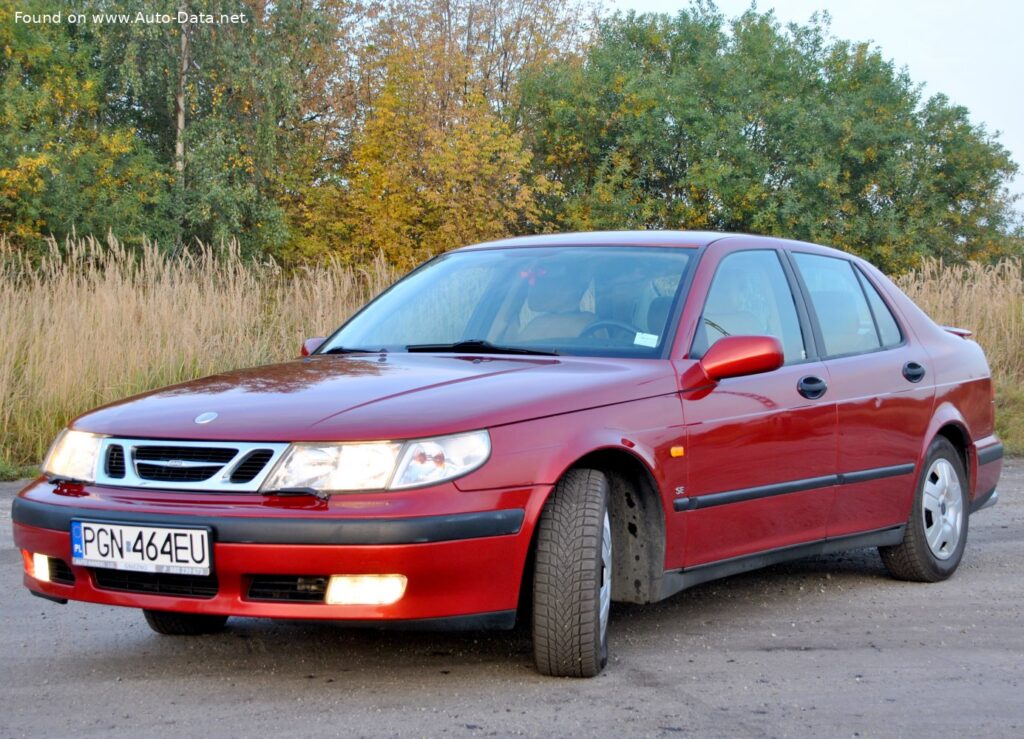
The Saab 9-5 2.0i T SE represents a significant entry in the mid-size executive car segment, produced between 1998 and 2001. This generation of the 9-5, the first to bear the name, aimed to establish Saab as a serious competitor against established German and British marques. While Saab was a relatively small manufacturer, particularly compared to its rivals, the 9-5 distinguished itself through a unique blend of Scandinavian design, innovative safety features, and turbocharged engine technology. The 2.0i T SE model, with its 150 horsepower engine, was positioned as a balance between performance and economy within the 9-5 lineup, offering a compelling alternative for drivers seeking something different.
The Saab 9-5: A Scandinavian Approach to Executive Travel
The first-generation Saab 9-5 was a pivotal model for the Swedish automaker. Launched in 1997 as a replacement for the aging Saab 9000, it represented a move upmarket and a commitment to a more sophisticated vehicle. The 9-5 was designed to appeal to a broader audience while retaining the core Saab values of safety, functionality, and a distinctive driving experience. The “SE” designation in the 2.0i T SE trim level indicated a higher level of standard equipment and refinement compared to the base models. The car was primarily sold in Europe, and to a lesser extent, in other markets like Australia and Asia. It did not receive significant sales volume in the United States, as Saab’s US market share was already limited.
Engine & Performance
At the heart of the Saab 9-5 2.0i T SE lies a 1.985-liter inline-four cylinder engine, designated the B205E. This engine is notable for its turbocharging, a technology Saab championed for many years. The turbocharger boosts power output to 150 horsepower at 5500 rpm, and delivers 215 Nm (158.58 lb.-ft.) of torque at 2500 rpm. This provides a good balance of usable power for both everyday driving and overtaking maneuvers. The engine features multi-port fuel injection and a double overhead camshaft (DOHC) valvetrain, contributing to its efficiency and responsiveness. Power is delivered to the front wheels via a five-speed manual transmission. Performance figures include a 0-100 km/h (0-62 mph) acceleration time of 11.6 seconds and a maximum speed of 210 km/h (130.49 mph). The weight-to-power ratio of 10.2 kg/Hp and weight-to-torque ratio of 7.1 kg/Nm indicate a reasonably efficient powertrain for its time.
Design & Features
The Saab 9-5 2.0i T SE is a four-door sedan with a distinctive, aerodynamic profile. The design, penned under the direction of Björn Envall, incorporates Saab’s signature styling cues, including a wraparound windshield and a distinctive front grille. The interior is characterized by a functional and ergonomically designed dashboard, prioritizing driver comfort and ease of use. The 9-5 offered a spacious cabin for five passengers and a generous 500-liter (17.66 cu. ft.) trunk. Safety was a key consideration in the 9-5’s design. It included standard features such as Anti-lock Braking System (ABS) and a robust safety cage. The car’s steering utilizes a hydraulic power steering rack and pinion system for precise control. Standard tire sizes were 205/65 R15 or 215/55 R16, mounted on 6.5J x 15 or 6.5J x 16 inch wheel rims respectively.
Technical Specifications
| General Information | |
| Brand | Saab |
| Model | 9-5 |
| Generation | 9-5 |
| Type (Engine) | 2.0i T SE (150 Hp) |
| Start of production | 1998 |
| End of production | 2001 |
| Powertrain Architecture | Internal Combustion engine |
| Body type | Sedan |
| Seats | 5 |
| Doors | 4 |
| Performance Specs | |
| Fuel consumption (urban) | 13.5 l/100 km (17.4 US mpg, 20.9 UK mpg) |
| Fuel consumption (extra urban) | 7.2 l/100 km (32.7 US mpg, 39.2 UK mpg) |
| Fuel Type | Petrol (Gasoline) |
| Acceleration 0 – 100 km/h | 11.6 sec |
| Acceleration 0 – 62 mph | 11.6 sec |
| Acceleration 0 – 60 mph | 11 sec |
| Maximum speed | 210 km/h (130.49 mph) |
| Weight-to-power ratio | 10.2 kg/Hp |
| Weight-to-torque ratio | 7.1 kg/Nm |
| Engine Specs | |
| Power | 150 Hp @ 5500 rpm |
| Power per litre | 75.6 Hp/l |
| Torque | 215 Nm @ 2500 rpm (158.58 lb.-ft. @ 2500 rpm) |
| Engine layout | Front, Transverse |
| Engine Model/Code | B205E |
| Engine displacement | 1985 cm3 (121.13 cu. in.) |
| Number of cylinders | 4 |
| Engine configuration | Inline |
| Cylinder Bore | 90 mm (3.54 in.) |
| Piston Stroke | 78 mm (3.07 in.) |
| Compression ratio | 9.2:1 |
| Number of valves per cylinder | 4 |
| Fuel injection system | Multi-port manifold injection |
| Engine aspiration | Turbocharger |
| Valvetrain | DOHC |
| Engine oil capacity | 4 l (4.23 US qt | 3.52 UK qt) |
| Coolant | 7.4 l (7.82 US qt | 6.51 UK qt) |
| Space, Volume and Weights | |
| Kerb Weight | 1535 kg (3384.1 lbs.) |
| Max. weight | 2050 kg (4519.48 lbs.) |
| Max load | 515 kg (1135.38 lbs.) |
| Trunk (boot) space – maximum | 500 l (17.66 cu. ft.) |
| Fuel tank capacity | 75 l (19.81 US gal | 16.5 UK gal) |
| Dimensions | |
| Length | 4805 mm (189.17 in.) |
| Width | 1792 mm (70.55 in.) |
| Height | 1449 mm (57.05 in.) |
| Wheelbase | 2703 mm (106.42 in.) |
| Front track | 1522 mm (59.92 in.) |
| Rear (Back) track | 1522 mm (59.92 in.) |
| Drivetrain, Brakes and Suspension | |
| Drivetrain Architecture | ICE drives front wheels |
| Drive wheel | Front wheel drive |
| Number of gears and type of gearbox | 5 gears, manual transmission |
| Front suspension | Spring Strut |
| Rear suspension | Spring Strut |
| Front brakes | Ventilated discs |
| Rear brakes | Disc |
| Assisting systems | ABS (Anti-lock braking system) |
| Steering type | Steering rack and pinion |
| Power steering | Hydraulic Steering |
| Tires size | 205/65 R15; 215/55 R16 |
| Wheel rims size | 6.5J x 15; 6.5J x 16 |
The Saab 9-5 2.0i T SE, while not a massive sales success, remains a fondly remembered car for its unique character and blend of Scandinavian design and engineering. It represents a significant chapter in Saab’s history, showcasing the company’s commitment to innovation and a distinctive driving experience.
