
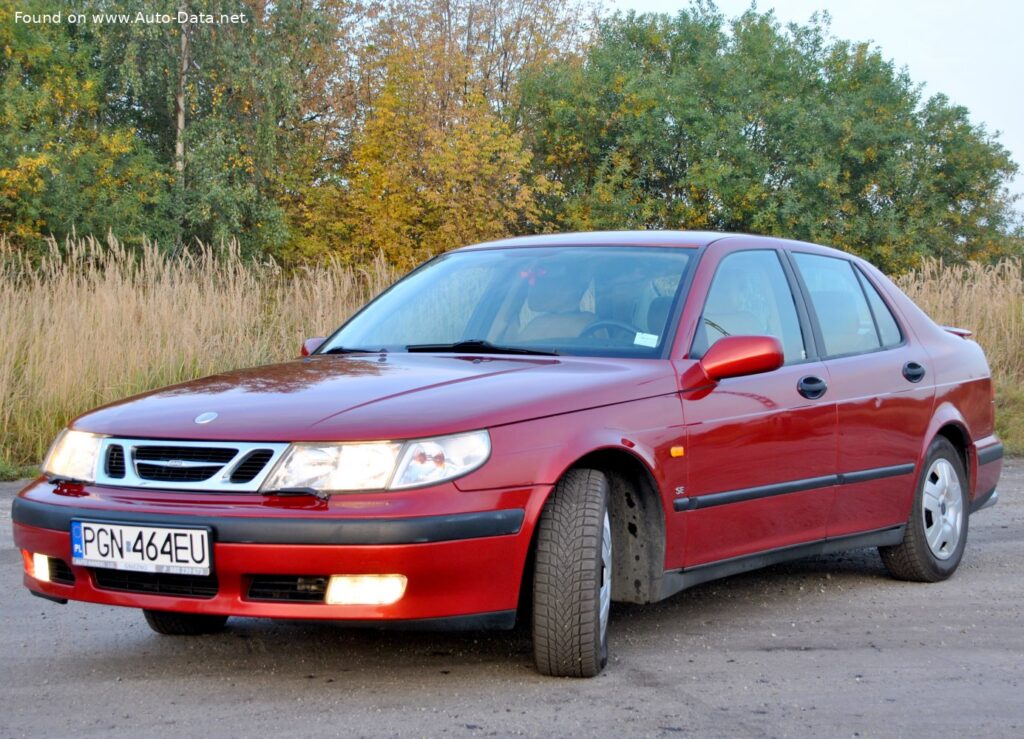
The first-generation Saab 9-5, introduced in 1997 as a replacement for the long-running 9000, marked a significant chapter in the Swedish automaker’s history. Positioned as a mid-size luxury sedan, it aimed to blend Saab’s distinctive design philosophy and commitment to safety with a more contemporary platform. The variant under review, the Saab 9-5 2.3i T SE (170 Hp), produced between 1998 and 2001, exemplifies Saab’s unique approach to performance and driver engagement. While Saab models were appreciated globally for their individualistic character, they held a particular niche in markets like Europe and North America, appealing to buyers seeking an alternative to the mainstream German luxury brands. This specific iteration, with its turbocharged four-cylinder engine and sophisticated engineering, showcased Saab’s enduring legacy of aviation-inspired design and advanced powertrain technology, making it a compelling choice in its competitive segment.
Engineering and Performance of the Saab 9-5
At the heart of the Saab 9-5 2.3i T SE lies a robust 2.3-liter (2290 cm3 or 139.74 cu. in.) inline-four engine, designated B235E. This powerplant is a prime example of Saab’s long-standing expertise in turbocharging, a technology that became synonymous with the brand. Unlike many performance engines of its era, Saab’s “light-pressure” turbo philosophy prioritized broad, accessible torque delivery over peak horsepower figures, resulting in a remarkably flexible and enjoyable driving experience. The engine employs a DOHC (Dual Overhead Camshaft) valvetrain with four valves per cylinder, ensuring efficient breathing and combustion. Fuel delivery is managed by a multi-port manifold injection system, precisely controlling the air-fuel mixture for optimal performance and efficiency.
The turbocharger, a key component, significantly boosts the engine’s output, allowing it to produce a healthy 170 horsepower at 5500 rpm. More impressively, the torque output stands at 280 Nm (206.52 lb.-ft.) available from a remarkably low 1800 rpm. This characteristic low-end torque is crucial for effortless acceleration and strong passing power, making the 9-5 feel more potent than its horsepower figure might suggest. The power is channeled to the front wheels through a precise 5-speed manual transmission, offering direct driver engagement and control. This combination allows the Saab 9-5 2.3i T SE to accelerate from 0 to 60 mph in a respectable 9.4 seconds (0-100 km/h in 9.9 seconds) and reach a top speed of 136.7 mph (220 km/h).
Despite its spirited performance, the 9-5 2.3i T SE also demonstrated reasonable fuel economy for its class and era. It achieved an estimated 15.5 US mpg in urban driving conditions and a more efficient 29.8 US mpg on the highway (7.9 l/100 km extra urban). These figures underscore Saab’s commitment to balancing performance with everyday usability and efficiency. The vehicle’s weight-to-power ratio is 9.2 kg/Hp (109 Hp/tonne), and its weight-to-torque ratio is 5.6 kg/Nm (179.5 Nm/tonne), reflecting a well-engineered balance for its intended executive sedan role. The engine’s layout is front, transverse, contributing to the front-wheel-drive architecture and efficient packaging within the sedan’s body.
Design and Features of the Saab 9-5
The Saab 9-5, specifically in its SE trim, embodied a distinctive design language that set it apart from its German and Japanese rivals. As a 4-door sedan designed to comfortably seat five occupants, its exterior styling was characterized by smooth, aerodynamic lines, a hallmark of Saab’s aviation heritage. The overall aesthetic was one of understated elegance, prioritizing functionality and safety without compromising on a unique visual identity. The dimensions of the vehicle – a length of 189.17 inches (4805 mm), a width of 70.55 inches (1792 mm), and a height of 57.05 inches (1449 mm) – contributed to a substantial road presence and a spacious interior.
Inside, the 9-5 offered an ergonomic and driver-focused cabin. Saab was renowned for its thoughtful interior design, which included features like the “Black Panel” function, allowing the driver to extinguish all instrument lighting except for critical information at night, reducing distraction. While not explicitly listed in the raw data, Saab vehicles of this vintage were typically equipped with high levels of passive and active safety features. The presence of ABS (Anti-lock Braking System) is confirmed, complementing the ventilated disc brakes at the front and disc brakes at the rear, ensuring confident stopping power. The steering system utilized a hydraulic rack and pinion setup, providing precise and communicative feedback to the driver.
The suspension system featured a Spring Strut design both front and rear. This configuration, combined with a wheelbase of 106.42 inches (2703 mm) and identical front and rear track widths of 59.92 inches (1522 mm), contributed to the 9-5’s characteristic blend of comfortable ride quality and predictable handling. The vehicle rode on 215/55 R16 tires, mounted on 6.5J x 17-inch wheel rims, providing a good balance of grip and ride compliance. Practicality was also a strong suit, with a generous trunk capacity of 17.66 cu. ft. (500 liters) and a fuel tank capacity of 19.81 US gallons (75 liters), offering ample range for long journeys. The kerb weight of 3439.21 lbs. (1560 kg) and a maximum permissible weight of 4519.48 lbs. (2050 kg) underscored its robust construction and load-carrying capability.
Technical Specifications
| Brand | Saab |
| Model | 9-5 |
| Generation | 9-5 |
| Type (Engine) | 2.3i T SE (170 Hp) |
| Start of production | 1998 year |
| End of production | 2001 year |
| Powertrain Architecture | Internal Combustion engine |
| Body type | Sedan |
| Seats | 5 |
| Doors | 4 |
| Fuel consumption (economy) – urban | 15.2 l/100 km (15.5 US mpg) |
| Fuel consumption (economy) – extra urban | 7.9 l/100 km (29.8 US mpg) |
| Fuel Type | Petrol (Gasoline) |
| Acceleration 0 – 60 mph | 9.4 sec |
| Maximum speed | 220 km/h (136.7 mph) |
| Weight-to-power ratio | 9.2 kg/Hp (109 Hp/tonne) |
| Weight-to-torque ratio | 5.6 kg/Nm (179.5 Nm/tonne) |
| Power | 170 Hp @ 5500 rpm |
| Power per litre | 74.2 Hp/l |
| Torque | 280 Nm @ 1800 rpm (206.52 lb.-ft. @ 1800 rpm) |
| Engine layout | Front, Transverse |
| Engine Model/Code | B235E |
| Engine displacement | 2290 cm3 (139.74 cu. in.) |
| Number of cylinders | 4 |
| Engine configuration | Inline |
| Cylinder Bore | 90 mm (3.54 in.) |
| Piston Stroke | 90 mm (3.54 in.) |
| Compression ratio | 9.3:1 |
| Number of valves per cylinder | 4 |
| Fuel injection system | Multi-port manifold injection |
| Engine aspiration | Turbocharger |
| Valvetrain | DOHC |
| Engine oil capacity | 4 l (4.23 US qt) |
| Coolant | 7.4 l (7.82 US qt) |
| Kerb Weight | 1560 kg (3439.21 lbs.) |
| Max. weight | 2050 kg (4519.48 lbs.) |
| Max load | 490 kg (1080.27 lbs.) |
| Trunk (boot) space – maximum | 500 l (17.66 cu. ft.) |
| Fuel tank capacity | 75 l (19.81 US gal) |
| Length | 4805 mm (189.17 in.) |
| Width | 1792 mm (70.55 in.) |
| Height | 1449 mm (57.05 in.) |
| Wheelbase | 2703 mm (106.42 in.) |
| Front track | 1522 mm (59.92 in.) |
| Rear (Back) track | 1522 mm (59.92 in.) |
| Drivetrain Architecture | The Internal combustion engine (ICE) drives the front wheels of the vehicle. |
| Drive wheel | Front wheel drive |
| Number of gears and type of gearbox | 5 gears, manual transmission |
| Front suspension | Spring Strut |
| Rear suspension | Spring Strut |
| Front brakes | Ventilated discs |
| Rear brakes | Disc |
| Assisting systems | ABS (Anti-lock braking system) |
| Steering type | Steering rack and pinion |
| Power steering | Hydraulic Steering |
| Tires size | 215/55 R16 |
| Wheel rims size | 6.5J x 17 |
