
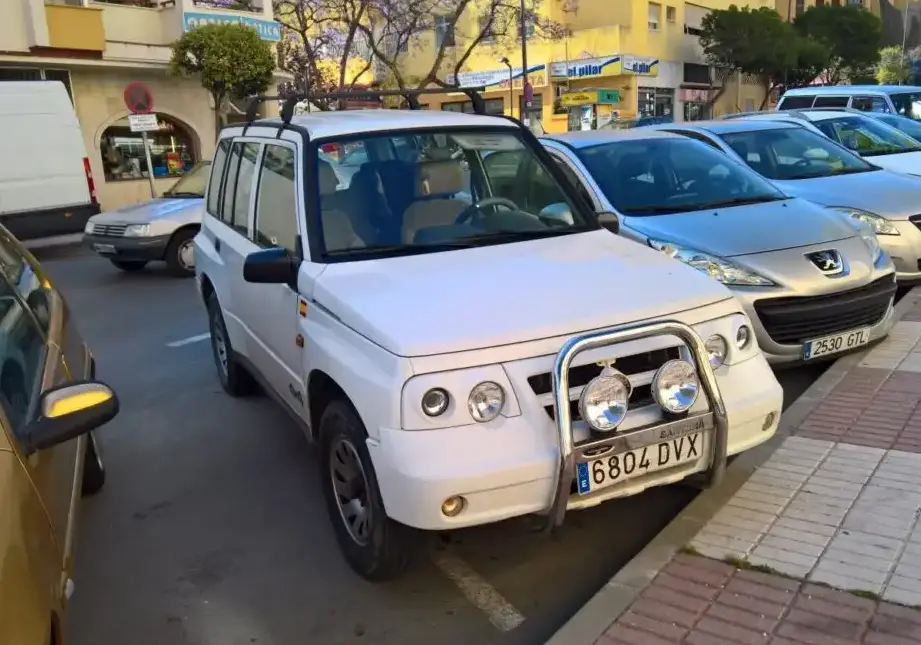
The Santana 350 1.6 HDi 4WD, produced between 2006 and 2009, represents a niche offering within the Santana 300/350 range. Positioned as a practical and capable SUV, it aimed to provide all-wheel-drive capability and reasonable fuel economy in a relatively affordable package. Built by Santana Motors, a Spanish automaker with a long history of licensed Land Rover production and independent designs, the 350 series was intended for both domestic and export markets, though its presence in North America was limited. This particular variant, powered by the DV6ATED4 engine and paired with a five-speed manual transmission, occupied a mid-range position in the lineup, offering a balance between cost, performance, and functionality.
Technical Specifications
| Brand | Santana |
| Model | 300/350 |
| Generation | 350 |
| Type (Engine) | 1.6 HDi (90 Hp) 4WD |
| Start of production | 2006 |
| End of production | 2009 |
| Powertrain Architecture | Internal Combustion engine |
| Body type | SUV |
| Seats | 5 |
| Doors | 5 |
| Fuel consumption (urban) | 6.8 l/100 km (34.6 US mpg, 41.5 UK mpg, 14.7 km/l) |
| Fuel consumption (extra urban) | 5.1 l/100 km (46.1 US mpg, 55.4 UK mpg, 19.6 km/l) |
| Fuel consumption (combined) | 5.7 l/100 km (41.3 US mpg, 49.6 UK mpg, 17.5 km/l) |
| CO2 emissions | 149 g/km |
| Fuel Type | Diesel |
| Maximum speed | 160 km/h (99.42 mph) |
| Weight-to-power ratio | 15.7 kg/Hp (63.5 Hp/tonne) |
| Weight-to-torque ratio | 6.6 kg/Nm (151.7 Nm/tonne) |
| Power | 90 Hp @ 4000 rpm |
| Power per litre | 57.7 Hp/l |
| Torque | 215 Nm @ 1750 rpm (158.58 lb.-ft. @ 1750 rpm) |
| Engine layout | Front, Longitudinal |
| Engine Model/Code | DV6ATED4 |
| Engine displacement | 1560 cm3 (95.2 cu. in.) |
| Number of cylinders | 4 |
| Engine configuration | Inline |
| Cylinder Bore | 75 mm (2.95 in.) |
| Piston Stroke | 88.3 mm (3.48 in.) |
| Compression ratio | 18:1 |
| Number of valves per cylinder | 4 |
| Fuel injection system | Diesel Commonrail |
| Engine aspiration | Turbocharger, Intercooler |
| Valvetrain | DOHC |
| Engine oil capacity | 3.75 l (3.96 US qt, 3.3 UK qt) |
| Kerb Weight | 1417 kg (3123.95 lbs.) |
| Max. weight | 1850 kg (4078.55 lbs.) |
| Max load | 433 kg (954.6 lbs.) |
| Fuel tank capacity | 55 l (14.53 US gal, 12.1 UK gal) |
| Length | 4040 mm (159.06 in.) |
| Width | 1635 mm (64.37 in.) |
| Height | 1700 mm (66.93 in.) |
| Wheelbase | 2480 mm (97.64 in.) |
| Front track | 1395-1405 mm (54.92 – 55.31 in.) |
| Rear track | 1400-1410 mm (55.12 – 55.51 in.) |
| Ride height (ground clearance) | 210 mm (8.27 in.) |
| Minimum turning circle | 10.8 m (35.43 ft.) |
| Drivetrain Architecture | All wheel drive (4×4). ICE drives rear wheels, front wheels engaged via clutch. |
| Number of gears | 5 |
| Gearbox type | Manual transmission |
| Front suspension | Independent, McPherson with coil spring and anti-roll bar |
| Rear suspension | Rigid axle, Coil spring |
| Front brakes | Disc, 290×10 mm |
| Rear brakes | Drum |
| Steering type | Cone worm with recirculation balls |
| Power steering | Hydraulic |
| Wheel rims size | 15 |
Powertrain & Engine Architecture
The heart of the Santana 350 1.6 HDi 4WD is the DV6ATED4 engine, a 1.6-liter inline-four cylinder diesel. This engine, developed by PSA Peugeot Citroën and widely used across various European brands, is known for its relatively compact size and fuel efficiency. The ‘DV6’ designation refers to the engine family, while ‘ATED4’ specifies the particular iteration with a turbocharger and direct injection. The engine utilizes a common rail direct injection system, delivering fuel at extremely high pressure for optimized combustion. A single overhead camshaft (SOHC) operates four valves per cylinder (DOHC), contributing to efficient gas exchange. The turbocharger, coupled with an intercooler, boosts power output by forcing more air into the cylinders. The five-speed manual transmission was the standard offering, providing a straightforward and durable shifting experience. The transmission’s gear ratios were tuned for a balance of fuel economy and usability, prioritizing torque delivery over outright acceleration.
Driving Characteristics
The 1.6 HDi engine, producing 90 horsepower, provided adequate, but not exhilarating, performance in the Santana 350. Acceleration was modest, with a 0-60 mph time estimated around 13-14 seconds. The engine’s strength lay in its torque output of 215 Nm (158.58 lb-ft), available from a low 1750 rpm. This made it well-suited for tackling varied terrain and carrying loads, leveraging the benefits of the four-wheel-drive system. The manual transmission allowed for precise control, but the gear ratios were spaced to maximize fuel economy rather than provide sporty acceleration. Compared to potential higher-output versions (which weren’t commonly offered in the Santana 350), this variant prioritized practicality and efficiency over performance. The 4WD system, typically part-time, engaged the front wheels when rear wheel slip was detected, enhancing traction on slippery surfaces.
Equipment & Trim Levels
The Santana 350 1.6 HDi 4WD typically came with a fairly basic level of equipment, reflecting its positioning as a value-oriented SUV. Standard features generally included power steering, central locking, and an AM/FM radio. Interior upholstery was typically cloth, with durable plastic trim. Air conditioning was often an optional extra, as were power windows and alloy wheels. The dashboard layout was functional and straightforward, prioritizing usability over aesthetic flair. Safety features were relatively limited by modern standards, typically including driver and passenger airbags and ABS brakes. The overall focus was on providing a robust and practical vehicle rather than a luxurious one.
Chassis & Braking
The Santana 350 utilized a body-on-frame construction, a traditional approach that contributed to its durability and off-road capability. The front suspension employed an independent McPherson strut setup with coil springs and an anti-roll bar, providing a reasonable level of ride comfort and handling. The rear suspension featured a rigid axle with coil springs, prioritizing load-carrying capacity and simplicity. The braking system consisted of disc brakes on the front wheels and drum brakes on the rear. While adequate for everyday use, the braking performance was not particularly strong compared to more modern vehicles. The steering system was a recirculating ball type, providing a direct but somewhat heavy feel.
Market Reception & Comparison
The Santana 350 1.6 HDi 4WD received mixed reviews. Critics generally praised its ruggedness, fuel efficiency, and all-wheel-drive capability, but noted its relatively low power output and basic interior. Compared to other SUVs in its class, such as the Suzuki Grand Vitara or the Nissan X-Trail, the Santana 350 offered a more utilitarian experience. Its fuel economy was competitive, but its performance lagged behind many rivals. Reliability was generally considered good, benefiting from the robust design of the engine and chassis. However, parts availability could be an issue in some markets due to Santana’s relatively limited production volumes.
Legacy
The Santana 350 1.6 HDi 4WD, while not a mainstream success, has developed a following among enthusiasts who appreciate its rugged simplicity and off-road capability. The DV6ATED4 engine has proven to be a durable and reliable unit, and parts are generally available, though sourcing can sometimes be challenging. In the used car market, these vehicles are often sought after by those looking for a practical and affordable 4×4. While not known for its speed or luxury, the Santana 350 1.6 HDi 4WD remains a testament to Santana Motors’ commitment to building robust and capable vehicles.
