
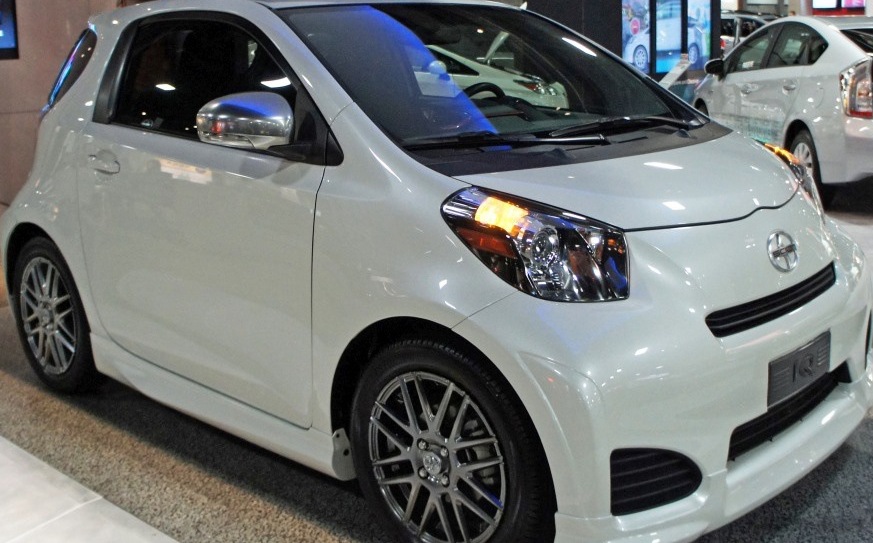
The Scion iQ 1.3, producing 94 horsepower with an automatic transmission, was a unique offering in the North American microcar segment from 2010 to 2015. Positioned as an entry-level vehicle within the iQ lineup – which was discontinued alongside the Scion brand itself – it aimed to provide efficient urban transportation in a remarkably small package. The iQ, built on Scion’s (and Toyota’s) innovative packaging principles, prioritized interior space despite its diminutive exterior dimensions. It was a rebadged version of the Toyota iQ, originally designed for the European and Japanese markets, and represented Scion’s attempt to capture a younger, style-conscious audience seeking fuel economy and maneuverability.
Technical Specifications
| Brand | Scion |
| Model | iQ |
| Generation | iQ |
| Type (Engine) | 1.3 (94 Hp) Automatic |
| Start of production | 2010 |
| End of production | 2015 |
| Powertrain Architecture | Internal Combustion engine |
| Body type | Hatchback |
| Seats | 4 |
| Doors | 3 |
| Fuel consumption (economy) – urban | 6.5 l/100 km (36.2 US mpg, 43.5 UK mpg, 15.4 km/l) |
| Fuel consumption (economy) – extra urban | 6.4 l/100 km (36.8 US mpg, 44.1 UK mpg, 15.6 km/l) |
| Fuel consumption (economy) – combined | 6.4 l/100 km (36.8 US mpg, 44.1 UK mpg, 15.6 km/l) |
| Fuel Type | Petrol (Gasoline) |
| Acceleration 0 – 100 km/h | 11.6 sec |
| Acceleration 0 – 62 mph | 11.6 sec |
| Acceleration 0 – 60 mph | 11 sec |
| Maximum speed | 171 km/h (106.25 mph) |
| Weight-to-power ratio | 10.3 kg/Hp, 97.4 Hp/tonne |
| Weight-to-torque ratio | 8 kg/Nm, 125.4 Nm/tonne |
| Power | 94 Hp @ 6000 rpm |
| Power per litre | 70.7 Hp/l |
| Torque | 121 Nm @ 4400 rpm (89.25 lb.-ft. @ 4400 rpm) |
| Engine layout | Front, Transverse |
| Engine Model/Code | 1NR-FE |
| Engine displacement | 1329 cm3 (81.1 cu. in.) |
| Number of cylinders | 4 |
| Engine configuration | Inline |
| Cylinder Bore | 72.4 mm (2.85 in.) |
| Piston Stroke | 80.5 mm (3.17 in.) |
| Compression ratio | 11.5:1 |
| Number of valves per cylinder | 4 |
| Fuel injection system | Multi-port manifold injection |
| Engine aspiration | Naturally aspirated engine |
| Valvetrain | DOHC, D-VVT-i |
| Engine oil capacity | 3.5 l (3.7 US qt | 3.08 UK qt) |
| Coolant | 4.7 l (4.97 US qt | 4.14 UK qt) |
| Kerb Weight | 965 kg (2127.46 lbs.) |
| Trunk (boot) space – minimum | 99 l (3.5 cu. ft.) |
| Trunk (boot) space – maximum | 473 l (16.7 cu. ft.) |
| Fuel tank capacity | 32 l (8.45 US gal | 7.04 UK gal) |
| Length | 3051 mm (120.12 in.) |
| Width | 1679 mm (66.1 in.) |
| Height | 1501 mm (59.09 in.) |
| Wheelbase | 1999 mm (78.7 in.) |
| Front track | 1476 mm (58.11 in.) |
| Rear (Back) track | 1461 mm (57.52 in.) |
| Ride height (ground clearance) | 135 mm (5.31 in.) |
| Drag coefficient (Cd) | 0.31 |
| Minimum turning circle (turning diameter) | 8.1 m (26.57 ft.) |
| Drivetrain Architecture | The Internal combustion engine (ICE) drives the front wheels of the vehicle. |
| Drive wheel | Front wheel drive |
| Number of gears and type of gearbox | automatic transmission CVT-i |
| Front suspension | Independent type McPherson |
| Rear suspension | Torsion |
| Front brakes | Ventilated discs |
| Rear brakes | Drum |
| Assisting systems | ABS (Anti-lock braking system) |
| Steering type | Steering rack and pinion |
| Power steering | Electric Steering |
| Tires size | 175/60 R16 |
| Wheel rims size | 5J x 16 |
INTRODUCTION
The Scion iQ 1.3 Automatic, produced from 2010 to 2015, represented a bold attempt to redefine personal transportation in the American market. Built on Toyota’s 1HX0 platform (also known as the A3 platform), the iQ was notable for its exceptionally small footprint – shorter than a Mini Cooper – while still accommodating four passengers. This was achieved through a clever asymmetrical dashboard design that maximized front passenger space. The 1.3-liter engine and automatic transmission combination was intended to appeal to buyers prioritizing fuel efficiency and ease of use, making it a popular choice for city commuting.
Powertrain & Engine Architecture
At the heart of the iQ 1.3 Automatic lies the 1NR-FE engine, a 1.329-liter inline-four cylinder gasoline engine. This engine utilizes a multi-port fuel injection system and a double overhead camshaft (DOHC) valvetrain with Toyota’s Variable Valve Timing-intelligent (VVT-i) technology. The VVT-i system optimizes valve timing based on engine speed and load, improving both fuel efficiency and power output. The 1NR-FE is a naturally aspirated engine, meaning it doesn’t employ turbocharging or supercharging. The engine is transversely mounted in the front of the vehicle. Paired with this engine is a Continuously Variable Transmission with intelligence (CVT-i). This transmission type offers seamless gear changes and contributes to the iQ’s fuel economy. The CVT-i simulates stepped gear ratios for a more familiar driving experience.
Driving Characteristics
The 94-horsepower output of the 1.3-liter engine, coupled with the CVT-i transmission, resulted in a driving experience focused on efficiency rather than outright performance. Acceleration from 0 to 60 mph took approximately 11 seconds, and top speed was limited to 106 mph. The CVT transmission, while smooth, lacked the responsiveness of a traditional automatic or manual gearbox. Power delivery was linear but not particularly strong, making it best suited for urban driving conditions. Compared to other iQ variants, such as those with manual transmissions, the automatic version offered less driver engagement but greater convenience. The CVT’s programming prioritized fuel economy, often holding the engine at lower RPMs to maximize efficiency.
Equipment & Trim Levels
The Scion iQ 1.3 Automatic typically came standard with features like air conditioning, power windows and locks, a basic audio system with auxiliary input, and ABS brakes. Safety features included multiple airbags. Interior upholstery was typically cloth, and the dashboard featured a unique asymmetrical design. Optional extras included a premium audio system, navigation, and alloy wheels. The iQ was offered in a limited number of trim levels, with the automatic version generally representing a mid-range offering. Higher trims added cosmetic enhancements and additional convenience features.
Chassis & Braking
The iQ’s chassis was designed to maximize rigidity within its small dimensions. It utilized a McPherson strut independent suspension in the front and a torsion beam suspension in the rear. The front brakes were ventilated discs, providing adequate stopping power, while the rear brakes were drums – a cost-saving measure common in this class of vehicle. The iQ’s relatively light weight (approximately 2127 lbs) helped to offset the limitations of the rear drum brakes. Electric power steering provided light and easy steering feel, ideal for maneuvering in tight city streets.
Market Reception & Comparison
The Scion iQ received mixed reviews from automotive critics. While praised for its innovative packaging and fuel efficiency, it was often criticized for its limited power and somewhat basic interior. Compared to other subcompact cars available in the US market, such as the Honda Fit or Nissan Versa, the iQ offered a more unique and stylish design but less practicality and cargo space. Fuel economy was competitive, averaging around 37 mpg combined. Reliability was generally good, consistent with Toyota’s reputation, but some owners reported minor issues with the CVT transmission.
Legacy
The Scion iQ, despite its relatively short production run, left a lasting impression as a bold and innovative microcar. The 1.3-liter engine and automatic transmission combination proved to be reasonably reliable, and used examples remain relatively affordable. While not a mainstream success, the iQ appealed to a niche market of buyers seeking a unique and fuel-efficient urban vehicle. The iQ’s innovative packaging and design principles influenced subsequent Toyota models, and it remains a popular choice among enthusiasts looking for a distinctive and economical city car. The CVT transmission, while not universally loved, has proven durable in many applications, and routine maintenance – including fluid changes – is key to its longevity.
