
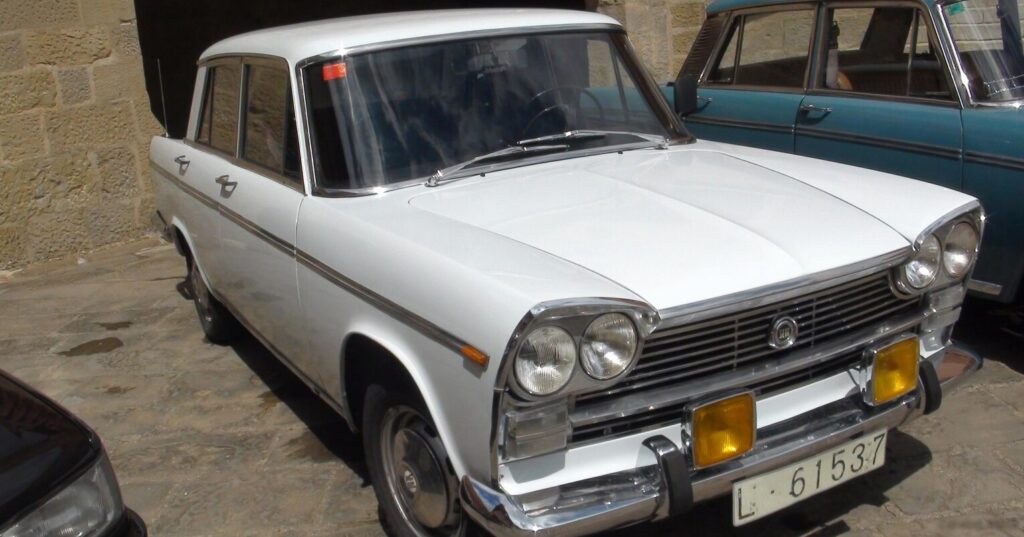
The SEAT 1500, specifically the 1.5-liter 80 horsepower variant, was a pivotal model for the Spanish automaker, representing a significant step towards modernizing the Spanish automotive industry. Produced from 1963 to 1973, this version of the 1500 occupied a crucial position in SEAT’s lineup as an accessible, yet relatively sophisticated, family sedan. It was built upon the foundations of the original 1500, but with refinements to the engine and overall design, aiming to broaden its appeal within the burgeoning Spanish middle class. The 1500 series, as a whole, was heavily influenced by the Fiat 1500 and 1800 models, reflecting SEAT’s early licensing agreements with the Italian manufacturer.
Technical Specifications
| Brand | Seat |
| Model | 1500 |
| Generation | 1500 |
| Type (Engine) | 1.5 (80 Hp) |
| Start of production | 1963 |
| End of production | 1973 |
| Powertrain Architecture | Internal Combustion engine |
| Body type | Sedan |
| Seats | 6 |
| Doors | 4 |
| Fuel Type | Petrol (Gasoline) |
| Maximum speed | 140 km/h (86.99 mph) |
| Weight-to-power ratio | 14.2 kg/Hp, 70.5 Hp/tonne |
| Weight-to-torque ratio | 9.6 kg/Nm, 104 Nm/tonne |
| Power | 80 Hp @ 5200 rpm |
| Power per litre | 54 Hp/l |
| Torque | 118 Nm @ 3200 rpm (87.03 lb.-ft. @ 3200 rpm) |
| Engine layout | Front, Longitudinal |
| Engine displacement | 1481 cm3 (90.38 cu. in.) |
| Number of cylinders | 4 |
| Engine configuration | Inline |
| Cylinder Bore | 77 mm (3.03 in.) |
| Piston Stroke | 79.5 mm (3.13 in.) |
| Compression ratio | 8.8:1 |
| Number of valves per cylinder | 2 |
| Fuel injection system | Carburettor |
| Engine aspiration | Naturally aspirated engine |
| Valvetrain | OHV |
| Kerb Weight | 1135 kg (2502.25 lbs.) |
| Fuel tank capacity | 60 l (15.85 US gal | 13.2 UK gal) |
| Length | 4465 mm (175.79 in.) |
| Width | 1620 mm (63.78 in.) |
| Height | 1431 mm (56.34 in.) |
| Wheelbase | 2650 mm (104.33 in.) |
| Front track | 1330 mm (52.36 in.) |
| Rear (Back) track | 1306 mm (51.42 in.) |
| Ride height (ground clearance) | 211 mm (8.31 in.) |
| Drivetrain Architecture | The Internal combustion engine (ICE) drives the rear wheels of the vehicle. |
| Drive wheel | Rear wheel drive |
| Number of gears and type of gearbox | 4 gears, manual transmission |
| Front suspension | Double wishbone, Transverse stabilizer |
| Rear suspension | Rigid axle suspension, Leaf spring |
| Front brakes | Disc |
| Rear brakes | Disc |
| Steering type | Worm-reduction unit |
Powertrain & Engine Architecture
The heart of the SEAT 1500 1.5 was its 1481cc inline-four cylinder engine. This engine, designated with various internal codes depending on the specific year and minor revisions, was a naturally aspirated unit employing an overhead valve (OHV) valvetrain. Fuel delivery was managed by a single carburetor, a common setup for the era. The 80 horsepower output at 5200 rpm, while modest by modern standards, was considered respectable for a family sedan in the 1960s and early 70s. Torque peaked at 118 Nm (87.03 lb-ft) at 3200 rpm, providing adequate pulling power for everyday driving. The engine’s longitudinal front-engine, rear-wheel-drive layout was typical of European cars of the time. The four-speed manual transmission was the standard offering, providing a direct connection between the engine and the rear wheels.
Driving Characteristics
The 1500 1.5 offered a driving experience characteristic of its era. Acceleration was adequate, but not particularly brisk. The 0 to 60 mph time was estimated to be around 14-16 seconds. The four-speed manual gearbox provided a reasonable spread of ratios, but required deliberate shifting. The car’s relatively light weight (1135 kg or 2502.25 lbs) helped to mitigate the effects of the modest horsepower. Handling was predictable, though not sporty, with the rigid rear axle contributing to a somewhat firm ride. Compared to later, more powerful versions of the 1500, or the subsequent 124 models, the 1.5 felt less refined and offered a more utilitarian driving experience. However, its simplicity and robust construction made it a reliable and relatively easy-to-maintain vehicle.
Equipment & Trim Levels
The SEAT 1500 1.5 was generally offered with a fairly basic level of equipment, reflecting its position as an affordable family car. Standard features typically included cloth upholstery, a simple dashboard layout with basic instrumentation (speedometer, fuel gauge, temperature gauge), and manually operated windows and door locks. Optional extras, depending on the market and year, could include a radio, whitewall tires, and upgraded interior trim. The interior was functional and spacious, offering comfortable seating for up to six passengers. The car’s build quality was generally good, though not on par with some of its more expensive European competitors.
Chassis & Braking
The SEAT 1500 1.5 featured a traditional chassis design for the period. The front suspension utilized a double wishbone setup with a transverse stabilizer bar, providing a reasonable level of ride comfort and handling. The rear suspension employed a rigid axle with leaf springs, a cost-effective and durable solution. Braking was accomplished via disc brakes on all four wheels, a relatively advanced feature for a car in this price range during the 1960s. The steering system was a worm-reduction unit, providing a somewhat indirect steering feel. The car’s overall chassis design prioritized durability and ease of maintenance over outright performance.
Market Reception & Comparison
The SEAT 1500 1.5 was well-received in the Spanish market, where it filled a crucial gap in the automotive landscape. It offered a modern, reliable, and relatively affordable option for families who were previously limited to older, less sophisticated vehicles. Critics praised the car’s build quality, spacious interior, and decent performance. Compared to other trims in the 1500 lineup, the 1.5 represented the entry-level option, offering a more economical choice for budget-conscious buyers. It was often compared to other European sedans of the time, such as the Fiat 1500 and the Renault 12, generally holding its own in terms of reliability and value for money. Fuel economy was reasonable for the era, averaging around 30-35 mpg.
Legacy
The SEAT 1500 1.5 played a significant role in the development of the Spanish automotive industry. It helped to modernize the country’s transportation infrastructure and provided a platform for SEAT to establish itself as a major automaker. The 1.5-liter engine proved to be remarkably durable and reliable, and many examples are still on the road today. In the used car market, the 1500 1.5 is appreciated by classic car enthusiasts for its simplicity, affordability, and historical significance. While not a high-performance vehicle, it represents a charming and well-built example of 1960s automotive engineering. Parts availability can be a challenge, but a dedicated community of owners and enthusiasts helps to keep these cars running.
