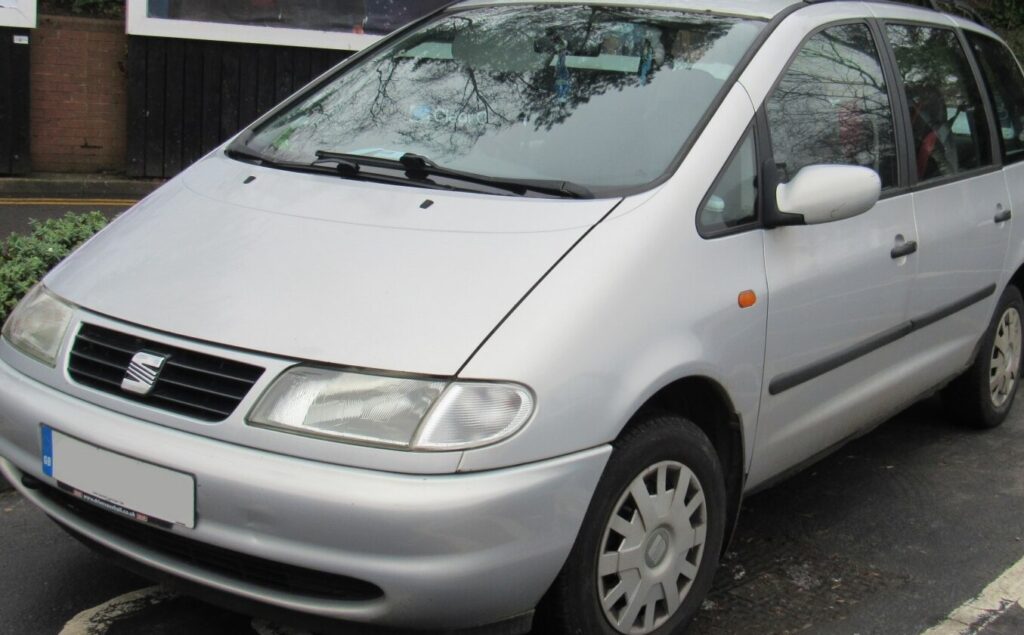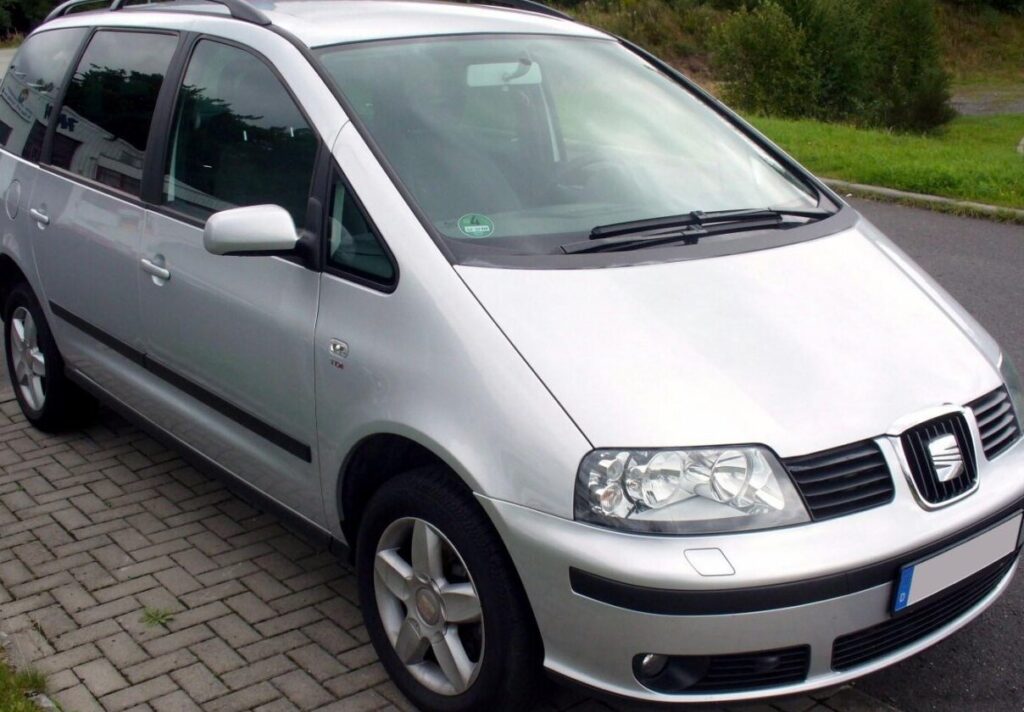
The Seat Alhambra I (7M), particularly the facelifted version introduced in 2000, represented Seat’s entry into the large MPV (Multi-Purpose Vehicle) segment. Produced from 1996 to 2010 (with the facelift spanning 2000-2010), the Alhambra was a collaborative effort with Ford, sharing its platform and many components with the Ford Galaxy. The 1.8 T (150 hp) Tiptronic variant, offered throughout much of the facelifted generation, aimed to provide a balance of performance and convenience for families seeking a spacious and versatile vehicle. It occupied a mid-range position within the Alhambra lineup, slotting between the lower-powered petrol engines and the more expensive, higher-performance options like the 2.8 VR6.
Technical Specifications
| Brand | Seat |
| Model | Alhambra |
| Generation | Alhambra I (7M, facelift 2000) |
| Type (Engine) | 1.8 T (150 Hp) Tiptronic |
| Start of production | 2000 year |
| End of production | 2010 year |
| Powertrain Architecture | Internal Combustion engine |
| Body type | Minivan, MPV |
| Seats | 7 |
| Doors | 5 |
| Fuel consumption (economy) – urban (NEDC) | 14.1-14.7 l/100 km (16.7 – 16 US mpg, 20 – 19.2 UK mpg, 7.1 – 6.8 km/l) |
| Fuel consumption (economy) – extra urban (NEDC) | 8-8.6 l/100 km (29.4 – 27.4 US mpg, 35.3 – 32.8 UK mpg, 12.5 – 11.6 km/l) |
| Fuel consumption (economy) – combined (NEDC) | 10.2-10.8 l/100 km (23.1 – 21.8 US mpg, 27.7 – 26.2 UK mpg, 9.8 – 9.3 km/l) |
| CO2 emissions (NEDC) | 245-259 g/km |
| Fuel Type | Petrol (Gasoline) |
| Acceleration 0 – 100 km/h | 12.1 sec |
| Acceleration 0 – 62 mph | 12.1 sec |
| Acceleration 0 – 60 mph | 11.5 sec |
| Maximum speed | 195 km/h (121.17 mph) |
| Emission standard | Euro 4 |
| Weight-to-power ratio | 10.9 kg/Hp, 91.9 Hp/tonne |
| Weight-to-torque ratio | 7.4 kg/Nm, 134.8 Nm/tonne |
| Power | 150 Hp @ 5800 rpm |
| Power per litre | 84.2 Hp/l |
| Torque | 220 Nm @ 1800 rpm (162.26 lb.-ft. @ 1800 rpm) |
| Engine layout | Front, Transverse |
| Engine Model/Code | AWC |
| Engine displacement | 1781 cm3 (108.68 cu. in.) |
| Number of cylinders | 4 |
| Engine configuration | Inline |
| Cylinder Bore | 81 mm (3.19 in.) |
| Piston Stroke | 86.4 mm (3.4 in.) |
| Compression ratio | 9.5:1 |
| Number of valves per cylinder | 5 |
| Fuel injection system | Multi-port manifold injection |
| Engine aspiration | Turbocharger, Intercooler |
| Valvetrain | DOHC |
| Engine oil capacity | 4.5 l (4.76 US qt | 3.96 UK qt) |
| Coolant | 7 l (7.4 US qt | 6.16 UK qt) |
| Kerb Weight | 1632 kg (3597.94 lbs.) |
| Max. weight | 2480 kg (5467.46 lbs.) |
| Max load | 848 kg (1869.52 lbs.) |
| Trunk (boot) space – minimum | 256 l (9.04 cu. ft.) |
| Trunk (boot) space – maximum | 2610 l (92.17 cu. ft.) |
| Fuel tank capacity | 70 l (18.49 US gal | 15.4 UK gal) |
| Max. roof load | 75 kg (165.35 lbs.) |
| Permitted trailer load with brakes (12%) | 1900 kg (4188.78 lbs.) |
| Permitted trailer load without brakes | 700 kg (1543.24 lbs.) |
| Permitted towbar download | 85 kg (187.39 lbs.) |
| Length | 4634 mm (182.44 in.) |
| Width | 1810 mm (71.26 in.) |
| Height | 1762 mm (69.37 in.) |
| Wheelbase | 2835 mm (111.61 in.) |
| Front track | 1520-1532 mm (59.84 – 60.31 in.) |
| Rear (Back) track | 1506-1518 mm (59.29 – 59.76 in.) |
| Front overhang | 892 mm (35.12 in.) |
| Rear overhang | 907 mm (35.71 in.) |
| Drag coefficient (Cd) | 0.31 |
| Minimum turning circle (turning diameter) | 10.9 m (35.76 ft.) |
| Drivetrain Architecture | The Internal combustion engine (ICE) drives the front wheels of the vehicle. |
| Drive wheel | Front wheel drive |
| Number of gears and type of gearbox | 5 gears, automatic transmission Tiptronic |
| Front suspension | Independent type McPherson, Transverse stabilizer |
| Rear suspension | Transverse stabilizer, Trailing arm, Coil spring |
| Front brakes | Ventilated discs |
| Rear brakes | Disc |
| Assisting systems | ABS (Anti-lock braking system) |
| Steering type | Steering rack and pinion |
| Power steering | Hydraulic Steering |
| Tires size | 215/55 R16; 225/45 R17 |
| Wheel rims size | 6J x 16; 7J x 17 |
Powertrain & Engine Architecture
The heart of the Alhambra 1.8 T Tiptronic is the 1.8-liter, turbocharged four-cylinder engine, internally designated as the AWC engine code. This engine is a member of the Volkswagen Group’s EA827 family. It features a cast iron block and an aluminum cylinder head, incorporating a belt-driven double overhead camshaft (DOHC) valvetrain with five valves per cylinder (three intake, two exhaust). Fuel delivery is managed by a multi-port fuel injection system, and the turbocharger, coupled with an intercooler, provides a significant boost in power output. The Tiptronic transmission is a five-speed automatic gearbox offering both fully automatic operation and a manual shift mode, allowing drivers some control over gear selection. This transmission was known for its relatively smooth shifts, but could sometimes feel hesitant during quick acceleration.
Driving Characteristics
The 150 hp and 220 Nm (162 lb-ft) of torque offered by the 1.8 T engine provided adequate performance for the Alhambra, especially considering its size and weight. Acceleration from 0-60 mph took around 11.5 to 12.1 seconds, which was respectable for a large MPV of that era. However, it wasn’t a particularly sporty experience. The Tiptronic transmission, while convenient, did detract somewhat from the engine’s potential, with gear changes sometimes feeling sluggish. Compared to the more powerful 2.8 VR6 version, the 1.8 T felt noticeably less responsive, particularly when fully loaded with passengers and luggage. The gear ratios were tuned for fuel efficiency and comfortable cruising rather than outright performance.
Equipment & Trim Levels
The 1.8 T Tiptronic variant of the Alhambra typically came with a reasonable level of standard equipment. This included air conditioning, central locking, electric front windows, power steering, and an ABS anti-lock braking system. Higher trim levels added features such as alloy wheels, rear parking sensors, a CD stereo system, and upgraded interior trim. Interior upholstery was generally cloth, with options for leather available at an extra cost. The dashboard layout was functional and straightforward, prioritizing practicality over stylistic flair.
Chassis & Braking
The Alhambra’s chassis featured an independent McPherson strut suspension at the front and a trailing arm setup with coil springs at the rear. A transverse stabilizer bar was fitted to both axles to reduce body roll. The braking system consisted of ventilated discs at the front and solid discs at the rear. The suspension was tuned for comfort, providing a relatively smooth ride, although it could feel somewhat wallowy when cornering. The braking performance was adequate for everyday use, but not particularly sporty.
Market Reception & Comparison
The Seat Alhambra 1.8 T Tiptronic was generally well-received by critics as a practical and spacious MPV. It offered a good balance of price, performance, and fuel economy. However, some reviewers noted that the Tiptronic transmission could feel slow to respond, and that the engine lacked the punch of the VR6 variant. Fuel economy was reasonable for a vehicle of its size, averaging around 23 mpg in combined driving. Compared to rivals like the Renault Espace and Citroën Evasion, the Alhambra offered a competitive package, particularly in terms of value for money.
Legacy
The Seat Alhambra 1.8 T Tiptronic has proven to be a relatively reliable vehicle, although, like any used car, it’s important to check for common issues. The 1.8-liter turbo engine is generally robust, but can be susceptible to oil leaks and turbocharger failure if not properly maintained. The Tiptronic transmission can also experience problems with solenoid valves and torque converter issues. Today, the Alhambra 1.8 T Tiptronic represents an affordable and practical option for families seeking a spacious and versatile MPV. Its relatively simple mechanicals and readily available parts make it a relatively easy vehicle to maintain and repair.