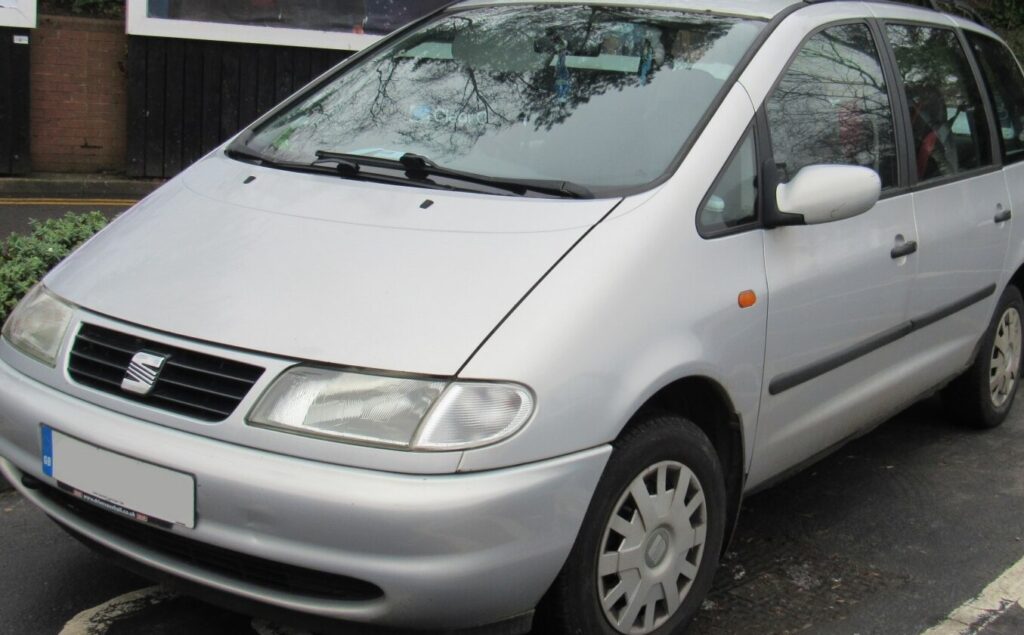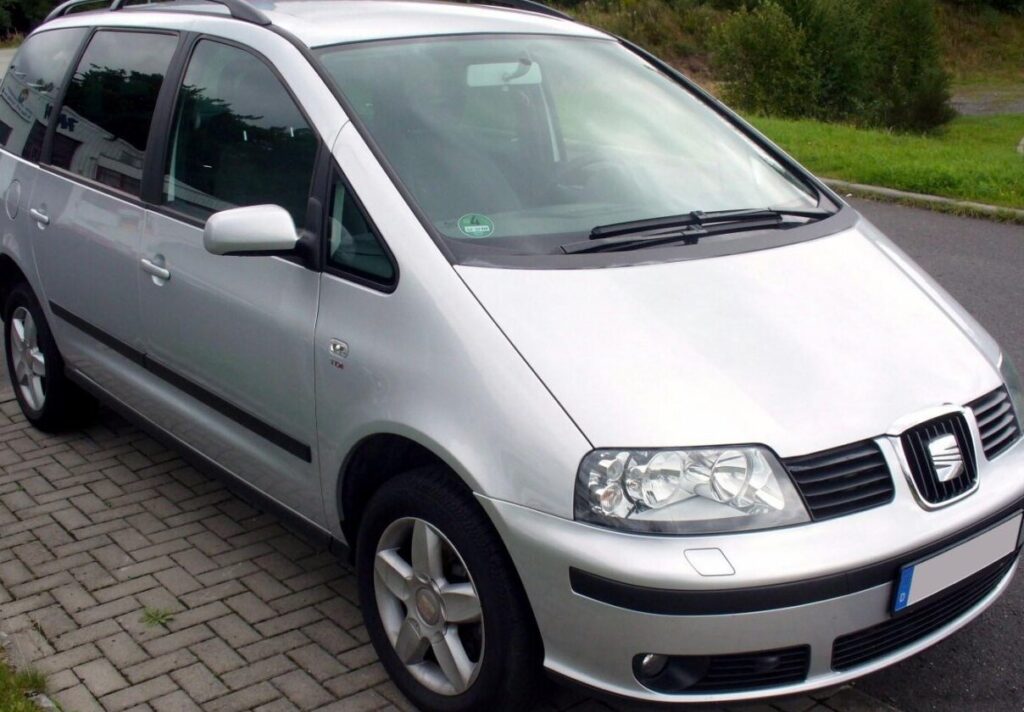
The Seat Alhambra I (7M), particularly the facelifted version introduced in 2000, represented Seat’s entry into the large MPV (Multi-Purpose Vehicle) segment. Produced from 2000 to 2006, this generation Alhambra was a collaborative effort with Volkswagen, sharing its platform and many components with the VW Sharan. The 1.9 TDI 90 hp variant, equipped with an automatic transmission, occupied a crucial position in the lineup as an entry-level diesel option, aimed at buyers prioritizing fuel efficiency and practicality over outright performance. It was designed to appeal to families needing a spacious and versatile vehicle for everyday use and longer journeys.
Technical Specifications
| Brand | Seat |
| Model | Alhambra |
| Generation | Alhambra I (7M, facelift 2000) |
| Type (Engine) | 1.9 TDI (90 Hp) |
| Start of production | 2000 year |
| End of production | 2006 year |
| Powertrain Architecture | Internal Combustion engine |
| Body type | Minivan, MPV |
| Seats | 7 |
| Doors | 5 |
| Fuel consumption (economy) – urban (NEDC) | 8 l/100 km (29.4 US mpg, 35.3 UK mpg, 12.5 km/l) |
| Fuel consumption (economy) – extra urban (NEDC) | 5.5 l/100 km (42.8 US mpg, 51.4 UK mpg, 18.2 km/l) |
| Fuel consumption (economy) – combined (NEDC) | 6.4 l/100 km (36.8 US mpg, 44.1 UK mpg, 15.6 km/l) |
| CO2 emissions (NEDC) | 173 g/km |
| Fuel Type | Diesel |
| Acceleration 0 – 100 km/h | 17.2 sec |
| Acceleration 0 – 62 mph | 17.2 sec |
| Acceleration 0 – 60 mph | 16.3 sec |
| Maximum speed | 164 km/h (101.9 mph) |
| Emission standard | Euro 3 |
| Weight-to-power ratio | 18.3 kg/Hp, 54.6 Hp/tonne |
| Weight-to-torque ratio | 6.9 kg/Nm, 145.5 Nm/tonne |
| Power | 90 Hp @ 4000 rpm |
| Power per litre | 47.5 Hp/l |
| Torque | 240 Nm @ 1900 rpm (177.01 lb.-ft. @ 1900 rpm) |
| Engine layout | Front, Transverse |
| Engine Model/Code | ANU |
| Engine displacement | 1896 cm3 (115.7 cu. in.) |
| Number of cylinders | 4 |
| Engine configuration | Inline |
| Cylinder Bore | 79.5 mm (3.13 in.) |
| Piston Stroke | 95.5 mm (3.76 in.) |
| Compression ratio | 18:1 |
| Number of valves per cylinder | 2 |
| Fuel injection system | Direct injection |
| Engine aspiration | Turbocharger, Intercooler |
| Valvetrain | SOHC |
| Engine oil capacity | 4.5 l (4.76 US qt | 3.96 UK qt) |
| Coolant | 6.8 l (7.19 US qt | 5.98 UK qt) |
| Kerb Weight | 1649 kg (3635.42 lbs.) |
| Max. weight | 2510 kg (5533.6 lbs.) |
| Max load | 861 kg (1898.18 lbs.) |
| Trunk (boot) space – minimum | 256 l (9.04 cu. ft.) |
| Trunk (boot) space – maximum | 2610 l (92.17 cu. ft.) |
| Fuel tank capacity | 70 l (18.49 US gal | 15.4 UK gal) |
| Max. roof load | 75 kg (165.35 lbs.) |
| Permitted trailer load with brakes (12%) | 2000 kg (4409.25 lbs.) |
| Permitted trailer load without brakes | 700 kg (1543.24 lbs.) |
| Permitted towbar download | 85 kg (187.39 lbs.) |
| Length | 4634 mm (182.44 in.) |
| Width | 1810 mm (71.26 in.) |
| Height | 1762 mm (69.37 in.) |
| Wheelbase | 2835 mm (111.61 in.) |
| Front track | 1520-1532 mm (59.84 – 60.31 in.) |
| Rear (Back) track | 1506-1518 mm (59.29 – 59.76 in.) |
| Front overhang | 892 mm (35.12 in.) |
| Rear overhang | 907 mm (35.71 in.) |
| Minimum turning circle (turning diameter) | 10.9 m (35.76 ft.) |
| Drivetrain Architecture | The Internal combustion engine (ICE) drives the front wheels of the vehicle. |
| Drive wheel | Front wheel drive |
| Number of gears and type of gearbox | 6 gears, manual transmission |
| Front suspension | Independent type McPherson, Transverse stabilizer |
| Rear suspension | Transverse stabilizer, Trailing arm, Coil spring |
| Front brakes | Ventilated discs |
| Rear brakes | Disc |
| Assisting systems | ABS (Anti-lock braking system) |
| Steering type | Steering rack and pinion |
| Power steering | Hydraulic Steering |
| Tires size | 215/55 R16; 225/45 R17 |
| Wheel rims size | 6J x 16; 7J x 17 |
Powertrain & Engine Architecture
The 1.9 TDI engine, identified by the code ANU, was a workhorse of the Volkswagen Group during this period. It’s a four-cylinder, inline diesel engine utilizing direct injection technology. This system injects fuel directly into the combustion chamber, improving efficiency and reducing emissions compared to older indirect injection systems. The engine featured a single overhead camshaft (SOHC) valvetrain operating two valves per cylinder. A turbocharger with an intercooler was employed to boost power output, providing 90 horsepower at 4000 rpm and 240 Nm (177 lb-ft) of torque at a relatively low 1900 rpm. The automatic transmission was typically a four-speed unit, designed for smooth operation and ease of use, though it wasn’t known for its particularly quick shifts.
Driving Characteristics
The 1.9 TDI 90 hp automatic Alhambra wasn’t a performance-oriented vehicle. Acceleration was leisurely, taking around 17.2 seconds to reach 62 mph. The automatic transmission, while convenient, contributed to this slower pace, as it prioritized fuel economy over rapid acceleration. The engine’s strength lay in its mid-range torque, making it suitable for carrying a full load of passengers and luggage. Gear ratios were optimized for comfortable cruising, and the engine felt most at home maintaining highway speeds. Compared to the more powerful TDI variants (like the 110 hp or 130 hp versions) or those equipped with a manual transmission, this version felt noticeably slower and less responsive.
Equipment & Trim Levels
The 1.9 TDI 90 hp automatic Alhambra typically came with a reasonable level of standard equipment. This included power windows, central locking, air conditioning, and an audio system. Interior upholstery was usually cloth, and the dashboard featured a functional, if somewhat basic, design. Optional extras included alloy wheels, upgraded audio systems, and parking sensors. Higher trim levels offered features like leather upholstery, automatic climate control, and rain-sensing wipers. The focus was on providing a practical and comfortable family vehicle rather than a luxurious one.
Chassis & Braking
The Alhambra’s chassis featured independent suspension at the front, utilizing McPherson struts and a transverse stabilizer bar. The rear suspension employed a trailing arm setup with coil springs and a stabilizer bar. This configuration aimed to provide a comfortable ride, even when the vehicle was fully loaded. Braking consisted of ventilated discs at the front and solid discs at the rear. Anti-lock Braking System (ABS) was standard, enhancing safety. The suspension was tuned for comfort rather than sporty handling, prioritizing a smooth ride over sharp cornering.
Market Reception & Comparison
The 1.9 TDI 90 hp automatic Alhambra was generally well-received as a practical and economical family vehicle. Critics praised its spacious interior, versatility, and fuel efficiency. However, the automatic transmission and relatively low power output were often criticized. Compared to the more powerful TDI variants, this version offered a lower price point but sacrificed performance. It competed with other large MPVs like the Renault Espace, Citroën Evasion, and Ford Galaxy, offering a compelling combination of space, practicality, and value.
Legacy
The 1.9 TDI engine, in its various iterations, proved to be remarkably durable and reliable. The ANU code engine found in this Alhambra variant is generally considered robust, with many examples exceeding high mileage with proper maintenance. The automatic transmission, however, is sometimes cited as a potential weak point, requiring careful servicing to prevent issues. In the used car market today, these Alhambra models are often sought after by buyers looking for an affordable and spacious MPV. Their relatively simple mechanicals and readily available parts make them relatively easy to maintain, contributing to their continued popularity as a budget-friendly family vehicle.