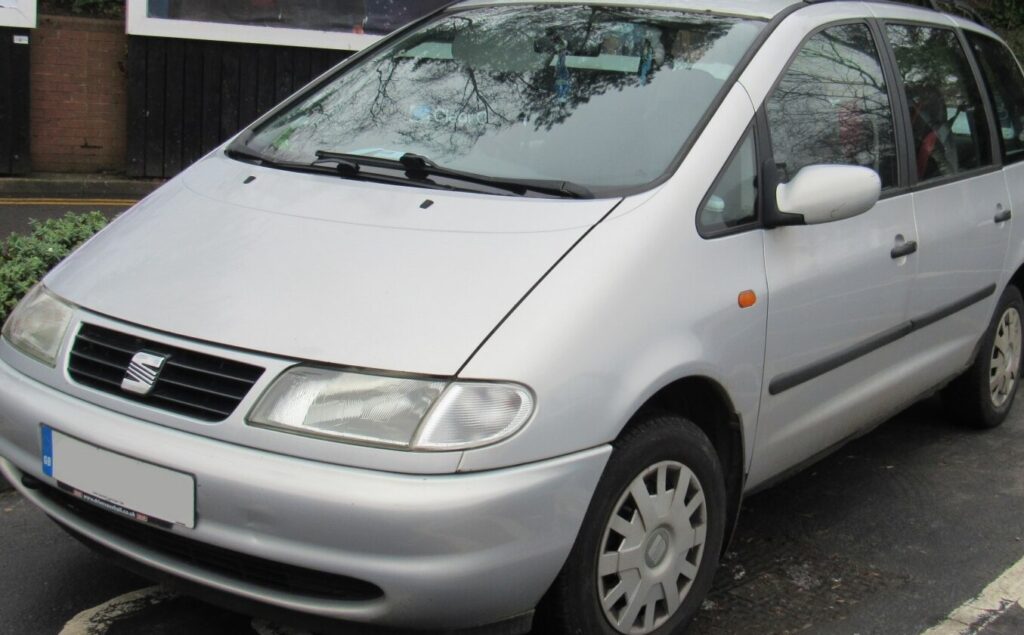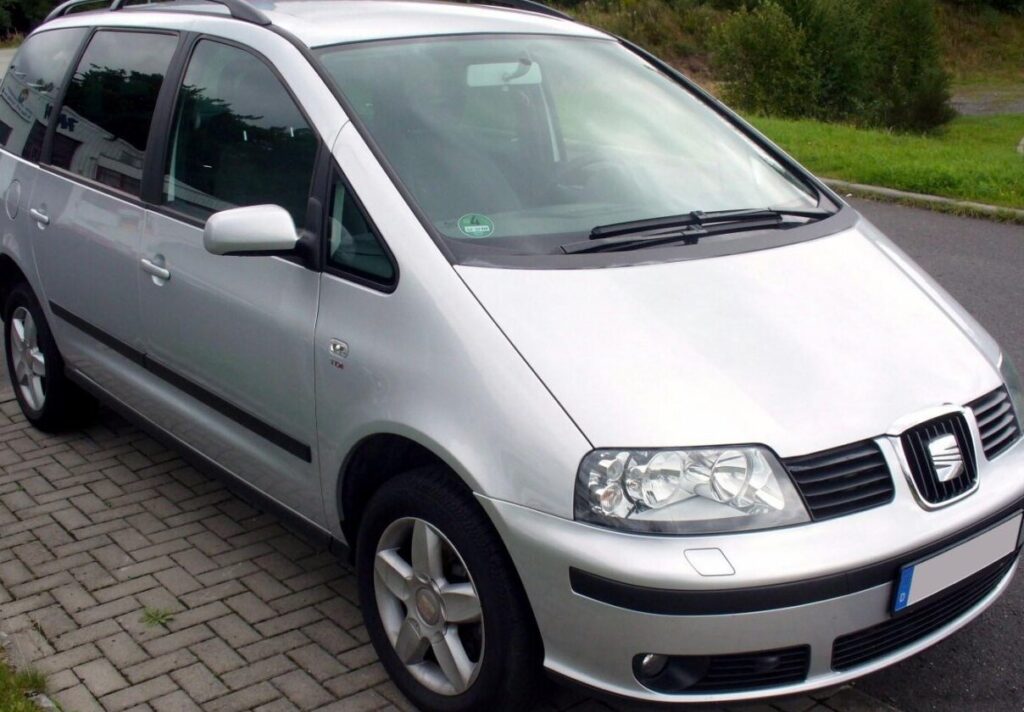
The Seat Alhambra I (7M), particularly the facelifted version introduced in 2000, represented Seat’s entry into the large MPV (Multi-Purpose Vehicle) segment. Production of this specific 2.0 TDI variant, producing 140 horsepower, ran from November 2005 to March 2010. Developed in collaboration with Ford – sharing a platform with the Ford Galaxy – the Alhambra aimed to provide a spacious and practical vehicle for families, competing with models like the Renault Espace and Volkswagen Sharan. This 2.0 TDI model occupied a mid-range position within the Alhambra lineup, offering a balance between fuel efficiency, performance, and equipment levels. It was positioned above the lower-powered gasoline engines and below the more expensive, higher-specification trims.
Technical Specifications
| Brand | Seat |
| Model | Alhambra |
| Generation | Alhambra I (7M, facelift 2000) |
| Type (Engine) | 2.0 TDI (140 Hp) |
| Start of production | November, 2005 |
| End of production | March, 2010 |
| Powertrain Architecture | Internal Combustion engine |
| Body type | Minivan, MPV |
| Seats | 7 |
| Doors | 5 |
| Fuel consumption (urban) | 8.3 l/100 km (28.3 US mpg, 34 UK mpg, 12 km/l) |
| Fuel consumption (extra urban) | 5.7 l/100 km (41.3 US mpg, 49.6 UK mpg, 17.5 km/l) |
| Fuel consumption (combined) | 6.6 l/100 km (35.6 US mpg, 42.8 UK mpg, 15.2 km/l) |
| CO2 emissions | 175 g/km |
| Fuel Type | Diesel |
| Acceleration 0 – 100 km/h | 12.2 sec |
| Acceleration 0 – 62 mph | 12.2 sec |
| Acceleration 0 – 60 mph | 11.6 sec |
| Maximum speed | 192 km/h (119.3 mph) |
| Emission standard | Euro 4 |
| Weight-to-power ratio | 11.9 kg/Hp, 84.1 Hp/tonne |
| Weight-to-torque ratio | 5.4 kg/Nm, 186.2 Nm/tonne |
| Power | 140 Hp @ 4000 rpm |
| Power per litre | 71.1 Hp/l |
| Torque | 310 Nm @ 1900 rpm (228.64 lb.-ft. @ 1900 rpm) |
| Engine layout | Front, Transverse |
| Engine Model/Code | EA188 / BRT |
| Engine displacement | 1968 cm3 (120.09 cu. in.) |
| Number of cylinders | 4 |
| Engine configuration | Inline |
| Cylinder Bore | 81 mm (3.19 in.) |
| Piston Stroke | 95.5 mm (3.76 in.) |
| Compression ratio | 18.5:1 |
| Number of valves per cylinder | 2 |
| Fuel injection system | Pump-nozzle (Unit Injector) |
| Engine aspiration | Turbocharger, Intercooler |
| Valvetrain | SOHC |
| Engine oil capacity | 4 l (4.23 US qt | 3.52 UK qt) |
| Coolant capacity | 6.8 l (7.19 US qt | 5.98 UK qt) |
| Kerb Weight | 1665 kg (3670.7 lbs.) |
| Max. weight | 2510 kg (5533.6 lbs.) |
| Max load | 845 kg (1862.91 lbs.) |
| Trunk (boot) space – minimum | 256 l (9.04 cu. ft.) |
| Trunk (boot) space – maximum | 2610 l (92.17 cu. ft.) |
| Fuel tank capacity | 70 l (18.49 US gal | 15.4 UK gal) |
| Max. roof load | 75 kg (165.35 lbs.) |
| Permitted trailer load with brakes (12%) | 2000 kg (4409.25 lbs.) |
| Permitted trailer load without brakes | 700 kg (1543.24 lbs.) |
| Permitted towbar download | 85 kg (187.39 lbs.) |
| Length | 4634 mm (182.44 in.) |
| Width | 1810 mm (71.26 in.) |
| Height | 1762 mm (69.37 in.) |
| Wheelbase | 2835 mm (111.61 in.) |
| Front track | 1520-1532 mm (59.84 – 60.31 in.) |
| Rear track | 1506-1518 mm (59.29 – 59.76 in.) |
| Front overhang | 892 mm (35.12 in.) |
| Rear overhang | 907 mm (35.71 in.) |
| Drag coefficient (Cd) | 0.31 |
| Minimum turning circle | 10.9 m (35.76 ft.) |
| Drivetrain Architecture | Front wheel drive |
| Number of gears | 6 |
| Gearbox type | Manual transmission |
| Front suspension | Independent type McPherson, Transverse stabilizer |
| Rear suspension | Transverse stabilizer, Trailing arm, Coil spring |
| Front brakes | Ventilated discs |
| Rear brakes | Disc |
| Assisting systems | ABS (Anti-lock braking system) |
| Steering type | Steering rack and pinion |
| Power steering | Hydraulic Steering |
| Tires size | 215/55 R16; 225/45 R17 |
| Wheel rims size | 6J x 16; 7J x 17 |
Powertrain & Engine Architecture
The heart of this Alhambra variant is the 2.0-liter, four-cylinder diesel engine, identified by the engine code EA188 / BRT. This engine belongs to the Volkswagen Group’s EA188 family, known for its robust construction and potential for tuning. The BRT variant utilizes a pump-nozzle (unit injector) fuel injection system, a technology favored for its precise fuel delivery and efficiency. A single overhead camshaft (SOHC) controls the two valves per cylinder. Crucially, the engine is turbocharged and intercooled, boosting power output to 140 horsepower and 310 Nm (228.64 lb-ft) of torque at a relatively low 1900 rpm. This torque curve provides good low-end grunt, beneficial for a vehicle of this size and weight. The engine is transversely mounted in the front of the vehicle, driving the front wheels. The six-speed manual transmission was the standard offering for this trim level, providing a good balance between fuel economy and driver control.
Driving Characteristics
The 2.0 TDI 140 hp Alhambra offers a competent, if not particularly sporty, driving experience. Acceleration from 0-60 mph takes around 11.6 seconds, and top speed is around 119.3 mph. The engine’s strong low-end torque makes it feel more responsive in everyday driving situations than the horsepower figure might suggest. The six-speed manual transmission allows the driver to keep the engine in its optimal power band. Compared to the gasoline variants, the 2.0 TDI provides significantly better fuel economy and a more relaxed cruising experience. However, it lacks the outright punch of higher-powered engines found in some competitor models. The gear ratios are tuned for efficiency and usability rather than outright performance.
Equipment & Trim Levels
The 2.0 TDI 140 hp Alhambra typically came equipped with a reasonable level of standard features. These included air conditioning, power windows, central locking, and an audio system. Higher trim levels, often denoted by “Style” or “Sport” packages, added features such as alloy wheels, upgraded upholstery, a multi-function steering wheel, and parking sensors. Optional extras included a sunroof, leather seats, and a more advanced navigation system. Interior upholstery was typically cloth, with the option of leather upgrades. The dashboard layout was functional and straightforward, prioritizing practicality over aesthetic flair.
Chassis & Braking
The Alhambra’s chassis features an independent McPherson strut suspension at the front and a trailing arm setup with coil springs at the rear. A transverse stabilizer bar is fitted to both axles to reduce body roll. Braking duties are handled by ventilated discs at the front and solid discs at the rear. Anti-lock Braking System (ABS) is standard. The suspension is tuned for comfort, providing a reasonably smooth ride, although it can feel somewhat soft when fully loaded. The braking system is adequate for the vehicle’s weight and performance.
Market Reception & Comparison
The Seat Alhambra 2.0 TDI 140 hp was generally well-received by automotive critics as a practical and economical MPV. Its fuel economy was a major selling point, and the engine provided sufficient power for most driving situations. Compared to the gasoline-powered Alhambra models, the TDI offered a significant improvement in fuel efficiency. However, some reviewers noted that the interior lacked the premium feel of some competitors, and the handling wasn’t particularly engaging. Reliability was generally good, although the pump-nozzle injection system could be prone to issues if not properly maintained.
Legacy
The Seat Alhambra I, including the 2.0 TDI 140 hp variant, has proven to be a relatively durable vehicle. The EA188 engine, while requiring regular maintenance, is known for its longevity. On the used car market, these Alhambras represent a good value proposition for families seeking a spacious and practical MPV. However, potential buyers should be aware of the potential for issues with the pump-nozzle injectors and ensure that the vehicle has been properly serviced. The Alhambra’s collaborative development with Ford ensured a wide availability of parts and a relatively straightforward repair process.