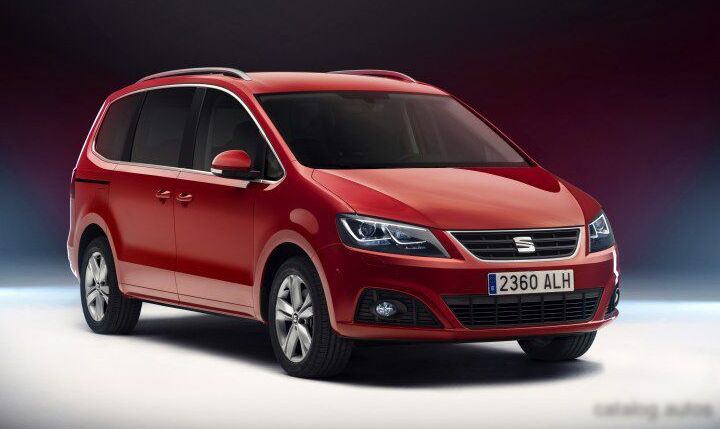
The Seat Alhambra II (7N), particularly the facelifted version introduced in 2015, represented Seat’s entry into the large MPV (Multi-Purpose Vehicle) segment. Produced from 2015 through March 2020, this generation Alhambra was a collaborative effort with Volkswagen, sharing its platform and many components with the Volkswagen Sharan. The 1.4 TSI (150 hp) variant, paired with a 7-speed DSG (Direct-Shift Gearbox) transmission, was positioned as a mid-range offering, balancing fuel efficiency with acceptable performance for family transport. It aimed to appeal to buyers seeking a spacious and practical vehicle without the higher price tag of more powerful engine options.
Technical Specifications
| Brand | Seat |
| Model | Alhambra |
| Generation | Alhambra II (7N, facelift 2015) |
| Type (Engine) | 1.4 TSI (150 Hp) DSG 7 Seat |
| Start of production | 2015 |
| End of production | March, 2020 |
| Powertrain Architecture | Internal Combustion engine |
| Body type | Minivan, MPV |
| Seats | 7 |
| Doors | 5 |
| Fuel consumption (combined) | 6.7 l/100 km (35.1 US mpg, 42.2 UK mpg, 14.9 km/l) |
| CO2 emissions | 156-157 g/km |
| Fuel Type | Petrol (Gasoline) |
| Acceleration 0 – 100 km/h | 9.9 sec |
| Acceleration 0 – 62 mph | 9.9 sec |
| Acceleration 0 – 60 mph | 9.4 sec |
| Maximum speed | 198 km/h (123.03 mph) |
| Emission standard | Euro 6 |
| Weight-to-power ratio | 11.3 kg/Hp, 88.6 Hp/tonne |
| Weight-to-torque ratio | 6.8 kg/Nm, 147.7 Nm/tonne |
| Power | 150 Hp @ 5000 rpm |
| Power per litre | 107.5 Hp/l |
| Torque | 250 Nm @ 2000 rpm (184.39 lb.-ft. @ 2000 rpm) |
| Engine layout | Front, Transverse |
| Engine Model/Code | CZDA |
| Engine displacement | 1395 cm3 (85.13 cu. in.) |
| Number of cylinders | 4 |
| Engine configuration | Inline |
| Cylinder Bore | 74.5 mm (2.93 in.) |
| Piston Stroke | 80 mm (3.15 in.) |
| Compression ratio | 10:1 |
| Number of valves per cylinder | 4 |
| Fuel injection system | Direct injection |
| Engine aspiration | Turbocharger, Intercooler |
| Engine oil capacity | 4 l (4.23 US qt | 3.52 UK qt) |
| Coolant | 8 l (8.45 US qt | 7.04 UK qt) |
| Kerb Weight | 1693 kg (3732.43 lbs.) |
| Max. weight | 2430 kg (5357.23 lbs.) |
| Max load | 737 kg (1624.81 lbs.) |
| Trunk (boot) space – minimum | 300 l (10.59 cu. ft.) |
| Trunk (boot) space – maximum | 2297 l (81.12 cu. ft.) |
| Fuel tank capacity | 70 l (18.49 US gal | 15.4 UK gal) |
| Length | 4854 mm (191.1 in.) |
| Width | 1904 mm (74.96 in.) |
| Height | 1720 mm (67.72 in.) |
| Wheelbase | 2919 mm (114.92 in.) |
| Front track | 1557-1569 mm (61.3 – 61.77 in.) |
| Rear (Back) track | 1605-1617 mm (63.19 – 63.66 in.) |
| Minimum turning circle | 11.9 m (39.04 ft.) |
| Drivetrain Architecture | Front wheel drive |
| Number of gears and type of gearbox | 6 gears, automatic transmission DSG |
| Front suspension | Independent type McPherson |
| Rear suspension | Independent coil spring |
| Front brakes | Ventilated discs |
| Rear brakes | Disc |
| Assisting systems | ABS (Anti-lock braking system) |
| Steering type | Steering rack and pinion |
| Power steering | Electric Steering |
| Tires size | 205/60 R16; 215/60 R16; 225/50 R17; 225/50 R18 |
| Wheel rims size | 16; 17; 18 |
Powertrain & Engine Architecture
The heart of this Alhambra variant is the CZDA engine code, a 1.4-liter turbocharged inline-four cylinder petrol engine. This engine is part of the Volkswagen Group’s EA211 engine family, known for its compact design and efficiency. It utilizes direct fuel injection (FSI) and a turbocharger with an intercooler to deliver a balance of power and fuel economy. The engine’s 16 valves (four per cylinder) are actuated by a dual overhead camshaft. The 7-speed DSG transmission is a dual-clutch automated manual gearbox, offering quick and smooth gear changes. It features two separate clutches for odd and even gears, allowing for pre-selection of the next gear and minimizing interruption in power delivery. This transmission contributed to the Alhambra’s relatively responsive feel, despite its size and weight.
Driving Characteristics
The 150 hp 1.4 TSI engine, coupled with the 7-speed DSG, provided adequate performance for everyday driving and family duties. Acceleration from 0-60 mph took around 9.4 seconds, which wasn’t particularly brisk but sufficient for merging onto highways and overtaking. The DSG transmission helped to keep the engine in its optimal power band, providing a more responsive feel than a traditional automatic. However, compared to the more powerful 2.0 TDI diesel or higher-output TSI petrol variants, this engine felt less effortless, especially when fully loaded with passengers and luggage. The gear ratios were tuned for fuel efficiency, meaning the engine could feel slightly strained when climbing hills or accelerating quickly. The overall driving experience was comfortable and refined, prioritizing practicality over sporty handling.
Equipment & Trim Levels
The 1.4 TSI DSG Alhambra typically came with a reasonable level of standard equipment. This included air conditioning, electric windows and mirrors, a basic audio system with USB connectivity, and alloy wheels. Higher trim levels, such as Style or Reference, added features like automatic climate control, parking sensors, a touchscreen infotainment system, and upgraded interior upholstery. Optional extras included a panoramic sunroof, leather seats, and a navigation system. Interior materials were generally durable and practical, reflecting the vehicle’s family-oriented focus. The dashboard layout was functional and user-friendly, although it lacked the premium feel of some competitors.
Chassis & Braking
The Alhambra II utilized a McPherson strut front suspension and an independent coil spring rear suspension. This setup provided a comfortable ride quality, absorbing bumps and imperfections in the road effectively. Stabilizer bars were fitted to both axles to reduce body roll during cornering. Braking duties were handled by ventilated discs at the front and solid discs at the rear, equipped with ABS (Anti-lock Braking System). The steering was electrically assisted, providing light and precise control. The Alhambra’s weight, however, meant that braking distances were longer than those of lighter vehicles.
Market Reception & Comparison
The 1.4 TSI DSG Alhambra was generally well-received by critics as a practical and fuel-efficient MPV. It offered a good balance of space, comfort, and affordability. However, some reviewers noted that the engine could feel underpowered when the vehicle was fully loaded. Compared to the 2.0 TDI diesel variant, the 1.4 TSI offered lower running costs in terms of fuel, but the diesel provided significantly more torque and better fuel economy overall. The petrol engine was also quieter and smoother than the diesel, which was a plus for some buyers. Against competitors like the Ford S-Max and Renault Espace, the Alhambra offered a more spacious interior and a more refined driving experience.
Legacy
The 1.4 TSI engine, while generally reliable, is known to require regular maintenance, particularly regarding the timing chain. DSG transmissions, while offering smooth shifting, can be prone to mechatronic unit failures if not serviced properly. Today, used examples of the 2015-2020 Alhambra 1.4 TSI DSG are relatively affordable, making them an attractive option for families seeking a spacious and practical MPV. However, potential buyers should be aware of the potential maintenance costs associated with the engine and transmission and ensure a thorough inspection before purchase. The Alhambra remains a popular choice for those needing a seven-seater vehicle with a large boot space and a comfortable ride.