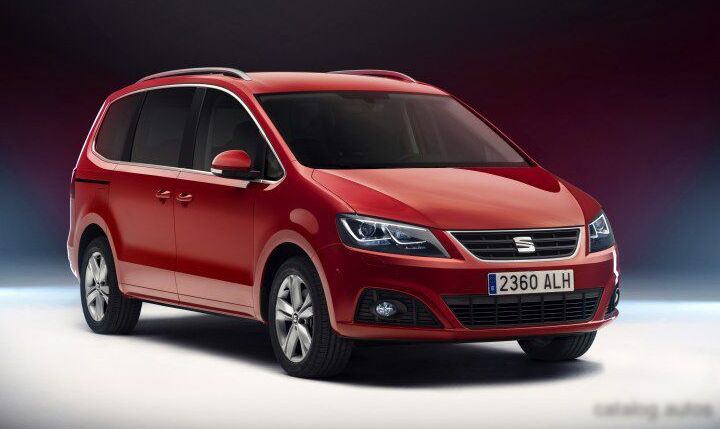
The Seat Alhambra II (7N), particularly the facelifted version introduced in May 2015, represented Seat’s entry into the large MPV (Multi-Purpose Vehicle) segment. This iteration of the Alhambra, co-developed with Volkswagen (sharing a platform with the VW Sharan), aimed to provide a spacious and practical vehicle for families. The 2.0 TDI 115 horsepower, seven-seat configuration was a key variant, positioned as a balance between affordability and usability within the Alhambra lineup. Production of this specific trim continued through 2016, catering primarily to the European market where MPVs remained popular for their versatility.
Technical Specifications
| Brand | Seat |
| Model | Alhambra |
| Generation | Alhambra II (7N, facelift 2015) |
| Type (Engine) | 2.0 TDI (115 Hp) 7 Seat |
| Start of production | May, 2015 |
| End of production | 2016 |
| Powertrain Architecture | Internal Combustion engine |
| Body type | Minivan, MPV |
| Seats | 7 |
| Doors | 5 |
| Fuel consumption (combined) | 5.1 l/100 km (46.1 US mpg, 55.4 UK mpg, 19.6 km/l) |
| CO2 emissions | 132 g/km |
| Fuel Type | Diesel |
| Acceleration 0 – 100 km/h | 12.6 sec |
| Acceleration 0 – 62 mph | 12.6 sec |
| Acceleration 0 – 60 mph | 12 sec |
| Maximum speed | 184 km/h (114.33 mph) |
| Emission standard | Euro 6 |
| Weight-to-power ratio | 15.2 kg/Hp, 65.8 Hp/tonne |
| Weight-to-torque ratio | 6.2 kg/Nm, 160.3 Nm/tonne |
| Power | 115 Hp @ 3500 rpm |
| Power per litre | 58.4 Hp/l |
| Torque | 280 Nm @ 1750-3000 rpm (206.52 lb.-ft. @ 1750-3000 rpm) |
| Engine layout | Front, Transverse |
| Engine Model/Code | CUVA, DFLD |
| Engine displacement | 1968 cm3 (120.09 cu. in.) |
| Number of cylinders | 4 |
| Engine configuration | Inline |
| Cylinder Bore | 81 mm (3.19 in.) |
| Piston Stroke | 95.5 mm (3.76 in.) |
| Compression ratio | 16:1 |
| Number of valves per cylinder | 4 |
| Fuel injection system | Diesel Commonrail |
| Engine aspiration | Turbocharger, Intercooler |
| Engine oil capacity | 4.6 l (4.86 US qt | 4.05 UK qt) |
| Coolant | 8 l (8.45 US qt | 7.04 UK qt) |
| Kerb Weight | 1747 kg (3851.48 lbs.) |
| Max. weight | 2520 kg (5555.65 lbs.) |
| Max load | 773 kg (1704.17 lbs.) |
| Trunk (boot) space – minimum | 300 l (10.59 cu. ft.) |
| Trunk (boot) space – maximum | 2297 l (81.12 cu. ft.) |
| Fuel tank capacity | 70 l (18.49 US gal | 15.4 UK gal) |
| Length | 4854 mm (191.1 in.) |
| Width | 1904 mm (74.96 in.) |
| Height | 1720 mm (67.72 in.) |
| Wheelbase | 2919 mm (114.92 in.) |
| Front track | 1557/1569 mm (61.3 in.) |
| Rear (Back) track | 1605/1617 mm (63.19 in.) |
| Minimum turning circle | 11.9 m (39.04 ft.) |
| Drivetrain Architecture | Front wheel drive |
| Number of gears | 6 gears, manual transmission |
| Front suspension | Independent type McPherson |
| Rear suspension | Independent coil spring |
| Front brakes | Ventilated discs |
| Rear brakes | Disc |
| Tires size | 205/60 R16; 215/60 R16; 225/50 R17; 225/50 R18 |
| Wheel rims size | 16; 17; 18 |
Powertrain & Engine Architecture
The 2.0 TDI engine in the 2015-2016 Seat Alhambra utilized the Volkswagen Group’s common rail diesel injection system. Engine codes CUVA and DFLD were commonly found in this application. This engine featured a turbocharger with an intercooler, enhancing power output and efficiency. The 1968cc inline-four cylinder engine produced 115 horsepower at 3500 rpm and 280 Nm (206.52 lb-ft) of torque between 1750 and 3000 rpm. The engine employed four valves per cylinder and a compression ratio of 16:1. The Alhambra 2.0 TDI was paired with a six-speed manual transmission, delivering power to the front wheels. This configuration prioritized fuel economy and smooth operation over outright performance.
Driving Characteristics
The 115 hp 2.0 TDI engine, coupled with the six-speed manual transmission, provided adequate, but not exhilarating, performance in the Alhambra. Acceleration from 0-100 km/h (0-62 mph) took approximately 12.6 seconds. The engine’s torque delivery was its strong suit, offering reasonable pulling power for everyday driving and when fully loaded with passengers and luggage. Compared to higher-output TDI variants (like the 150 hp or 184 hp versions), this engine felt less strained during highway cruising and offered improved fuel economy. The manual transmission allowed for greater driver control, but the gear ratios were tuned for efficiency rather than sporty acceleration. The Alhambra’s weight, exceeding 1700 kg, was noticeable, particularly when climbing hills or overtaking.
Equipment & Trim Levels
The 2.0 TDI 115 hp Alhambra typically came with a respectable level of standard equipment. This included air conditioning, electric front windows, central locking, and a basic audio system. Higher trim levels, often denoted by specific packages, added features like alloy wheels, rear parking sensors, cruise control, and upgraded interior upholstery. Interior materials were generally durable and practical, reflecting the Alhambra’s family-oriented focus. Optional extras included a navigation system, leather seats, and a panoramic sunroof. The seven-seat configuration was standard, with the rear seats typically folding flat into the floor to maximize cargo space.
Chassis & Braking
The Alhambra II utilized a McPherson strut front suspension and an independent coil spring rear suspension. This setup aimed to balance ride comfort with handling stability. The front brakes were ventilated discs, while the rear brakes were solid discs. ABS (Anti-lock Braking System) was standard. The Alhambra’s suspension was tuned for comfort, prioritizing a smooth ride over sporty handling. Stabilizer bars were fitted to both the front and rear axles to reduce body roll during cornering. The steering was power-assisted, providing relatively light and easy steering feel.
Market Reception & Comparison
The Seat Alhambra 2.0 TDI 115 hp was generally well-received by automotive critics as a practical and economical MPV. It was praised for its spacious interior, versatile seating configuration, and fuel efficiency. However, some reviewers noted that the engine lacked the punch of higher-output TDI variants. Compared to the Volkswagen Sharan, which shared the same platform and engines, the Alhambra often offered a more competitive price point. Against rivals like the Ford Galaxy and Renault Espace, the Alhambra held its own in terms of space, practicality, and value for money. Fuel economy was a key selling point, with the 2.0 TDI achieving around 5.1 l/100 km (46.1 US mpg) in combined driving.
Legacy
The 2.0 TDI engine, in various iterations, proved to be a reliable and durable powertrain within the Volkswagen Group. While some early common rail diesel engines experienced issues with fuel injectors and diesel particulate filters (DPF), the later versions, like those found in the 2015-2016 Alhambra, were generally more robust. On the used car market, the Alhambra 2.0 TDI 115 hp represents a relatively affordable and practical option for families. Maintenance costs are generally reasonable, although regular servicing, including DPF regeneration, is essential. The Alhambra’s spacious interior and versatile seating configuration continue to make it a popular choice for those needing a large, family-friendly vehicle.