
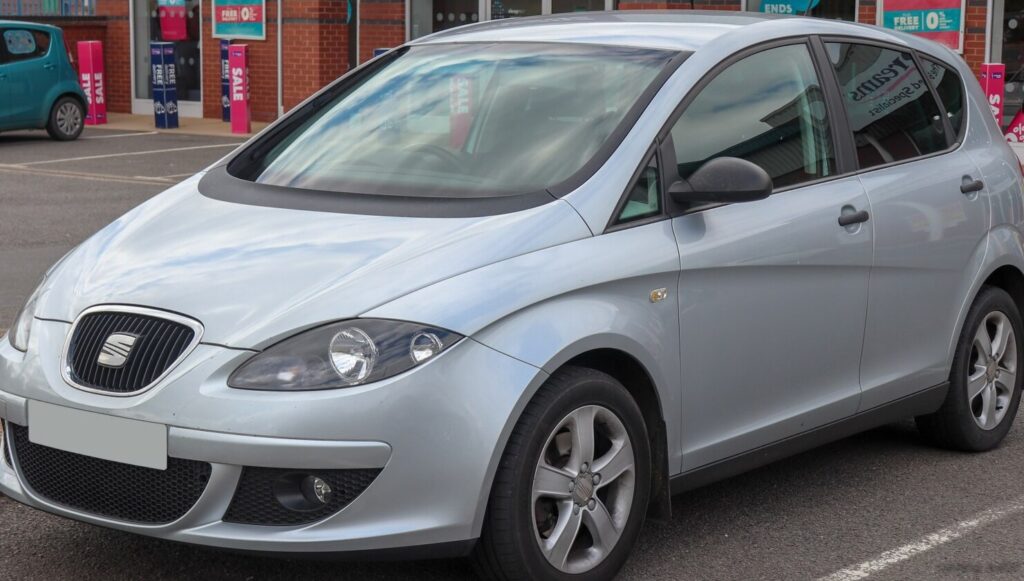
The Seat Altea 2.0 FSI Automatic, produced between May 2004 and March 2009, represents a mid-range offering within the first generation (5P) of the Altea model line. Positioned as a compact minivan, the Altea aimed to blend the practicality of a multi-purpose vehicle with a more stylish and dynamic design than many of its competitors. The 2.0 FSI Automatic variant was targeted towards buyers seeking a balance of performance and convenience, offering a step up from the base 1.6-liter engine while remaining more accessible than the sportier FR trims. It was primarily sold within the European market, where compact MPVs were a popular segment.
Technical Specifications
| Brand | Seat |
| Model | Altea |
| Generation | Altea (5P) |
| Type (Engine) | 2.0 FSI (150 Hp) Automatic |
| Start of production | May, 2004 |
| End of production | March, 2009 |
| Powertrain Architecture | Internal Combustion engine |
| Body type | Minivan |
| Seats | 5 |
| Doors | 5 |
| Fuel consumption (urban) | 11.8 l/100 km (19.9 US mpg, 23.9 UK mpg, 8.5 km/l) |
| Fuel consumption (extra urban) | 6.7 l/100 km (35.1 US mpg, 42.2 UK mpg, 14.9 km/l) |
| Fuel consumption (combined) | 8.9 l/100 km (26.4 US mpg, 31.7 UK mpg, 11.2 km/l) |
| Fuel Type | Petrol (Gasoline) |
| Acceleration 0 – 100 km/h | 10.1 sec |
| Acceleration 0 – 62 mph | 10.1 sec |
| Acceleration 0 – 60 mph | 9.6 sec |
| Maximum speed | 203 km/h (126.14 mph) |
| Weight-to-power ratio | 9.4 kg/Hp, 106 Hp/tonne |
| Weight-to-torque ratio | 7.1 kg/Nm, 141.3 Nm/tonne |
| Power | 150 Hp @ 6000 rpm |
| Power per litre | 75.6 Hp/l |
| Torque | 200 Nm @ 3500 rpm (147.51 lb.-ft. @ 3500 rpm) |
| Engine layout | Front, Transverse |
| Engine Model/Code | BVY |
| Engine displacement | 1984 cm3 (121.07 cu. in.) |
| Number of cylinders | 4 |
| Engine configuration | Inline |
| Cylinder Bore | 82.5 mm (3.25 in.) |
| Piston Stroke | 92.8 mm (3.65 in.) |
| Compression ratio | 11.5:1 |
| Number of valves per cylinder | 4 |
| Fuel injection system | Direct injection |
| Engine aspiration | Naturally aspirated engine |
| Engine oil capacity | 4.6 l (4.86 US qt | 4.05 UK qt) |
| Kerb Weight | 1415 kg (3119.54 lbs.) |
| Max. weight | 2010 kg (4431.29 lbs.) |
| Max load | 595 kg (1311.75 lbs.) |
| Trunk (boot) space – minimum | 409 l (14.44 cu. ft.) |
| Trunk (boot) space – maximum | 409 l (14.44 cu. ft.) |
| Fuel tank capacity | 55 l (14.53 US gal | 12.1 UK gal) |
| Length | 4280 mm (168.5 in.) |
| Width | 1768 mm (69.61 in.) |
| Height | 1568 mm (61.73 in.) |
| Wheelbase | 2578 mm (101.5 in.) |
| Front track | 1534 mm (60.39 in.) |
| Rear (Back) track | 1523 mm (59.96 in.) |
| Minimum turning circle | 10.9 m (35.76 ft.) |
| Drivetrain Architecture | The Internal combustion engine (ICE) drives the front wheels of the vehicle. |
| Drive wheel | Front wheel drive |
| Number of gears and type of gearbox | 6 gears, automatic transmission |
| Front suspension | Independent, type McPherson with coil spring and anti-roll bar |
| Rear suspension | Several levers and rods |
| Front brakes | Ventilated discs |
| Rear brakes | Disc |
| Assisting systems | ABS (Anti-lock braking system) |
| Steering type | Steering rack and pinion |
| Power steering | Electric Steering |
| Tires size | 205/55 R16 |
| Wheel rims size | 6.5J x 16 |
Powertrain & Engine Architecture
The heart of the Altea 2.0 FSI Automatic is the BVY engine code, a 1.984-liter (121.07 cubic inches) inline-four cylinder gasoline engine. This engine utilizes direct fuel injection (FSI – Fuel Stratified Injection), a technology that allows for precise fuel delivery directly into the combustion chamber, improving efficiency and power output. The FSI system, a key feature of Volkswagen Group engines of this era, contributed to the engine’s relatively high specific output of 75.6 horsepower per liter. The engine features a dual overhead camshaft (DOHC) valvetrain with four valves per cylinder, optimizing airflow for enhanced performance. The automatic transmission is a six-speed unit, providing smooth gear changes and contributing to a more relaxed driving experience. This transmission was chosen to appeal to drivers prioritizing comfort and ease of use over outright sporty engagement.
Driving Characteristics
The 150 horsepower and 147.51 lb.-ft. of torque produced by the 2.0 FSI engine, coupled with the six-speed automatic transmission, resulted in a respectable, though not particularly exhilarating, driving experience. Acceleration from 0 to 60 mph took approximately 9.6 seconds, and the top speed was around 126 mph. Compared to the manual transmission version of the same engine, the automatic offered slightly slower acceleration due to inherent transmission losses. However, the automatic’s gear ratios were well-suited to everyday driving, providing adequate power for overtaking and cruising on the highway. Compared to the more powerful Altea FR models, the 2.0 FSI Automatic felt less responsive, but it offered a more refined and comfortable ride. The automatic transmission, while convenient, didn’t offer the same level of driver control as a manual gearbox.
Equipment & Trim Levels
The Altea 2.0 FSI Automatic typically came equipped with a reasonable level of standard features. These included air conditioning, power windows, central locking, and an integrated audio system. Interior upholstery was generally cloth, with options for upgraded materials available. Dashboard configuration was functional and modern for its time, with a focus on ergonomics. Optional extras included alloy wheels, a sunroof, parking sensors, and a more advanced audio system with navigation. The trim level often dictated the availability of these options, with higher trims offering more standard features and a wider range of customization possibilities.
Chassis & Braking
The Altea 2.0 FSI Automatic utilized an independent McPherson strut suspension setup at the front, providing a comfortable ride and decent handling. The rear suspension employed a multi-link system, further enhancing ride quality and stability. Braking duties were handled by ventilated discs at the front and solid discs at the rear, equipped with an Anti-lock Braking System (ABS) as standard. The Altea’s chassis was tuned to prioritize comfort and practicality, rather than outright sporty handling. Stabilizer bars were fitted front and rear to reduce body roll during cornering.
Market Reception & Comparison
The Seat Altea 2.0 FSI Automatic received generally positive reviews from automotive critics. It was praised for its spacious interior, comfortable ride, and practical design. However, some critics noted that the engine, while adequate, lacked the punch of some of its rivals. Fuel economy was considered reasonable for its class, averaging around 26.4 US mpg in combined driving. Compared to other trims in the Altea lineup, the 2.0 FSI Automatic offered a good balance of performance and affordability. The 1.6-liter base engine was less powerful, while the FR models were more expensive and focused on sporty driving. The 2.0 TDI diesel variants were also popular, offering superior fuel economy but a different driving experience.
Legacy
The Seat Altea 2.0 FSI Automatic, while not a particularly rare or collectible vehicle, has proven to be relatively reliable in the long term. The 2.0 FSI engine, when properly maintained, is known for its durability. Common issues include occasional problems with the fuel injectors and the timing chain. The automatic transmission is generally robust, but regular fluid changes are essential to ensure its longevity. Today, these Altea models can be found on the used car market at affordable prices, offering a practical and comfortable option for buyers seeking a spacious and versatile vehicle. Its blend of practicality and style continues to appeal to a niche market seeking an alternative to more mainstream MPVs.
