
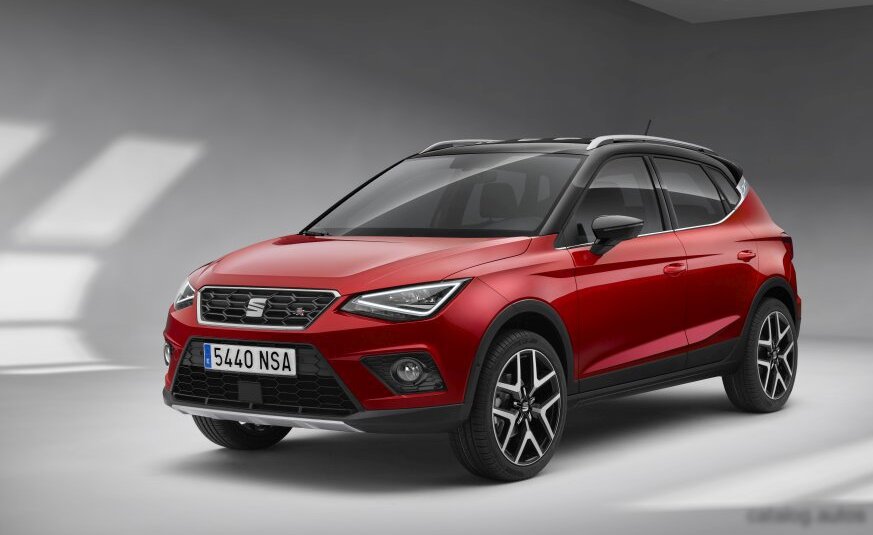
The Seat Arona 1.6 TDI (95 hp) was a subcompact crossover SUV produced by the Spanish automaker Seat from 2017 to 2019. Positioned as an entry-level offering within the Arona range, it aimed to provide an affordable and fuel-efficient option in the increasingly popular B-segment crossover market. The Arona, launched in 2017, was Seat’s response to rivals like the Renault Captur, Peugeot 2008, and Volkswagen T-Cross. This particular variant, powered by the 1.6-liter TDI diesel engine, was primarily sold in European markets where diesel fuel remained prevalent and government incentives favored lower CO2 emissions.
Technical Specifications
| Brand | Seat |
| Model | Arona |
| Generation | Arona |
| Type (Engine) | 1.6 TDI (95 Hp) |
| Start of production | 2017 |
| End of production | 2019 |
| Powertrain Architecture | Internal Combustion engine |
| Body type | SUV |
| Seats | 5 |
| Doors | 5 |
| Fuel consumption (urban) | 4.6-4.7 l/100 km (51.1 – 50 US mpg) |
| Fuel consumption (extra urban) | 3.7 l/100 km (63.6 US mpg) |
| Fuel consumption (combined) | 4.0-4.1 l/100 km (58.8 – 57.4 US mpg) |
| CO2 emissions | 105-106 g/km |
| Fuel Type | Diesel |
| Acceleration 0 – 100 km/h | 11.9 sec |
| Acceleration 0 – 62 mph | 11.9 sec |
| Acceleration 0 – 60 mph | 11.3 sec |
| Maximum speed | 172 km/h (106.88 mph) |
| Emission standard | Euro 6 |
| Weight-to-power ratio | 12.9 kg/Hp |
| Weight-to-torque ratio | 4.9 kg/Nm |
| Power | 95 Hp @ 2750-4600 rpm |
| Torque | 250 Nm @ 1500-2600 rpm (184.39 lb.-ft.) |
| Engine layout | Front, Transverse |
| Engine Model/Code | DGTD |
| Engine displacement | 1598 cm3 (97.52 cu. in.) |
| Number of cylinders | 4 |
| Engine configuration | Inline |
| Cylinder Bore | 79.5 mm (3.13 in.) |
| Piston Stroke | 80.5 mm (3.17 in.) |
| Compression ratio | 16.2:1 |
| Fuel injection system | Diesel Commonrail |
| Engine aspiration | Turbocharger, Intercooler |
| Engine oil capacity | 4.7 l (4.97 US qt | 4.14 UK qt) |
| Coolant | 8 l (8.45 US qt | 7.04 UK qt) |
| Kerb Weight | 1222 kg (2694.05 lbs.) |
| Max. weight | 1800 kg (3968.32 lbs.) |
| Max load | 578 kg (1274.27 lbs.) |
| Trunk (boot) space – minimum | 400 l (14.13 cu. ft.) |
| Trunk (boot) space – maximum | 1280 l (45.2 cu. ft.) |
| Fuel tank capacity | 40 l (10.57 US gal | 8.8 UK gal) |
| Length | 4138 mm (162.91 in.) |
| Width | 1780 mm (70.08 in.) |
| Height | 1552 mm (61.1 in.) |
| Wheelbase | 2566 mm (101.02 in.) |
| Front track | 1503 mm (59.17 in.) |
| Rear track | 1486 mm (58.5 in.) |
| Front suspension | Independent type McPherson |
| Rear suspension | Coil spring, Elastic beam |
| Front brakes | Ventilated discs, 276×24 mm |
| Rear brakes | Drum, 228×42 mm |
| Gearbox | 5 gears, manual transmission |
Powertrain & Engine Architecture
The heart of the Arona 1.6 TDI (95 hp) is the Volkswagen Group’s DGTD engine. This is a 1.6-liter, four-cylinder diesel engine utilizing common rail direct injection and a turbocharger with intercooling. The engine code ‘DGTD’ signifies a specific calibration of this engine for use in Seat vehicles. The engine produces 95 horsepower at 2750-4600 rpm and 250 Nm (184 lb-ft) of torque between 1500-2600 rpm. The fuel injection system is a Bosch common rail system, delivering highly pressurized fuel directly into the cylinders for efficient combustion. The engine features a single overhead camshaft (SOHC) operating two valves per cylinder. The Arona 1.6 TDI was exclusively offered with a five-speed manual transmission, prioritizing fuel economy over outright performance. This transmission was chosen to complement the engine’s torque characteristics and keep costs down.
Driving Characteristics
The Arona 1.6 TDI (95 hp) offered a practical and economical driving experience. Acceleration was modest, taking approximately 11.9 seconds to reach 62 mph (100 km/h). The engine’s strength lay in its low-end torque, making it suitable for everyday driving and urban commutes. The five-speed manual transmission was well-matched to the engine, providing adequate gear spacing for most driving situations. However, compared to higher-powered Arona variants (like the 1.0 TSI petrol engine), the 1.6 TDI felt noticeably slower, especially when fully loaded or tackling uphill climbs. The gear ratios were optimized for fuel efficiency, meaning the engine could feel strained at higher speeds. The steering was light and easy, making it maneuverable in city traffic, but lacked the feedback desired by more enthusiastic drivers.
Equipment & Trim Levels
The 1.6 TDI variant of the Arona typically came with a base level of equipment, focusing on practicality and affordability. Standard features generally included air conditioning, a basic infotainment system with a touchscreen display, Bluetooth connectivity, electric front windows, and steel wheels with wheel covers. Safety features such as ABS, ESC (Electronic Stability Control), and multiple airbags were also standard. Higher trim levels, such as Style and Xcellence, added features like alloy wheels, climate control, a more advanced infotainment system with navigation, rear parking sensors, and cruise control. Interior upholstery was typically cloth, with options for different color schemes. Optional extras included a panoramic sunroof, automatic headlights and wipers, and a driver assistance pack with features like lane assist and traffic sign recognition.
Chassis & Braking
The Arona 1.6 TDI utilized a front-wheel-drive chassis with independent McPherson strut suspension at the front and a torsion beam setup at the rear. This configuration provided a reasonable balance between ride comfort and handling. The front brakes were ventilated discs, while the rear brakes were drum brakes – a cost-saving measure common in entry-level models. The steering system was an electric power-assisted rack and pinion system, offering light and precise steering. Stabilizer bars were fitted to both the front and rear axles to reduce body roll during cornering. The suspension tuning was geared towards comfort, absorbing bumps and imperfections in the road surface effectively. However, the torsion beam rear suspension limited the car’s handling capabilities compared to more sophisticated independent rear suspension setups found in higher-spec Arona models.
Market Reception & Comparison
The Seat Arona 1.6 TDI (95 hp) was generally well-received by automotive critics as a practical and economical choice. Its fuel efficiency was a major selling point, with combined fuel consumption figures ranging from 4.0 to 4.1 liters per 100 kilometers (58.8-57.4 US mpg). However, its performance was often criticized as being underwhelming, particularly when compared to the more powerful petrol engine options available in the Arona lineup. Compared to the 1.0 TSI petrol engine, the 1.6 TDI offered better fuel economy but significantly less power and acceleration. The 1.6 TDI was also seen as a more sensible choice for drivers who covered high annual mileages and prioritized running costs over driving excitement. Reliability was generally good, with the Volkswagen Group’s diesel engines having a reputation for durability.
Legacy
The Seat Arona 1.6 TDI (95 hp) represents a significant point in Seat’s expansion into the crossover market. While the 1.6 TDI engine is no longer in production due to tightening emissions regulations and a shift towards petrol and hybrid powertrains, these models remain relatively common on the used car market. The powertrain is generally considered reliable, but potential buyers should be aware of the maintenance requirements associated with diesel engines, such as regular servicing of the diesel particulate filter (DPF). Today, these Aronas offer an affordable and fuel-efficient option for buyers seeking a compact crossover, though their age and mileage should be carefully considered. The Arona itself proved to be a successful model for Seat, establishing the brand as a key player in the competitive B-segment crossover market.
