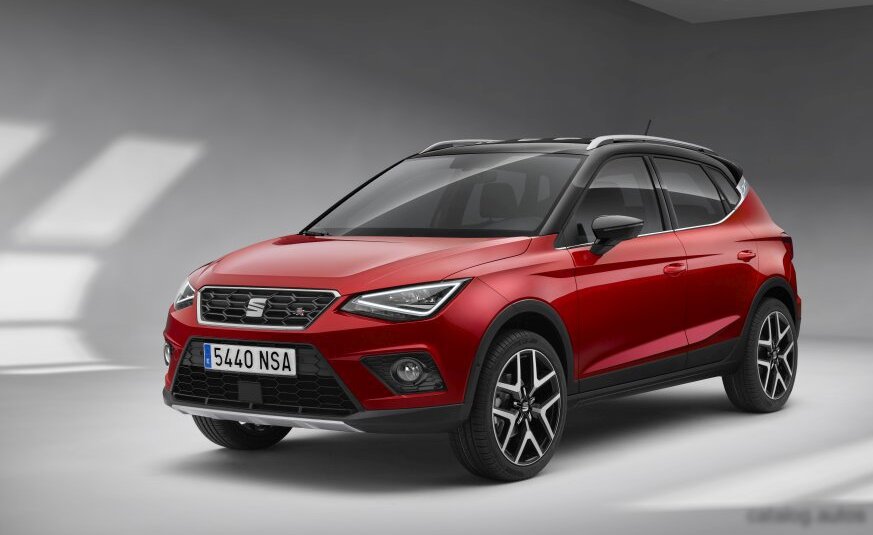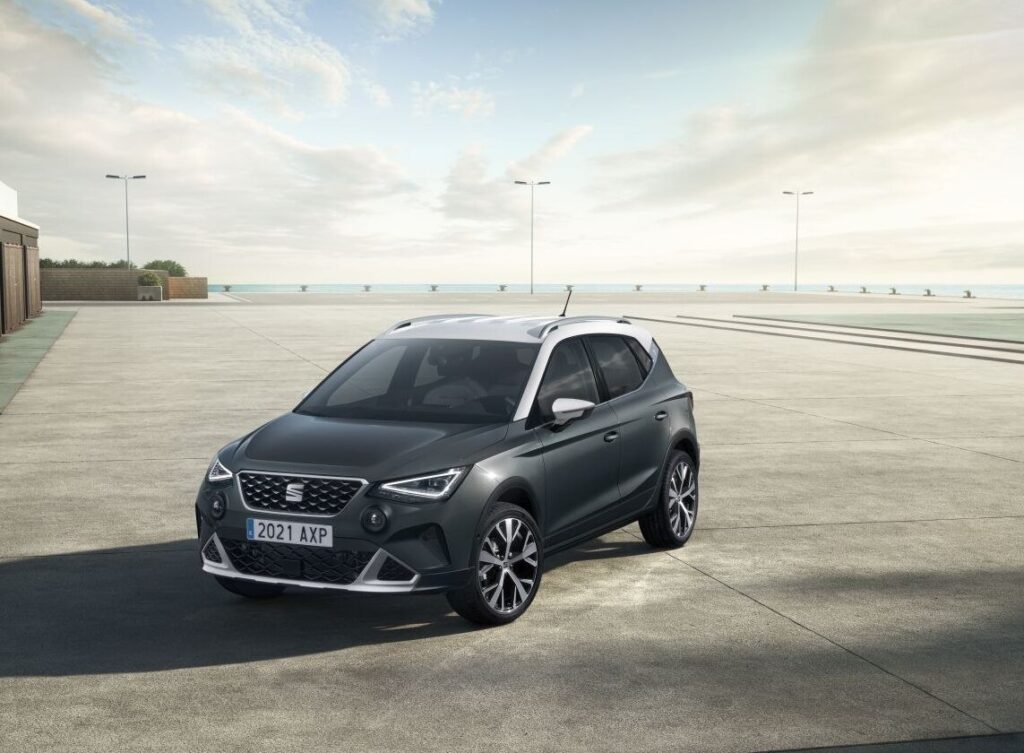
The Seat Arona (facelift 2021) 1.0 TSI 115 horsepower variant represents a key offering within the second-generation Arona subcompact SUV lineup. Introduced in February 2024 and continuing through October 2025, this model served as a popular entry point into the Arona range, balancing affordability with a reasonable level of performance and modern features. It’s built on the Volkswagen Group’s MQB A0 platform, shared with vehicles like the Volkswagen T-Cross and Audi Q2, and was primarily marketed towards European consumers seeking a practical and stylish urban crossover.
Technical Specifications
| Brand | Seat |
| Model | Arona |
| Generation | Arona (facelift 2021) |
| Type (Engine) | 1.0 TSI (115 Hp) |
| Start of production | February, 2024 |
| End of production | October, 2025 |
| Powertrain Architecture | Internal Combustion engine |
| Body type | SUV |
| Seats | 5 |
| Doors | 5 |
| Combined fuel consumption (WLTP) | 5.4-5.7 l/100 km (43.6 – 41.3 US mpg, 52.3 – 49.6 UK mpg, 18.5 – 17.5 km/l) |
| CO2 emissions (WLTP) | 122-130 g/km |
| Fuel Type | Petrol (Gasoline) |
| Acceleration 0 – 100 km/h | 10 sec |
| Acceleration 0 – 62 mph | 10 sec |
| Acceleration 0 – 60 mph | 9.5 sec |
| Maximum speed | 193 km/h (119.92 mph) |
| Emission standard | Euro 6e |
| Weight-to-power ratio | 9.9 kg/Hp, 101.1 Hp/tonne |
| Weight-to-torque ratio | 5.7 kg/Nm, 175.7 Nm/tonne |
| Power | 115 Hp @ 5500 rpm |
| Power per litre | 115.1 Hp/l |
| Torque | 200 Nm @ 2000-3500 rpm (147.51 lb.-ft. @ 2000-3500 rpm) |
| Engine layout | Front, Transverse |
| Engine Model/Code | EA211 evo2 |
| Engine displacement | 999 cm3 (60.96 cu. in.) |
| Number of cylinders | 3 |
| Engine configuration | Inline |
| Cylinder Bore | 74.5 mm (2.93 in.) |
| Piston Stroke | 76.4 mm (3.01 in.) |
| Compression ratio | 11.5:1 |
| Number of valves per cylinder | 4 |
| Fuel injection system | Direct injection |
| Engine aspiration | Turbocharger, Intercooler |
| Valvetrain | DOHC |
| Engine systems | Start & Stop System, Particulate filter |
| Kerb Weight | 1138 kg (2508.86 lbs.) |
| Max. weight | 1720 kg (3791.95 lbs.) |
| Max load | 582 kg (1283.09 lbs.) |
| Trunk (boot) space – minimum | 400 l (14.13 cu. ft.) |
| Trunk (boot) space – maximum | 1280 l (45.2 cu. ft.) |
| Fuel tank capacity | 40 l (10.57 US gal | 8.8 UK gal) |
| Max. roof load | 75 kg (165.35 lbs.) |
| Permitted trailer load with brakes (8%) | 1200 kg (2645.55 lbs.) |
| Permitted trailer load with brakes (12%) | 1100 kg (2425.08 lbs.) |
| Permitted trailer load without brakes | 600 kg (1322.77 lbs.) |
| Permitted towbar download | 55 kg (121.25 lbs.) |
| Length | 4153 mm (163.5 in.) |
| Width | 1780 mm (70.08 in.) |
| Width including mirrors | 1942 mm (76.46 in.) |
| Height | 1537 mm (60.51 in.) |
| Wheelbase | 2566 mm (101.02 in.) |
| Front track | 1513 mm (59.57 in.) |
| Rear (Back) track | 1495 mm (58.86 in.) |
| Front overhang | 809 mm (31.85 in.) |
| Rear overhang | 778 mm (30.63 in.) |
| Minimum turning circle (turning diameter) | 10.6 m (34.78 ft.) |
| Drivetrain Architecture | The Internal combustion engine (ICE) drives the front wheels of the vehicle. |
| Drive wheel | Front wheel drive |
| Number of gears and type of gearbox | 6 gears, manual transmission |
| Front suspension | Independent, type McPherson with coil spring and anti-roll bar |
| Rear suspension | Coil spring, Elastic beam |
| Front brakes | Ventilated discs, 276×24 mm |
| Rear brakes | Disc, 230×9 mm |
| Assisting systems | ABS (Anti-lock braking system) |
| Steering type | Steering rack and pinion |
| Power steering | Electric Steering |
| Tires size | 205/60 R16; 205/55 R17; 215/40 R18 |
| Wheel rims size | 6J x 16; 6.5J x 17; 7J x 18 |
INTRODUCTION
The Seat Arona 1.0 TSI 115 horsepower, introduced with the 2021 facelift, is a front-wheel-drive, five-door subcompact SUV designed to appeal to buyers seeking a practical and economical vehicle for urban environments. Positioned as a mid-range offering within the Arona lineup, it slotted between the lower-powered 1.0 TSI 95 hp version and the more potent 1.5 TSI models. The facelift brought updated styling, improved technology, and refinements to the interior, enhancing the Arona’s overall appeal. This variant was particularly popular in Europe, where smaller SUVs are in high demand, offering a blend of style, functionality, and fuel efficiency.
Powertrain & Engine Architecture
At the heart of the Arona 1.0 TSI 115 is the Volkswagen Group’s EA211 evo2 1.0-liter turbocharged three-cylinder gasoline engine. This engine, designated as a TSI (Turbocharged Stratified Injection) unit, utilizes direct fuel injection and a single-scroll turbocharger with an intercooler to deliver a balance of power and efficiency. The engine produces 115 horsepower at 5500 rpm and 200 Nm (147.51 lb-ft) of torque between 2000 and 3500 rpm. The engine features a DOHC (Dual Overhead Camshaft) valvetrain with four valves per cylinder. The Arona 1.0 TSI 115 was typically paired with a 6-speed manual transmission, although a 7-speed dual-clutch DSG automatic transmission was also available as an option. The engine also incorporates Start & Stop technology and a particulate filter to reduce emissions, meeting Euro 6e standards.
Driving Characteristics
The 1.0 TSI 115 powertrain delivers adequate performance for everyday driving. Acceleration from 0 to 100 km/h (0-62 mph) takes around 10 seconds, and top speed is rated at 193 km/h (119.92 mph). While not particularly sporty, the engine provides sufficient power for navigating city streets and merging onto highways. The turbocharger provides a noticeable boost in torque at lower engine speeds, making it feel responsive in most driving situations. Compared to the lower-powered 95 hp version, the 115 hp variant offers a more relaxed driving experience, particularly when fully loaded or tackling inclines. The 6-speed manual transmission offers precise shifts, while the optional DSG automatic provides smooth and quick gear changes. The gear ratios are tuned for fuel efficiency, prioritizing economy over outright acceleration.
Equipment & Trim Levels
The Arona 1.0 TSI 115 typically came equipped with a respectable level of standard features. Depending on the specific trim level (Style, Xcellence, FR), standard equipment included air conditioning, a touchscreen infotainment system with Apple CarPlay and Android Auto compatibility, Bluetooth connectivity, and a suite of safety features such as ABS, ESC (Electronic Stability Control), and multiple airbags. Higher trim levels offered additional features like climate control, a larger touchscreen display, parking sensors, a rear-view camera, and alloy wheels. Interior upholstery typically consisted of fabric seats, with optional leather upholstery available on higher trims. Dashboard materials were generally of good quality for the segment, with a focus on practicality and durability.
Chassis & Braking
The Arona 1.0 TSI 115 utilizes a McPherson strut front suspension and a torsion beam rear suspension. This setup provides a comfortable ride quality, absorbing bumps and imperfections in the road effectively. The front suspension incorporates a stabilizer bar to reduce body roll during cornering. Braking duties are handled by ventilated discs at the front and solid discs at the rear. ABS (Anti-lock Braking System) is standard, providing enhanced braking performance in emergency situations. The steering is electrically assisted, offering a light and precise feel.
Market Reception & Comparison
The Seat Arona 1.0 TSI 115 was generally well-received by automotive critics. It was praised for its fuel efficiency, comfortable ride, and stylish design. However, some reviewers noted that the engine could feel strained when pushed hard, and the interior space was somewhat limited compared to some competitors. Compared to the more powerful 1.5 TSI variants, the 1.0 TSI 115 offered a more affordable entry point into the Arona range, but at the expense of performance. In terms of fuel economy, the 1.0 TSI 115 delivered competitive figures, typically achieving between 5.4 and 5.7 liters per 100 kilometers (43.6-41.3 US mpg).
Legacy
The Seat Arona 1.0 TSI 115 has proven to be a reliable and durable powertrain. The EA211 engine family is known for its longevity and relatively low maintenance costs. On the used car market, these models represent a good value proposition, offering a practical and economical option for buyers seeking a small SUV. Common issues are relatively minor, often related to the turbocharger or fuel injection system, but generally do not pose significant problems. The Arona 1.0 TSI 115 continues to be a popular choice among used car buyers, thanks to its blend of affordability, fuel efficiency, and practicality.