
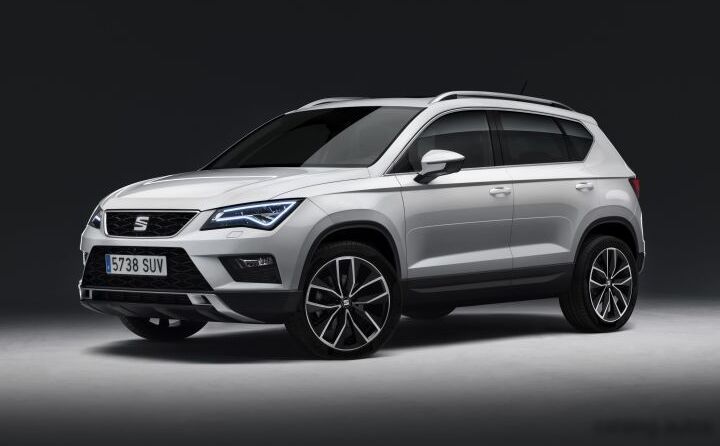
The Seat Ateca I 1.4 TSI (150 hp) DSG Start/Stop represents a significant entry in the compact SUV market for the Spanish automaker. Introduced in 2016 and remaining in production through 2018, this variant occupied a key position within the Ateca lineup, offering a balance between performance, fuel efficiency, and technology. The Ateca itself was Seat’s first foray into the popular compact SUV segment, built on the Volkswagen Group’s MQB platform (A1 generation), also underpinning models like the Volkswagen Tiguan, Skoda Karoq, and Audi Q3. This particular engine and transmission combination aimed to appeal to buyers seeking a refined and practical SUV experience without the higher costs associated with more powerful engine options.
Technical Specifications
| Brand | Seat |
| Model | Ateca |
| Generation | Ateca I |
| Type (Engine) | 1.4 TSI (150 Hp) DSG Start/Stop |
| Start of production | 2016 |
| End of production | 2018 |
| Powertrain Architecture | Internal Combustion engine |
| Body type | SUV |
| Seats | 5 |
| Doors | 5 |
| Fuel consumption (combined) | 5.5 l/100 km (42.8 US mpg, 51.4 UK mpg, 18.2 km/l) |
| CO2 emissions | 126 g/km |
| Fuel Type | Petrol (Gasoline) |
| Acceleration 0 – 100 km/h | 9 sec |
| Acceleration 0 – 62 mph | 9 sec |
| Acceleration 0 – 60 mph | 8.6 sec |
| Maximum speed | 198 km/h (123.03 mph) |
| Emission standard | Euro 6 |
| Weight-to-power ratio | 8.6 kg/Hp, 116.4 Hp/tonne |
| Weight-to-torque ratio | 5.2 kg/Nm, 193.9 Nm/tonne |
| Power | 150 Hp @ 5000-6000 rpm |
| Power per litre | 107.5 Hp/l |
| Torque | 250 Nm @ 1500-3500 rpm (184.39 lb.-ft. @ 1500-3500 rpm) |
| Engine layout | Front, Transverse |
| Engine Model/Code | CZEA |
| Engine displacement | 1395 cm3 (85.13 cu. in.) |
| Number of cylinders | 4 |
| Engine configuration | Inline |
| Cylinder Bore | 74.5 mm (2.93 in.) |
| Piston Stroke | 80 mm (3.15 in.) |
| Compression ratio | 10.5:1 |
| Number of valves per cylinder | 4 |
| Fuel injection system | Direct injection |
| Engine aspiration | Turbocharger, Intercooler |
| Engine oil capacity | 4 l (4.23 US qt | 3.52 UK qt) |
| Coolant | 8 l (8.45 US qt | 7.04 UK qt) |
| Kerb Weight | 1289 kg (2841.76 lbs.) |
| Max. weight | 1910 kg (4210.83 lbs.) |
| Max load | 621 kg (1369.07 lbs.) |
| Trunk (boot) space – minimum | 510 l (18.01 cu. ft.) |
| Fuel tank capacity | 50 l (13.21 US gal | 11 UK gal) |
| Permitted trailer load with brakes (8%) | 1800 kg (3968.32 lbs.) |
| Permitted trailer load with brakes (12%) | 1600 kg (3527.4 lbs.) |
| Permitted trailer load without brakes | 680 kg (1499.14 lbs.) |
| Length | 4363 mm (171.77 in.) |
| Width | 1841 mm (72.48 in.) |
| Height | 1601 mm (63.03 in.) |
| Wheelbase | 2638-2630 mm (103.86 – 103.54 in.) |
| Front track | 1576-1541 mm (62.05 – 60.67 in.) |
| Rear (Back) track | 1572-1544 mm (61.89 – 60.79 in.) |
| Minimum turning circle | 10.8 m (35.43 ft.) |
| Drivetrain Architecture | Front wheel drive |
| Number of gears and type of gearbox | 7 gears, automatic transmission DSG |
| Front suspension | Independent, type McPherson with coil spring and anti-roll bar |
| Rear suspension | Semi-independent, coil spring |
| Front brakes | Ventilated discs |
| Rear brakes | Disc |
| Assisting systems | ABS (Anti-lock braking system) |
| Steering type | Steering rack and pinion |
| Power steering | Electric Steering |
| Tires size | 215/55 R17 94V; 215/50 R18 92W |
| Wheel rims size | 7Jx17 ET 45; 7Jx18 ET 45 |
INTRODUCTION
The Seat Ateca I 1.4 TSI (150 hp) DSG Start/Stop, launched in 2016, was positioned as a mid-range offering within the Ateca lineup. It aimed to provide a compelling alternative to competitors like the Nissan Qashqai, Kia Sportage, and Hyundai Tucson. The “DSG” designation indicates the use of Volkswagen’s dual-clutch gearbox, known for its quick and smooth shifts. The “Start/Stop” system further enhanced its appeal by improving fuel economy in urban driving conditions. Built on the MQB platform, the Ateca offered a surprisingly spacious interior and a relatively engaging driving experience for a compact SUV.
Powertrain & Engine Architecture
At the heart of this Ateca variant lies the 1.4-liter turbocharged four-cylinder engine, bearing the code CZEA. This engine is part of Volkswagen Group’s EA211 family, known for its efficiency and relatively compact size. The CZEA engine features direct fuel injection, delivering fuel directly into the combustion chamber for improved combustion efficiency and power output. It also incorporates an intercooled turbocharger to boost power and torque. The engine produces 150 horsepower at 5000-6000 rpm and 250 Nm (184 lb-ft) of torque between 1500-3500 rpm. The engine is paired with a seven-speed dual-clutch transmission (DSG), which provides rapid gear changes and contributes to a more dynamic driving experience. The DSG transmission is electronically controlled and offers both automatic and manual shift modes.
Driving Characteristics
The 1.4 TSI with the DSG transmission delivers a respectable, if not exhilarating, driving experience. Acceleration from 0-60 mph takes around 8.6 seconds, and the top speed is 123 mph. The DSG transmission is a key contributor to the car’s responsiveness, providing quick and seamless gear changes. However, compared to the more powerful 1.8 TSI or 2.0 TSI variants, the 1.4 TSI feels less potent, particularly when fully loaded or tackling steep inclines. The gear ratios are tuned for a balance between fuel economy and performance, with taller gears for highway cruising and shorter gears for quicker acceleration. The engine is generally quiet and refined, but can become slightly noisy under hard acceleration. The front-wheel-drive configuration provides adequate traction in most conditions, but may struggle in slippery surfaces.
Equipment & Trim Levels
The 1.4 TSI DSG Start/Stop typically came equipped with a generous amount of standard features. These included air conditioning, a touchscreen infotainment system with Bluetooth connectivity, alloy wheels, and a suite of safety features such as ABS, ESC (Electronic Stability Control), and multiple airbags. Higher trim levels offered additional features like automatic climate control, parking sensors, a rearview camera, and a larger touchscreen display. Interior upholstery was typically cloth, with options for leather upgrades. Dashboard design was modern and functional, with a focus on ergonomics. Optional extras included a panoramic sunroof, navigation system, and advanced driver-assistance systems.
Chassis & Braking
The Ateca’s chassis is tuned for a comfortable ride and predictable handling. The front suspension utilizes a McPherson strut design, while the rear suspension employs a semi-independent torsion beam setup. This configuration provides a good balance between ride comfort and handling precision. The steering is electrically assisted and offers a reasonable level of feedback. Braking duties are handled by ventilated discs at the front and solid discs at the rear. ABS (Anti-lock Braking System) is standard, providing enhanced braking performance in emergency situations. Stabilizer bars are fitted to both the front and rear axles to reduce body roll during cornering.
Market Reception & Comparison
The Seat Ateca 1.4 TSI DSG Start/Stop was generally well-received by automotive critics. It was praised for its stylish design, spacious interior, and comfortable ride. The 1.4 TSI engine was considered adequate for most drivers, offering a good balance between performance and fuel economy. However, some critics noted that the engine could feel strained when pushed hard. Compared to the more powerful engine options, the 1.4 TSI offered a more affordable entry point into the Ateca range. Fuel economy was a strong point, with combined figures of around 42.8 US mpg. Reliability was generally good, although some owners reported minor issues with the DSG transmission.
Legacy
The Seat Ateca I 1.4 TSI DSG Start/Stop remains a popular choice in the used car market. The CZEA engine, while not known for being exceptionally powerful, has proven to be relatively reliable when properly maintained. The DSG transmission, however, requires regular servicing to ensure optimal performance and longevity. The Ateca’s combination of practicality, style, and technology continues to appeal to buyers seeking a versatile and well-rounded compact SUV. Its success helped establish Seat as a serious contender in the European SUV market and paved the way for future models.
