
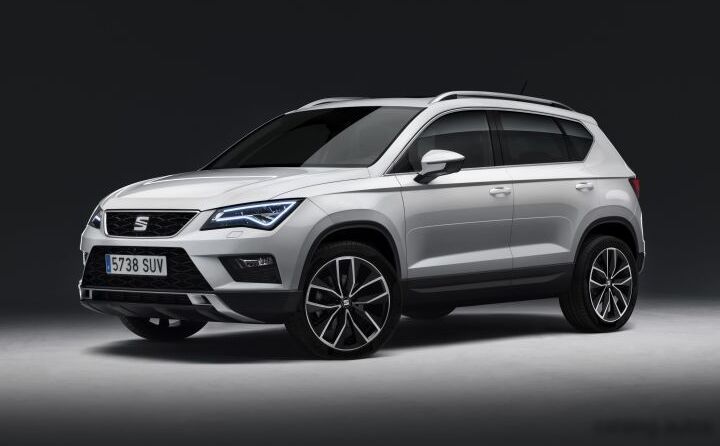
The Seat Ateca I 2.0 TDI (150 hp) Start/Stop, produced from 2016 to 2018, represents a significant entry in Seat’s foray into the burgeoning compact SUV market. Positioned as a mid-range offering within the Ateca lineup, it aimed to balance fuel efficiency, practicality, and a reasonable level of performance for European drivers. The Ateca itself was Seat’s first vehicle to utilize the Volkswagen Group’s MQB platform (A1 generation), a modular architecture designed to underpin a wide variety of vehicles across multiple brands. This particular variant, with its 2.0-liter turbocharged diesel engine and six-speed manual transmission, became a popular choice for those seeking a versatile and economical family vehicle.
Technical Specifications
| Brand | Seat |
| Model | Ateca |
| Generation | Ateca I |
| Type (Engine) | 2.0 TDI (150 Hp) Start/Stop |
| Start of production | 2016 |
| End of production | 2018 |
| Powertrain Architecture | Internal Combustion engine |
| Body type | SUV |
| Seats | 5 |
| Doors | 5 |
| Fuel consumption (combined) | 4.4 l/100 km (53.5 US mpg, 64.2 UK mpg, 22.7 km/l) |
| CO2 emissions | 114 g/km |
| Fuel Type | Diesel |
| Acceleration 0 – 100 km/h | 8.6 sec |
| Acceleration 0 – 62 mph | 8.6 sec |
| Acceleration 0 – 60 mph | 8.2 sec |
| Maximum speed | 202 km/h (125.52 mph) |
| Emission standard | Euro 6 |
| Weight-to-power ratio | 8.9 kg/Hp, 111.8 Hp/tonne |
| Weight-to-torque ratio | 3.9 kg/Nm, 253.4 Nm/tonne |
| Power | 150 Hp @ 3500-4000 rpm |
| Power per litre | 76.2 Hp/l |
| Torque | 340 Nm @ 1750-3000 rpm (250.77 lb.-ft. @ 1750-3000 rpm) |
| Engine layout | Front, Transverse |
| Engine Model/Code | DFFA |
| Engine displacement | 1968 cm3 (120.09 cu. in.) |
| Number of cylinders | 4 |
| Engine configuration | Inline |
| Cylinder Bore | 81 mm (3.19 in.) |
| Piston Stroke | 95.5 mm (3.76 in.) |
| Compression ratio | 16.2:1 |
| Number of valves per cylinder | 4 |
| Fuel injection system | Diesel Commonrail |
| Engine aspiration | Turbocharger, Intercooler |
| Engine oil capacity | 4.6 l (4.86 US qt | 4.05 UK qt) |
| Coolant | 8 l (8.45 US qt | 7.04 UK qt) |
| Kerb Weight | 1342 kg (2958.6 lbs.) |
| Max. weight | 1950 kg (4299.01 lbs.) |
| Max load | 608 kg (1340.41 lbs.) |
| Trunk (boot) space – minimum | 510 l (18.01 cu. ft.) |
| Fuel tank capacity | 50 l (13.21 US gal | 11 UK gal) |
| Permitted trailer load with brakes (8%) | 1900 kg (4188.78 lbs.) |
| Permitted trailer load with brakes (12%) | 1900 kg (4188.78 lbs.) |
| Permitted trailer load without brakes | 700 kg (1543.24 lbs.) |
| Length | 4363 mm (171.77 in.) |
| Width | 1841 mm (72.48 in.) |
| Height | 1601 mm (63.03 in.) |
| Wheelbase | 2638-2630 mm (103.86 – 103.54 in.) |
| Front track | 1576-1541 mm (62.05 – 60.67 in.) |
| Rear (Back) track | 1572-1544 mm (61.89 – 60.79 in.) |
| Minimum turning circle | 10.8 m (35.43 ft.) |
| Drivetrain Architecture | Front wheel drive |
| Number of gears and type of gearbox | 6 gears, manual transmission |
| Front suspension | Independent, type McPherson with coil spring and anti-roll bar |
| Rear suspension | Independent coil spring |
| Front brakes | Ventilated discs |
| Rear brakes | Disc |
| Assisting systems | ABS (Anti-lock braking system) |
| Steering type | Steering rack and pinion |
| Power steering | Electric Steering |
| Tires size | 215/55 R17 94V; 215/50 R18 92W |
| Wheel rims size | 7Jx17 ET 45; 7Jx18 ET 45 |
Powertrain & Engine Architecture
At the heart of the Ateca 2.0 TDI lies the DFFA engine code, a member of the Volkswagen Group’s modular engine family. This 1968cc inline-four cylinder diesel engine utilizes a common rail direct injection system, delivering fuel at extremely high pressures for optimized combustion. A turbocharger with an intercooler further enhances performance by forcing more air into the cylinders. The engine produces 150 horsepower at 3500-4000 rpm and a substantial 340 Nm (250.77 lb-ft) of torque between 1750 and 3000 rpm. This broad torque curve is characteristic of modern turbocharged diesel engines, providing strong pulling power across a wide range of engine speeds. The six-speed manual transmission was the standard offering for this variant, providing drivers with full control over gear selection. The gear ratios were tuned for a balance of fuel efficiency and responsiveness, with a relatively long final drive to aid in highway cruising.
Driving Characteristics
The 2.0 TDI 150 hp Ateca offered a composed and refined driving experience. While not overtly sporty, the engine provided ample power for everyday driving and overtaking maneuvers. The 0-60 mph time of around 8.2 seconds was respectable for a compact SUV. The manual transmission allowed for precise gear changes, and the clutch pedal was relatively light and easy to operate. Compared to the lower-powered 1.6 TDI variants, the 2.0 TDI offered a noticeable improvement in acceleration and overall responsiveness. It also felt more relaxed on the highway, with less need for frequent downshifts. Compared to the higher-output 2.0 TDI models (typically around 184 hp), this version prioritized fuel economy over outright performance.
Equipment & Trim Levels
The Ateca 2.0 TDI 150 hp Start/Stop typically came equipped with a generous level of standard features. These included air conditioning, a touchscreen infotainment system with Bluetooth connectivity, alloy wheels, and a suite of safety features such as ABS, ESC (Electronic Stability Control), and multiple airbags. Higher trim levels, such as Style and Xcellence, added features like automatic climate control, parking sensors, a reversing camera, and upgraded interior upholstery. Optional extras included a panoramic sunroof, adaptive cruise control, and a navigation system.
Chassis & Braking
The Ateca’s chassis featured independent suspension all around, with McPherson struts at the front and a multi-link setup at the rear. This configuration provided a comfortable ride quality and good handling characteristics. The steering was precise and well-weighted, offering a good level of feedback to the driver. Braking duties were handled by ventilated discs at the front and solid discs at the rear. ABS (Anti-lock Braking System) was standard, ensuring safe and controlled stopping power in a variety of conditions.
Market Reception & Comparison
The Seat Ateca was generally well-received by automotive critics, who praised its stylish design, spacious interior, and enjoyable driving dynamics. The 2.0 TDI 150 hp variant was particularly noted for its fuel efficiency and strong performance. Compared to rivals such as the Nissan Qashqai and Kia Sportage, the Ateca offered a more premium feel and a more engaging driving experience. Its fuel economy of around 53.5 US mpg was competitive within its class, and its reliability proved to be generally good.
Legacy
The Seat Ateca played a crucial role in establishing Seat as a serious contender in the compact SUV segment. The 2.0 TDI engine, in particular, proved to be a reliable and durable powertrain. On the used car market today, these models continue to be sought after for their practicality, fuel efficiency, and relatively low running costs. While diesel engines have faced increased scrutiny in recent years, the Ateca 2.0 TDI remains a viable option for those seeking a well-rounded and economical SUV.
