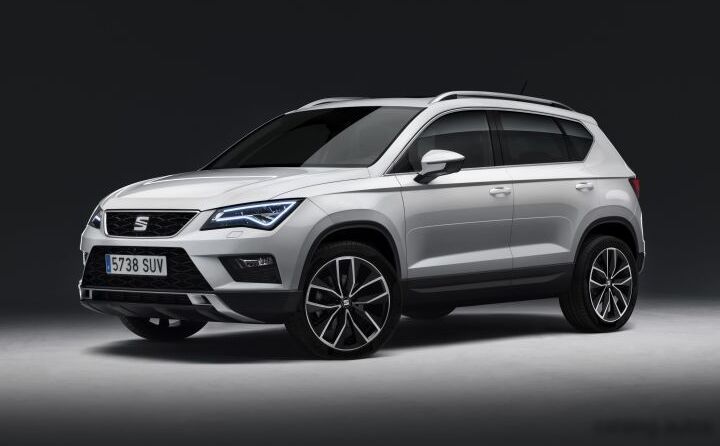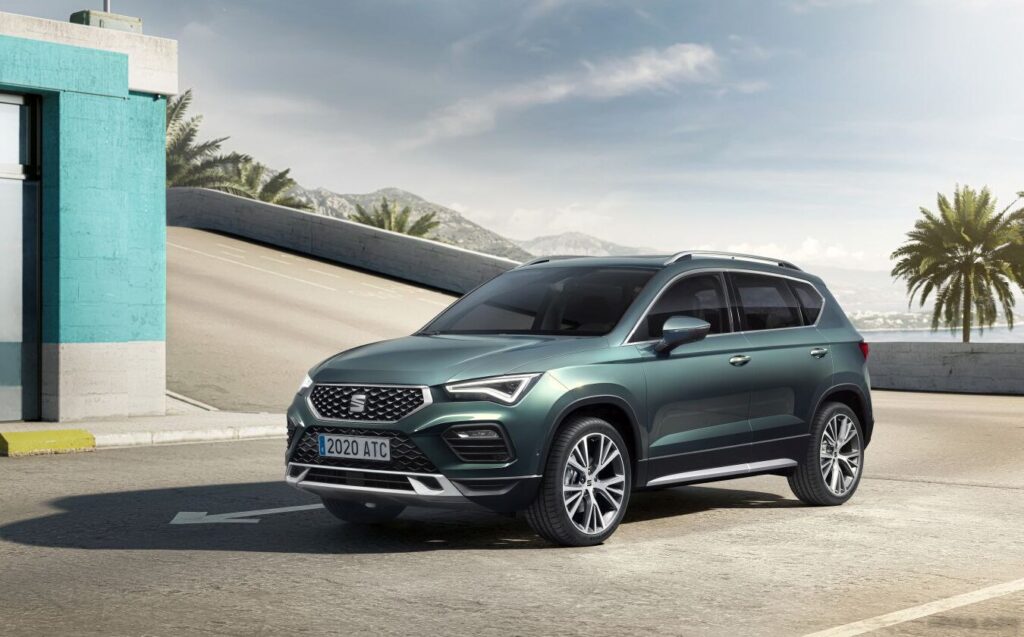
The Seat Ateca I, specifically the facelifted version introduced in June 2020 with the 1.0 EcoTSI engine producing 116 horsepower, represents an entry point into the Ateca compact SUV range. Positioned as a fuel-efficient and accessible option, this variant aimed to broaden the Ateca’s appeal to buyers prioritizing economy and practicality over outright performance. It falls within the first generation of the Ateca (codenamed KH7), which was Seat’s first foray into the highly competitive compact SUV segment, sharing its MQB platform with the Volkswagen Tiguan, Skoda Karoq, and Audi Q3.
Technical Specifications
| Brand | Seat |
| Model | Ateca |
| Generation | Ateca I (facelift 2020) |
| Type (Engine) | 1.0 EcoTSI (116 Hp) |
| Start of production | June, 2020 |
| Powertrain Architecture | Internal Combustion engine |
| Body type | SUV |
| Seats | 5 |
| Doors | 5 |
| Combined fuel consumption (WLTP) | 6.4-7.2 l/100 km (36.8 – 32.7 US mpg, 44.1 – 39.2 UK mpg, 15.6 – 13.9 km/l) |
| CO2 emissions (WLTP) | 146-162 g/km |
| Fuel consumption (urban) | 6.4 l/100 km (36.8 US mpg, 44.1 UK mpg, 15.6 km/l) |
| Fuel consumption (extra urban) | 4.7 l/100 km (50 US mpg, 60.1 UK mpg, 21.3 km/l) |
| Fuel consumption (combined) | 5.4 l/100 km (43.6 US mpg, 52.3 UK mpg, 18.5 km/l) |
| CO2 emissions | 123 g/km |
| Fuel Type | Petrol (Gasoline) |
| Acceleration 0 – 100 km/h | 10.7 sec |
| Acceleration 0 – 62 mph | 10.7 sec |
| Acceleration 0 – 60 mph | 10.2 sec |
| Maximum speed | 183 km/h (113.71 mph) |
| Emission standard | Euro 6d-Temp |
| Weight-to-power ratio | 10.9 kg/Hp, 91.3 Hp/tonne |
| Weight-to-torque ratio | 6.4 kg/Nm, 157.5 Nm/tonne |
| Power | 116 Hp @ 5000-5500 rpm |
| Power per litre | 116.1 Hp/l |
| Torque | 200 Nm @ 2000-3500 rpm (147.51 lb.-ft. @ 2000-3500 rpm) |
| Engine layout | Front, Transverse |
| Engine Model/Code | DKRA, DKRF |
| Engine displacement | 999 cm3 (60.96 cu. in.) |
| Number of cylinders | 3 |
| Engine configuration | Inline |
| Cylinder Bore | 74.5 mm (2.93 in.) |
| Piston Stroke | 76.4 mm (3.01 in.) |
| Compression ratio | 10.5:1 |
| Number of valves per cylinder | 4 |
| Fuel injection system | Direct injection |
| Engine aspiration | Turbocharger, Intercooler |
| Engine oil capacity | 4.3 l (4.54 US qt | 3.78 UK qt) |
| Coolant | 8 l (8.45 US qt | 7.04 UK qt) |
| Kerb Weight | 1270 kg (2799.87 lbs.) |
| Max. weight | 1880 kg (4144.69 lbs.) |
| Max load | 610 kg (1344.82 lbs.) |
| Trunk (boot) space – minimum | 510 l (18.01 cu. ft.) |
| Trunk (boot) space – maximum | 1604 l (56.64 cu. ft.) |
| Fuel tank capacity | 50 l (13.21 US gal | 11 UK gal) |
| Max. roof load | 75 kg (165.35 lbs.) |
| Permitted trailer load with brakes (8%) | 1500 kg (3306.93 lbs.) |
| Permitted trailer load with brakes (12%) | 1300 kg (2866.01 lbs.) |
| Permitted trailer load without brakes | 670 kg (1477.1 lbs.) |
| Permitted towbar download | 80 kg (176.37 lbs.) |
| Length | 4381 mm (172.48 in.) |
| Width | 1841 mm (72.48 in.) |
| Width including mirrors | 2078 mm (81.81 in.) |
| Height | 1615 mm (63.58 in.) |
| Wheelbase | 2638 mm (103.86 in.) |
| Front track | 1576 mm (62.05 in.) |
| Rear (Back) track | 1541 mm (60.67 in.) |
| Front overhang | 871 mm (34.29 in.) |
| Rear overhang | 872 mm (34.33 in.) |
| Minimum turning circle | 10.8 m (35.43 ft.) |
| Drivetrain Architecture | Front wheel drive |
| Number of gears and type of gearbox | 6 gears, manual transmission |
| Front suspension | Independent type McPherson |
| Rear suspension | Semi-independent, coil spring |
| Front brakes | Ventilated discs, 312×25 mm |
| Rear brakes | Disc, 272×10 mm |
| Tires size | 215/60 R16 95W; 215/55 R17 94V; 215/50 R18 92W |
| Wheel rims size | 6J x 16; 7J x 17; 7J x 18 |
INTRODUCTION
The Seat Ateca 1.0 EcoTSI (116 hp) launched in June 2020 as part of the facelift for the first-generation Ateca. This variant was designed to offer a more economical and accessible entry point into the Ateca range, appealing to buyers who prioritized fuel efficiency and lower running costs. The facelift brought styling updates, enhanced technology, and refinements to the engine lineup. The 1.0 EcoTSI model occupied the lower end of the spectrum, offering a balance between affordability and the practicality of a compact SUV. It competed directly with other entry-level compact SUVs like the Nissan Qashqai and Kia Sportage.
Powertrain & Engine Architecture
The heart of the Ateca 1.0 EcoTSI is the DKRA/DKRF engine, a 999cc three-cylinder turbocharged gasoline engine. This engine is part of Volkswagen Group’s EA211 family, known for its compact size and efficiency. It utilizes direct fuel injection and a single-scroll turbocharger with an intercooler to deliver 116 horsepower at 5000-5500 rpm and 200 Nm (147.51 lb-ft) of torque between 2000-3500 rpm. The engine features four valves per cylinder and a timing chain for durability. The 1.0 EcoTSI is paired with a six-speed manual transmission as standard, driving the front wheels. While a dual-clutch DSG automatic transmission was available on other Ateca models, it wasn’t offered with the base 1.0 EcoTSI engine.
Driving Characteristics
The 1.0 EcoTSI-equipped Ateca delivers adequate performance for everyday driving, but it’s not designed for spirited acceleration. The 0-60 mph time of around 10.2 seconds reflects this. The engine feels responsive enough around town, and the turbocharger provides a noticeable boost in power when needed. However, overtaking maneuvers on the highway require more planning. The six-speed manual transmission is well-matched to the engine, offering precise shifts and helping to keep the engine in its optimal power band. Compared to the more powerful 1.5 TSI or 2.0 TSI variants, the 1.0 EcoTSI feels noticeably slower, but it compensates with significantly better fuel economy.
Equipment & Trim Levels
The 1.0 EcoTSI typically came with a reasonable level of standard equipment, though it was less lavish than higher-spec Ateca models. Standard features generally included air conditioning, a touchscreen infotainment system with Apple CarPlay and Android Auto compatibility, alloy wheels, and a suite of safety features like ABS, ESC, and multiple airbags. Higher trim levels added features such as parking sensors, a rear-view camera, automatic climate control, and upgraded interior upholstery. Optional extras included a panoramic sunroof, adaptive cruise control, and a premium sound system.
Chassis & Braking
The Ateca utilizes a McPherson strut front suspension and a semi-independent torsion beam rear suspension. This setup provides a comfortable ride quality, well-suited for everyday driving. The steering is precise and well-weighted, offering good feedback to the driver. Braking duties are handled by ventilated discs at the front and solid discs at the rear. ABS (Anti-lock Braking System) and ESC (Electronic Stability Control) are standard, providing enhanced safety and stability. The suspension tuning is generally geared towards comfort rather than outright sportiness, prioritizing ride quality over sharp handling.
Market Reception & Comparison
The Seat Ateca 1.0 EcoTSI was generally well-received by critics as a practical and economical choice in the compact SUV segment. Reviewers praised its fuel efficiency, comfortable ride, and well-equipped interior. However, some criticized its lack of outright performance compared to more powerful rivals. Compared to the 1.5 TSI version, the 1.0 EcoTSI offered significantly better fuel economy (around 6.4-7.2 l/100km vs. 6.0-6.5 l/100km for the 1.5 TSI) but with a noticeable reduction in power and acceleration. The 1.0 EcoTSI was aimed at buyers who prioritized economy and practicality over performance, making it a compelling option for those seeking a budget-friendly compact SUV.
Legacy
The 1.0 EcoTSI engine has proven to be relatively reliable, although, like any turbocharged engine, it requires regular maintenance and the use of high-quality oil. The EA211 engine family has a generally good reputation for durability. On the used car market, the Ateca 1.0 EcoTSI represents a good value proposition, offering a practical and economical SUV at a competitive price. Its fuel efficiency and relatively low running costs make it an attractive option for buyers seeking a budget-friendly and reliable compact SUV. However, potential buyers should be aware of its limited performance compared to higher-powered variants.