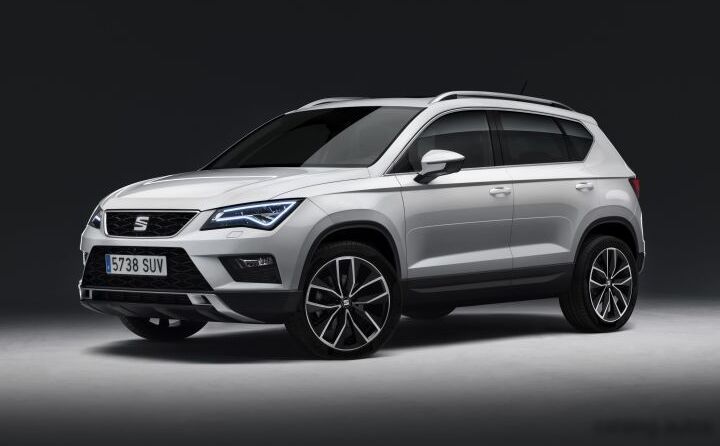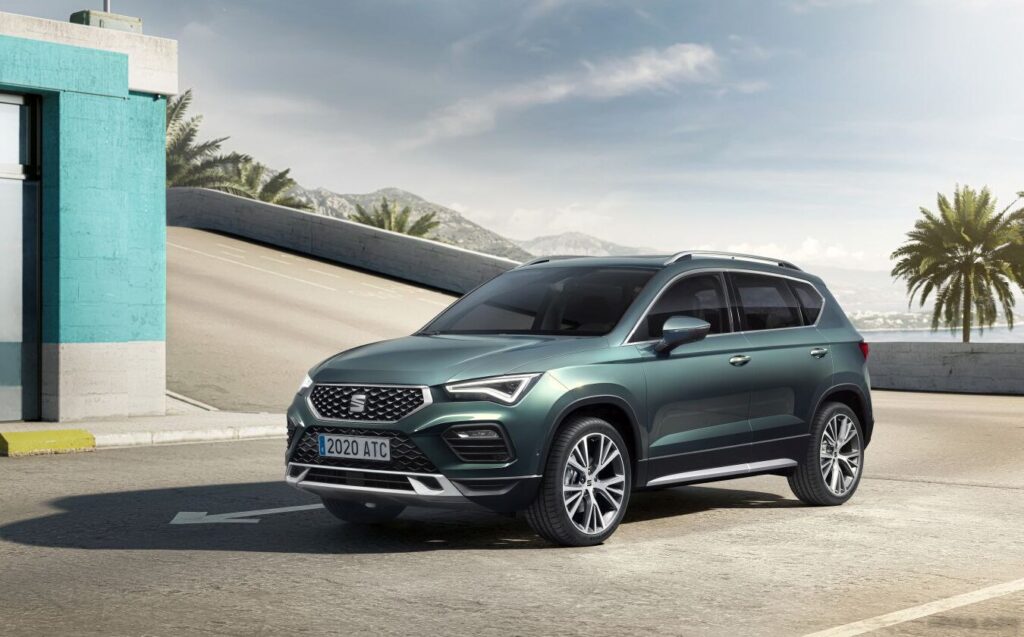
The Seat Ateca I (facelift, introduced in June 2020) 2.0 TDI 150 hp 4Drive DSG represents a significant iteration of Seat’s compact SUV offering. Positioned as a mid-range option within the Ateca lineup, this variant aimed to balance fuel efficiency, respectable performance, and all-weather capability through its four-wheel-drive system. Production continued until June 2023. The Ateca itself is built on the Volkswagen Group’s MQB platform (A3/1HX0), shared with models like the Volkswagen Tiguan, Skoda Karoq, and Audi Q3, and was Seat’s first foray into the popular compact SUV segment. This facelift brought styling updates, enhanced technology, and refinements to the powertrain options.
Technical Specifications
| Brand | Seat |
| Model | Ateca |
| Generation | Ateca I (facelift 2020) |
| Type (Engine) | 2.0 TDI (150 Hp) 4Drive DSG |
| Start of production | June, 2020 |
| End of production | June, 2023 |
| Powertrain Architecture | Internal Combustion engine |
| Body type | SUV |
| Seats | 5 |
| Doors | 5 |
| Combined fuel consumption (WLTP) | 6.1-6.7 l/100 km (38.6 – 35.1 US mpg, 46.3 – 42.2 UK mpg, 16.4 – 14.9 km/l) |
| CO2 emissions (WLTP) | 161-177 g/km |
| Fuel consumption (urban) | 6.1 l/100 km (38.6 US mpg, 46.3 UK mpg, 16.4 km/l) |
| Fuel consumption (extra urban) | 4.8 l/100 km (49 US mpg, 58.9 UK mpg, 20.8 km/l) |
| Fuel consumption (combined) | 5.2 l/100 km (45.2 US mpg, 54.3 UK mpg, 19.2 km/l) |
| CO2 emissions | 138 g/km |
| Fuel Type | Diesel |
| Acceleration 0 – 100 km/h | 8.8 sec |
| Acceleration 0 – 62 mph | 8.8 sec |
| Acceleration 0 – 60 mph | 8.4 sec |
| Maximum speed | 196 km/h (121.79 mph) |
| Emission standard | Euro 6 DG |
| Weight-to-power ratio | 10.2 kg/Hp, 98.5 Hp/tonne |
| Weight-to-torque ratio | 4.5 kg/Nm, 223.2 Nm/tonne |
| Power | 150 Hp @ 3500-4000 rpm |
| Power per litre | 76.2 Hp/l |
| Torque | 340 Nm @ 1750-3000 rpm (250.77 lb.-ft. @ 1750-3000 rpm) |
| Engine layout | Front, Transverse |
| Engine Model/Code | DFFA |
| Engine displacement | 1968 cm3 (120.09 cu. in.) |
| Number of cylinders | 4 |
| Engine configuration | Inline |
| Cylinder Bore | 81 mm (3.19 in.) |
| Piston Stroke | 95.5 mm (3.76 in.) |
| Compression ratio | 16.2:1 |
| Number of valves per cylinder | 4 |
| Fuel injection system | Diesel Commonrail |
| Engine aspiration | Turbocharger, Intercooler |
| Engine oil capacity | 4.6 l (4.86 US qt | 4.05 UK qt) |
| Coolant | 8 l (8.45 US qt | 7.04 UK qt) |
| Kerb Weight | 1523 kg (3357.64 lbs.) |
| Max. weight | 2130 kg (4695.85 lbs.) |
| Max load | 607 kg (1338.21 lbs.) |
| Trunk (boot) space – minimum | 485 l (17.13 cu. ft.) |
| Trunk (boot) space – maximum | 1579 l (55.76 cu. ft.) |
| Fuel tank capacity | 55 l (14.53 US gal | 12.1 UK gal) |
| AdBlue tank | 12 l (3.17 US gal | 2.64 UK gal) |
| Max. roof load | 75 kg (165.35 lbs.) |
| Permitted trailer load with brakes (8%) | 2100 kg (4629.71 lbs.) |
| Permitted trailer load with brakes (12%) | 2100 kg (4629.71 lbs.) |
| Permitted trailer load without brakes | 750 kg (1653.47 lbs.) |
| Permitted towbar download | 50 kg (110.23 lbs.) |
| Length | 4381 mm (172.48 in.) |
| Width | 1841 mm (72.48 in.) |
| Width including mirrors | 2078 mm (81.81 in.) |
| Height | 1625 mm (63.98 in.) |
| Wheelbase | 2630 mm (103.54 in.) |
| Front track | 1572 mm (61.89 in.) |
| Rear (Back) track | 1544 mm (60.79 in.) |
| Minimum turning circle | 10.8 m (35.43 ft.) |
| Drivetrain Architecture | The Internal combustion engine (ICE) drives permanently the four wheels of the vehicle. |
| Drive wheel | All wheel drive (4×4) |
| Number of gears and type of gearbox | 7 gears, automatic transmission DSG |
| Front suspension | Independent type McPherson |
| Rear suspension | Independent multi-link suspension |
| Front brakes | Ventilated discs, 312×25 mm |
| Rear brakes | Disc, 272×10 mm |
| Assisting systems | ABS (Anti-lock braking system) |
| Steering type | Steering rack and pinion |
| Power steering | Electric Steering |
| Tires size | 225/55 R17 97V; 225/50 R18 95W; 245/40 R19 94W |
| Wheel rims size | 7J x 17; 7J x 18; 8J x 19 |
INTRODUCTION
The Seat Ateca 2.0 TDI 150 hp 4Drive DSG, launched with the 2020 facelift, offered a compelling package for buyers seeking a practical, efficient, and capable compact SUV. It slotted into the Ateca range between the lower-powered diesel variants and the more performance-oriented petrol options. The facelift brought a refreshed exterior design, a more modern interior with upgraded technology, and improvements to the driver assistance systems. This variant was primarily aimed at European markets, where diesel engines and all-wheel drive systems remain popular due to fuel costs and varied weather conditions. The 4Drive system provided enhanced traction and stability, making it suitable for both urban driving and occasional off-road excursions.
Powertrain & Engine Architecture
At the heart of the Ateca 2.0 TDI 4Drive DSG lies the Volkswagen Group’s DFFA engine, a 2.0-liter four-cylinder diesel engine. This engine utilizes a common rail direct injection system, delivering fuel directly into the combustion chamber at extremely high pressure for optimized combustion. The engine also features a turbocharger with an intercooler, boosting power and torque output. The 150 hp version of this engine is tuned for a balance of performance and fuel economy. The engine code ‘DFFA’ signifies a specific calibration within the broader 2.0 TDI family. The seven-speed dual-clutch transmission (DSG) is a key component, offering quick and smooth gear changes. The DSG transmission is known for its efficiency and responsiveness, contributing to the overall driving experience. The engine also incorporates a diesel particulate filter (DPF) to reduce harmful emissions, and a Start & Stop system to further improve fuel economy.
Driving Characteristics
The 150 hp 2.0 TDI with the DSG transmission provides adequate performance for everyday driving. Acceleration from 0-60 mph takes around 8.4 seconds, and the car feels responsive in most situations. While not a sports SUV, the engine delivers a usable amount of torque (340 Nm / 250.77 lb.-ft.) from 1750-3000 rpm, making overtaking and merging onto highways relatively effortless. The DSG transmission shifts quickly and smoothly, and the 4Drive all-wheel-drive system provides excellent traction in various conditions. Compared to the lower-powered diesel variants, the 150 hp version offers a noticeable improvement in performance. However, it doesn’t match the punch of the higher-output petrol engines. The gear ratios are tuned for a balance of acceleration and fuel efficiency, with taller gears for cruising on the highway.
Equipment & Trim Levels
The Ateca 2.0 TDI 150 hp 4Drive DSG typically came equipped with a generous amount of standard features. These included air conditioning, a touchscreen infotainment system with Apple CarPlay and Android Auto compatibility, alloy wheels, and a suite of safety features such as ABS, ESC, and multiple airbags. Higher trim levels offered additional features like leather upholstery, a panoramic sunroof, a premium sound system, and advanced driver assistance systems such as adaptive cruise control and lane keeping assist. Interior upholstery was typically cloth on the base trims, with leather options available on higher-spec models. The dashboard layout was modern and functional, with a focus on ergonomics.
Chassis & Braking
The Ateca’s chassis features an independent McPherson strut suspension at the front and a multi-link suspension at the rear, providing a comfortable and controlled ride. The 4Drive all-wheel-drive system utilizes a Haldex clutch to distribute torque between the front and rear axles as needed. The braking system consists of ventilated discs at the front and solid discs at the rear. ABS (Anti-lock Braking System) is standard, ensuring safe and effective braking in emergency situations. Stabilizer bars are fitted to both the front and rear axles to reduce body roll during cornering.
Market Reception & Comparison
The Seat Ateca 2.0 TDI 150 hp 4Drive DSG was generally well-received by automotive critics. It was praised for its comfortable ride, spacious interior, and efficient engine. The 4Drive system was also highlighted as a valuable asset, providing enhanced stability and traction. Compared to other trims in the Ateca lineup, this variant offered a good balance of performance, fuel economy, and price. The 1.6 TDI models were more affordable but lacked the performance of the 2.0 TDI. The petrol-powered Atecas offered more outright performance but typically had higher fuel consumption. Fuel economy figures of 6.1-6.7 l/100 km (38.6 – 35.1 US mpg) were competitive for its class.
Legacy
The Seat Ateca 2.0 TDI 150 hp 4Drive DSG has proven to be a reliable and durable vehicle. The 2.0 TDI engine is known for its longevity, and the DSG transmission, while requiring occasional maintenance, is generally robust. On the used car market, these models hold their value reasonably well, particularly those with a full service history and low mileage. The combination of practicality, efficiency, and all-wheel-drive capability continues to make it an attractive option for buyers seeking a versatile compact SUV. Potential buyers should be aware of the maintenance requirements of the DPF and DSG transmission, and ensure that these have been properly addressed.