Technical Specifications
| Brand | Seat |
| Model | Cordoba |
| Generation | Cordoba Coupe I (facelift 1999) |
| Type (Engine) | 1.4 16V (75 Hp) |
| Start of production | September, 1999 |
| End of production | August, 2002 |
| Powertrain Architecture | Internal Combustion engine |
| Body type | Coupe |
| Seats | 5 |
| Doors | 3 |
| Fuel consumption (urban) | 8.4 l/100 km (28 US mpg, 33.6 UK mpg, 11.9 km/l) |
| Fuel consumption (extra urban) | 5.3 l/100 km (44.4 US mpg, 53.3 UK mpg, 18.9 km/l) |
| Fuel consumption (combined) | 6.4 l/100 km (36.8 US mpg, 44.1 UK mpg, 15.6 km/l) |
| Fuel Type | Petrol (Gasoline) |
| Acceleration 0 – 100 km/h | 12.9 sec |
| Acceleration 0 – 62 mph | 12.9 sec |
| Acceleration 0 – 60 mph | 12.3 sec |
| Maximum speed | 170 km/h (105.63 mph) |
| Weight-to-power ratio | 13.7 kg/Hp, 72.8 Hp/tonne |
| Weight-to-torque ratio | 8 kg/Nm, 124.3 Nm/tonne |
| Power | 75 Hp @ 5000 rpm |
| Power per litre | 54 Hp/l |
| Torque | 128 Nm @ 3300 rpm (94.41 lb.-ft. @ 3300 rpm) |
| Engine layout | Front, Transverse |
| Engine Model/Code | APE |
| Engine displacement | 1390 cm3 (84.82 cu. in.) |
| Number of cylinders | 4 |
| Engine configuration | Inline |
| Cylinder Bore | 76.5 mm (3.01 in.) |
| Piston Stroke | 75.6 mm (2.98 in.) |
| Compression ratio | 10.5:1 |
| Number of valves per cylinder | 4 |
| Fuel injection system | Multi-port manifold injection |
| Engine aspiration | Naturally aspirated engine |
| Valvetrain | OHC |
| Engine oil capacity | 3.2 l (3.38 US qt | 2.82 UK qt) |
| Coolant capacity | 6 l (6.34 US qt | 5.28 UK qt) |
| Kerb Weight | 1030 kg (2270.76 lbs.) |
| Max. weight | 1490 kg (3284.89 lbs.) |
| Max load | 460 kg (1014.13 lbs.) |
| Trunk (boot) space – minimum | 455 l (16.07 cu. ft.) |
| Trunk (boot) space – maximum | 760 l (26.84 cu. ft.) |
| Fuel tank capacity | 45 l (11.89 US gal | 9.9 UK gal) |
| Length | 4165 mm (163.98 in.) |
| Width | 1645 mm (64.76 in.) |
| Height | 1420 mm (55.91 in.) |
| Wheelbase | 2445 mm (96.26 in.) |
| Front track | 1430 mm (56.3 in.) |
| Rear track | 1395 mm (54.92 in.) |
| Drivetrain Architecture | Front wheel drive |
| Number of gears | 5 |
| Gearbox type | Manual transmission |
| Front suspension | Spring Strut |
| Rear suspension | Suspension with traction connecting levers |
| Front brakes | Disc |
| Rear brakes | Drum |
| Assisting systems | ABS (Anti-lock braking system) |
| Steering type | Steering rack and pinion |
| Power steering | Hydraulic Steering |
| Tires size | 175/70 R13 |
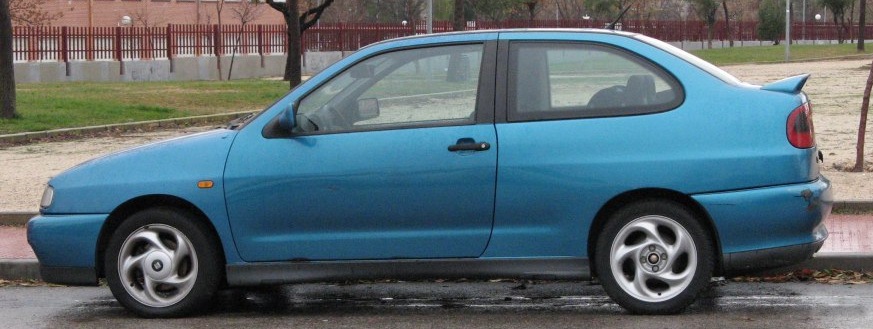
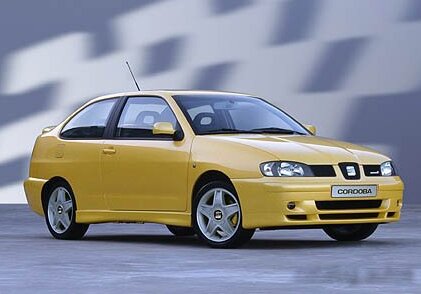
The Seat Cordoba Coupe I (facelift 1999) 1.4 16V, produced from September 1999 through August 2002, served as the entry point into the Cordoba Coupe range. Built on the Volkswagen Group’s 1HX0/A3 platform – shared with the Volkswagen Golf, Bora, and Audi A3 – it was designed to offer a stylish coupe experience at a more accessible price point. This variant targeted buyers who prioritized fuel efficiency and affordability over outright performance, providing a compelling alternative to the more powerful engine options available in the Cordoba lineup.
Powertrain & Engine Architecture
The Cordoba 1.4 16V was powered by the Volkswagen Group’s APE engine, a 1.390-liter inline-four cylinder gasoline engine. This engine employed a single overhead camshaft (OHC) design, actuating four valves per cylinder. Fuel delivery was handled by a multi-port fuel injection system, balancing efficiency with reasonable performance. The engine’s 10.5:1 compression ratio contributed to its modest power output. The engine was mounted transversely, driving the front wheels. A five-speed manual transmission was standard, featuring gear ratios optimized for fuel economy. The transmission’s taller gearing aimed to keep engine speeds low during cruising, enhancing efficiency, but requiring downshifts for quicker acceleration. The APE engine, while not known for its high output, was valued for its reliability and relatively simple design.
Driving Characteristics
The 1.4 16V Cordoba Coupe delivered a practical, though not particularly sporty, driving experience. Generating 75 horsepower and 94 lb-ft of torque, acceleration was sufficient for everyday commuting, but overtaking required planning. The 0-60 mph time of approximately 12.3 seconds and a top speed of 105.63 mph reflected this. Compared to the 1.8-liter and 2.0-liter versions, the 1.4 felt noticeably slower. However, the lighter engine weight contributed to a more balanced handling feel. The five-speed manual transmission was precise and easy to operate. The long gearing kept engine speeds low at highway speeds, promoting fuel economy, but also necessitated downshifts when quicker acceleration was needed. The suspension, tuned for comfort, provided a relatively smooth ride, though it didn’t offer the same level of control as the sportier trims.
Equipment & Trim Levels
The 1.4 16V Cordoba Coupe typically came equipped with a fairly basic set of features, consistent with its entry-level positioning. Standard equipment generally included power steering, central locking, and an AM/FM radio. Interior upholstery was typically cloth, and the dashboard featured a simple, functional layout. Optional extras included air conditioning, alloy wheels, and an upgraded audio system. The trim level was often simply designated as the base “Cordoba” model, with additional features available as individual options. Interior plastics were durable but lacked the premium feel found in higher-specification models. The focus was on providing essential features at an affordable price.
Chassis & Braking
The Cordoba Coupe’s chassis utilized a MacPherson strut front suspension and a torsion beam rear suspension. This configuration offered a reasonable balance between ride comfort and handling. The front brakes were ventilated discs, while the rear brakes were drums. ABS (Anti-lock Braking System) was standard, enhancing braking safety. The suspension was tuned for comfort, resulting in a relatively soft ride quality. Stabilizer bars were present, but were thinner compared to those found on higher-performance models, leading to slightly more pronounced body roll during cornering. The braking system, while adequate for the car’s performance, wasn’t designed for aggressive driving.
Market Reception & Comparison
The 1.4 16V Cordoba Coupe was generally well-received as an affordable and practical coupe option. Critics praised its fuel efficiency – around 36.8 US mpg combined – and reasonable running costs, but acknowledged its lack of significant performance. Compared to the 1.8-liter and 2.0-liter variants, the 1.4 offered lower fuel consumption but considerably less power. It was often considered a good choice for young drivers or those seeking a stylish and economical coupe for daily commuting. Its reliability was generally considered good, typical of Volkswagen Group products of the era. The 1.4 offered a compelling value proposition for buyers prioritizing practicality and affordability.
Legacy
The Seat Cordoba Coupe 1.4 16V, while not a performance icon, remains a relatively common sight on European roads today. The APE engine is known for its durability, and with regular maintenance, it can provide many years of reliable service. In the used car market, these models are typically very affordable, making them an attractive option for budget-conscious buyers. Parts availability is generally good, thanks to the widespread use of the APE engine in other Volkswagen Group vehicles. While not highly sought after by collectors, the 1.4 16V Cordoba Coupe represents a practical and stylish entry point into the world of classic coupes, offering a blend of affordability, reliability, and distinctive styling.