
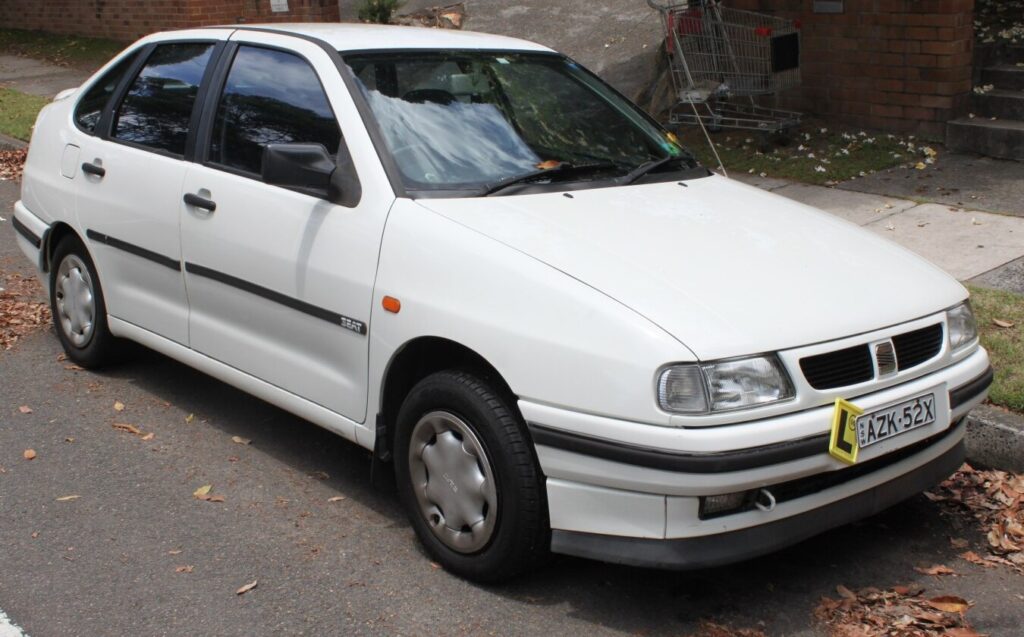
The SEAT Córdoba I 1.9 D, produced between September 1993 and June 1999, represented an entry-level offering within the first generation of the Córdoba range (1993-1999). Positioned as a practical and economical sedan, it was primarily aimed at the European market, offering a diesel-powered alternative to the gasoline variants. The Córdoba itself was SEAT’s replacement for the aging SEAT Tempo, and was based on the Volkswagen Polo Mk3 platform (1HX0/A3), benefiting from shared components and engineering. This 1.9 D variant, with its modest 64 horsepower, served as the base model, prioritizing fuel efficiency and affordability over outright performance.
Technical Specifications
| Brand | Seat |
| Model | Cordoba |
| Generation | Cordoba I |
| Type (Engine) | 1.9 D (64 Hp) |
| Start of production | September, 1993 |
| End of production | June, 1999 |
| Powertrain Architecture | Internal Combustion engine |
| Body type | Sedan |
| Seats | 5 |
| Doors | 4 |
| Fuel consumption (urban) | 7.9 l/100 km (29.8 US mpg, 35.8 UK mpg, 12.7 km/l) |
| Fuel consumption (extra urban) | 4.6 l/100 km (51.1 US mpg, 61.4 UK mpg, 21.7 km/l) |
| Fuel consumption (combined) | 5.5 l/100 km (42.8 US mpg, 51.4 UK mpg, 18.2 km/l) |
| Fuel Type | Diesel |
| Acceleration 0 – 100 km/h | 17.1 sec |
| Acceleration 0 – 62 mph | 17.1 sec |
| Acceleration 0 – 60 mph | 16.2 sec |
| Maximum speed | 157 km/h (97.56 mph) |
| Weight-to-power ratio | 16.4 kg/Hp, 61 Hp/tonne |
| Weight-to-torque ratio | 8.5 kg/Nm, 118.1 Nm/tonne |
| Power | 64 Hp @ 4400 rpm |
| Power per litre | 33.8 Hp/l |
| Torque | 124 Nm @ 2000 rpm (91.46 lb.-ft. @ 2000 rpm) |
| Engine layout | Front, Transverse |
| Engine Model/Code | 1Y |
| Engine displacement | 1896 cm3 (115.7 cu. in.) |
| Number of cylinders | 4 |
| Engine configuration | Inline |
| Cylinder Bore | 79.5 mm (3.13 in.) |
| Piston Stroke | 95.5 mm (3.76 in.) |
| Compression ratio | 22.5:1 |
| Number of valves per cylinder | 2 |
| Fuel injection system | Precombustion chamber injection |
| Engine aspiration | Naturally aspirated engine |
| Valvetrain | OHC |
| Engine oil capacity | 4.5 l (4.76 US qt | 3.96 UK qt) |
| Coolant | 6.6 l (6.97 US qt | 5.81 UK qt) |
| Kerb Weight | 1050 kg (2314.85 lbs.) |
| Max. weight | 1510 kg (3328.98 lbs.) |
| Max load | 460 kg (1014.13 lbs.) |
| Trunk (boot) space – minimum | 455 l (16.07 cu. ft.) |
| Trunk (boot) space – maximum | 762 l (26.91 cu. ft.) |
| Fuel tank capacity | 52 l (13.74 US gal | 11.44 UK gal) |
| Length | 4144 mm (163.15 in.) |
| Width | 1640 mm (64.57 in.) |
| Height | 1424 mm (56.06 in.) |
| Wheelbase | 2443 mm (96.18 in.) |
| Front track | 1430 mm (56.3 in.) |
| Rear (Back) track | 1394 mm (54.88 in.) |
| Drivetrain Architecture | The Internal combustion engine (ICE) drives the front wheels of the vehicle. |
| Drive wheel | Front wheel drive |
| Number of gears and type of gearbox | 5 gears, manual transmission |
| Front suspension | Wishbone |
| Rear suspension | Suspension with traction connecting levers |
| Front brakes | Disc |
| Rear brakes | Disc |
| Assisting systems | ABS (Anti-lock braking system) |
| Steering type | Steering rack and pinion |
| Power steering | Hydraulic Steering |
| Tires size | 175/70 R13; 185/60 R14 |
Powertrain & Engine Architecture
The Córdoba 1.9 D was powered by the Volkswagen Group’s 1Y engine, a 1.9-liter inline-four diesel engine. This engine was a workhorse, known for its durability and fuel efficiency, rather than its performance. It utilized a precombustion chamber injection system, a common technology for diesel engines of the era. This system involved injecting fuel into a precombustion chamber, where it partially ignited before entering the main combustion chamber, aiding in more complete combustion and reducing emissions. The engine featured an overhead camshaft (OHC) valvetrain with two valves per cylinder. The 1Y engine produced 64 horsepower at 4400 rpm and 124 Nm (91.46 lb-ft) of torque at 2000 rpm. The engine was transversely mounted, driving the front wheels. The standard transmission was a five-speed manual gearbox, optimized for fuel economy and providing adequate, though not sporty, acceleration.
Driving Characteristics
The driving experience in the Córdoba 1.9 D was characterized by its practicality and economy. Acceleration was slow, taking approximately 17.1 seconds to reach 62 mph (100 km/h). The engine’s torque delivery was relatively flat, providing usable power at lower engine speeds, making it suitable for everyday driving and city commutes. The five-speed manual transmission allowed drivers to optimize fuel efficiency and maintain comfortable cruising speeds on the highway. Compared to the more powerful gasoline variants, such as the 1.6 or 2.0-liter engines, the 1.9 D lacked responsiveness and overall performance. However, it offered significantly better fuel economy, making it a popular choice for drivers prioritizing cost-effectiveness.
Equipment & Trim Levels
The 1.9 D Córdoba typically came with a basic level of equipment, reflecting its position as the entry-level model. Standard features generally included power steering, central locking, and basic instrumentation. Interior upholstery was typically cloth, and the dashboard featured a functional, if somewhat spartan, design. Optional extras included air conditioning, power windows, and an upgraded audio system. Higher trim levels, such as the Stella or GLX, offered more luxurious features, but the 1.9 D remained the most affordable option.
Chassis & Braking
The Córdoba I utilized a relatively simple chassis design. Front suspension consisted of wishbones, while the rear suspension employed a torsion beam setup with traction connecting levers. This configuration provided a comfortable ride, but didn’t offer particularly sporty handling. Braking was initially equipped with disc brakes on all four wheels, although some earlier models may have featured drum brakes on the rear. An Anti-lock Braking System (ABS) was available as an option, enhancing safety and control during emergency braking situations. The steering was a rack and pinion system with hydraulic power assistance, providing reasonable steering feel and maneuverability.
Market Reception & Comparison
The SEAT Córdoba 1.9 D was well-received in the European market as a practical and affordable family car. Critics praised its fuel efficiency and durability, but noted its lack of performance. Compared to other diesel-powered vehicles in its class, such as the Peugeot 306 HDi or the Renault 19 dTi, the Córdoba 1.9 D offered a competitive fuel economy and a reasonable price point. However, it often lagged behind in terms of refinement and overall driving experience. Within the Córdoba lineup, the 1.9 D served as a budget-friendly alternative to the more powerful and better-equipped gasoline models.
Legacy
The 1.9 D engine, in its various iterations, proved to be remarkably durable and reliable. Córdoba 1.9 D models, even with high mileage, can still be found on the road today, a testament to the engine’s robust construction. In the used car market, these vehicles are often sought after by those looking for an inexpensive and dependable mode of transportation. While not a performance icon, the Córdoba 1.9 D holds a place in automotive history as a practical and economical car that served the needs of many European drivers during the 1990s. Maintenance is generally straightforward, with parts readily available and relatively inexpensive, contributing to its continued viability as a budget-friendly option.