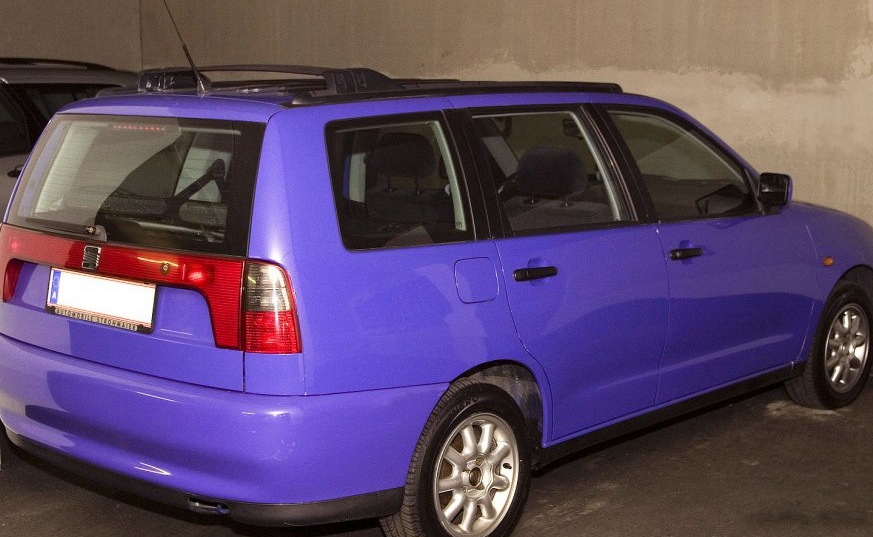
The SEAT Córdoba Vario I 1.4 i, produced between August 1996 and June 1999, represents a practical and affordable entry point into the compact estate car segment. Part of the SEAT Córdoba Mk1 (6K) series, the Vario I – denoting the estate body style – aimed to provide increased cargo capacity and versatility compared to the hatchback version. This particular variant, powered by the 1.4-liter inline-four engine producing 60 horsepower, was positioned as the base model within the Vario range, prioritizing fuel economy and low running costs over outright performance. It was primarily marketed in Europe, where the demand for small, economical station wagons was significant.
Technical Specifications
| Brand | Seat |
| Model | Cordoba |
| Generation | Cordoba Vario I |
| Type (Engine) | 1.4 i (60 Hp) |
| Start of production | August, 1996 |
| End of production | June, 1999 |
| Powertrain Architecture | Internal Combustion engine |
| Body type | Station wagon (estate) |
| Seats | 5 |
| Doors | 5 |
| Fuel consumption (urban) | 9 l/100 km (26.1 US mpg, 31.4 UK mpg, 11.1 km/l) |
| Fuel consumption (extra urban) | 5.7 l/100 km (41.3 US mpg, 49.6 UK mpg, 17.5 km/l) |
| Fuel Type | Petrol (Gasoline) |
| Acceleration 0 – 100 km/h | 16 sec |
| Acceleration 0 – 62 mph | 16 sec |
| Acceleration 0 – 60 mph | 15.2 sec |
| Maximum speed | 155 km/h (96.31 mph) |
| Weight-to-power ratio | 17 kg/Hp, 58.8 Hp/tonne |
| Weight-to-torque ratio | 8.8 kg/Nm, 113.7 Nm/tonne |
| Power | 60 Hp @ 4700 rpm |
| Power per litre | 43.2 Hp/l |
| Torque | 116 Nm @ 3000 rpm (85.56 lb.-ft. @ 3000 rpm) |
| Engine layout | Front, Transverse |
| Engine Model/Code | AEX, APQ |
| Engine displacement | 1390 cm3 (84.82 cu. in.) |
| Number of cylinders | 4 |
| Engine configuration | Inline |
| Cylinder Bore | 76.5 mm (3.01 in.) |
| Piston Stroke | 75.6 mm (2.98 in.) |
| Compression ratio | 10.7:1 |
| Number of valves per cylinder | 2 |
| Fuel injection system | Multi-port manifold injection |
| Engine aspiration | Naturally aspirated engine |
| Valvetrain | OHC |
| Engine oil capacity | 3.4 l (3.59 US qt | 2.99 UK qt) |
| Coolant | 5.5 l (5.81 US qt | 4.84 UK qt) |
| Kerb Weight | 1020 kg (2248.72 lbs.) |
| Max. weight | 1480 kg (3262.84 lbs.) |
| Max load | 460 kg (1014.13 lbs.) |
| Trunk (boot) space – minimum | 350 l (12.36 cu. ft.) |
| Trunk (boot) space – maximum | 1250 l (44.14 cu. ft.) |
| Fuel tank capacity | 45 l (11.89 US gal | 9.9 UK gal) |
| Length | 4163 mm (163.9 in.) |
| Width | 1640 mm (64.57 in.) |
| Height | 1433 mm (56.42 in.) |
| Wheelbase | 2443 mm (96.18 in.) |
| Front track | 1429 mm (56.26 in.) |
| Rear (Back) track | 1394 mm (54.88 in.) |
| Drivetrain Architecture | The Internal combustion engine (ICE) drives the front wheels of the vehicle. |
| Drive wheel | Front wheel drive |
| Number of gears and type of gearbox | 5 gears, manual transmission |
| Front suspension | Spring Strut |
| Rear suspension | Suspension with traction connecting levers |
| Front brakes | Ventilated discs |
| Rear brakes | Drum |
| Steering type | Steering rack and pinion |
| Power steering | Hydraulic Steering |
| Tires size | 175/70 R13 |
| Wheel rims size | 13 |
Powertrain & Engine Architecture
The Córdoba Vario I 1.4 i utilized either the AEX or APQ engine code, both representing variations of the Volkswagen EA827 series. This 1.4-liter inline-four engine featured a single overhead camshaft (OHC) operating two valves per cylinder. Fuel delivery was managed by a multi-port fuel injection system, a common setup for engines of this era, providing a balance between efficiency and performance. The engine’s relatively low compression ratio of 10.7:1 contributed to its ability to run on lower octane fuels, a consideration for many European markets. The engine produced 60 horsepower at 4700 rpm and 116 Nm (85.56 lb-ft) of torque at 3000 rpm. The engine was transversely mounted, driving the front wheels. The standard transmission was a five-speed manual gearbox, designed for durability and ease of use. While an automatic transmission was offered on other Córdoba variants, it was not typically paired with the base 1.4-liter engine.
Driving Characteristics
The 1.4-liter engine in the Córdoba Vario I provided adequate, but not exhilarating, performance. Acceleration from 0 to 100 km/h (0-62 mph) took approximately 16 seconds, and top speed was limited to 155 km/h (96.31 mph). The five-speed manual transmission allowed drivers to keep the engine in its optimal power band, but the limited horsepower meant that overtaking maneuvers required careful planning. Compared to the more powerful 1.6 and 2.0-liter versions of the Córdoba, the 1.4 felt noticeably slower, particularly when fully loaded. However, the lighter weight of the 1.4-liter engine contributed to improved fuel economy and a more nimble feel in city driving. The gear ratios were fairly standard for the time, prioritizing fuel efficiency over rapid acceleration.
Equipment & Trim Levels
The Córdoba Vario I 1.4 i was typically equipped with basic, but functional, features. Standard equipment included power steering, central locking, and front electric windows. Interior upholstery was typically cloth, with a simple dashboard layout. Optional extras included air conditioning, alloy wheels, and a radio/cassette player. The trim level was generally considered entry-level, focusing on providing a practical and affordable estate car. Higher trim levels, available with the larger engines, offered more luxurious features such as upgraded upholstery, rear electric windows, and a sunroof.
Chassis & Braking
The Córdoba Vario I featured a MacPherson strut front suspension and a torsion beam rear suspension. The front brakes were ventilated discs, providing adequate stopping power, while the rear brakes were drums, a cost-saving measure common in this segment. The suspension setup was tuned for comfort rather than sporty handling, providing a relatively smooth ride on most road surfaces. The steering was hydraulic power-assisted, making it easy to maneuver at low speeds. The car rode on 175/70 R13 tires, mounted on 13-inch steel wheels.
Market Reception & Comparison
The Córdoba Vario I 1.4 i was generally well-received as a practical and affordable estate car. Critics praised its spacious interior and generous cargo capacity. However, the 1.4-liter engine was often criticized for its lack of power, particularly when compared to the larger engine options. Fuel economy was a strong point, making it an attractive option for budget-conscious buyers. Compared to rivals such as the Renault Clio Estate and Peugeot 205 Estate, the Córdoba Vario I offered a competitive level of equipment and practicality at a similar price point. The 1.6-liter version offered a noticeable performance improvement, but at a higher cost.
Legacy
The SEAT Córdoba Vario I 1.4 i, while not a performance icon, remains a relatively reliable and affordable used car. The EA827 engine is known for its durability, although regular maintenance is essential to prevent issues such as oil leaks and timing chain wear. Parts availability is generally good, and the car’s simple mechanical design makes it relatively easy to repair. Today, these cars are often sought after by those looking for a practical and economical classic estate car, or as a first car for a young driver. The Vario I represents a significant step in SEAT’s development as a brand, demonstrating its ability to produce competitive and well-rounded vehicles for the European market.