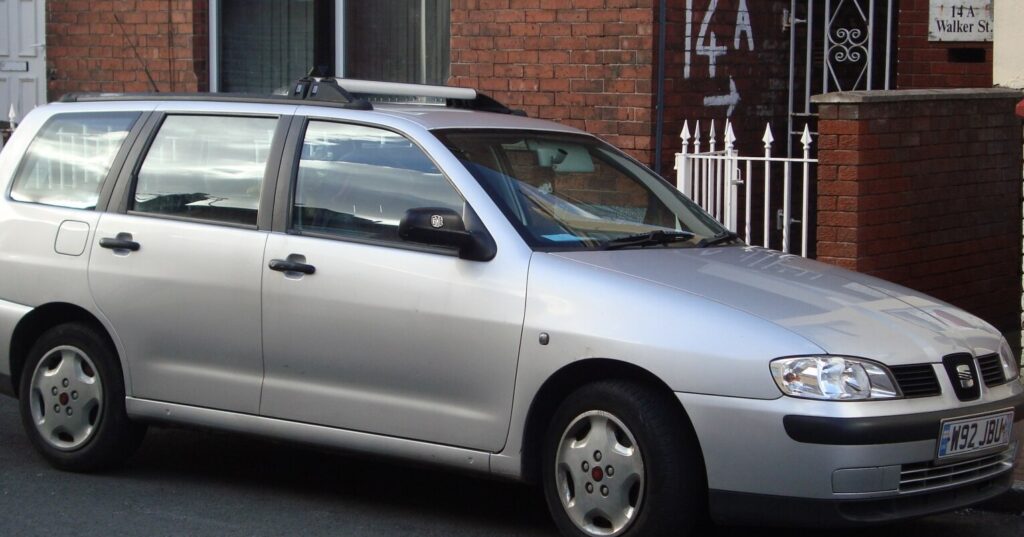
The Seat Cordoba Vario I (facelifted in 1999) 1.4 16V, producing 75 horsepower, was a practical and affordable station wagon aimed at the European market. Introduced in September 1999 and continuing through August 2002, this variant occupied the lower-mid range of the Cordoba Vario I lineup, positioned as an entry point for buyers seeking the versatility of a wagon without the expense of higher-performance engines. It was built on the Volkswagen Group’s 1HX0/A3 platform, shared with models like the Volkswagen Golf, Bora, and Skoda Octavia, providing a solid foundation for a family-oriented vehicle.
Technical Specifications
| Brand | Seat |
| Model | Cordoba |
| Generation | Cordoba Vario I (facelift 1999) |
| Type (Engine) | 1.4 16V (75 Hp) |
| Start of production | September, 1999 |
| End of production | August, 2002 |
| Powertrain Architecture | Internal Combustion engine |
| Body type | Station wagon (estate) |
| Seats | 5 |
| Doors | 5 |
| Fuel consumption (urban) | 8.4 l/100 km (28 US mpg, 33.6 UK mpg, 11.9 km/l) |
| Fuel consumption (extra urban) | 5.4 l/100 km (43.6 US mpg, 52.3 UK mpg, 18.5 km/l) |
| Fuel Type | Petrol (Gasoline) |
| Acceleration 0 – 100 km/h | 13.2 sec |
| Acceleration 0 – 62 mph | 13.2 sec |
| Acceleration 0 – 60 mph | 12.5 sec |
| Maximum speed | 167 km/h (103.77 mph) |
| Weight-to-power ratio | 14.1 kg/Hp, 71.1 Hp/tonne |
| Weight-to-torque ratio | 8.2 kg/Nm, 121.3 Nm/tonne |
| Power | 75 Hp @ 5000 rpm |
| Power per litre | 54 Hp/l |
| Torque | 128 Nm @ 3300 rpm (94.41 lb.-ft. @ 3300 rpm) |
| Engine layout | Front, Transverse |
| Engine Model/Code | APE |
| Engine displacement | 1390 cm3 (84.82 cu. in.) |
| Number of cylinders | 4 |
| Engine configuration | Inline |
| Cylinder Bore | 76.5 mm (3.01 in.) |
| Piston Stroke | 75.6 mm (2.98 in.) |
| Compression ratio | 10.5:1 |
| Number of valves per cylinder | 4 |
| Fuel injection system | Multi-port manifold injection |
| Engine aspiration | Naturally aspirated engine |
| Valvetrain | OHC |
| Engine oil capacity | 3.2 l (3.38 US qt, 2.82 UK qt) |
| Coolant | 6 l (6.34 US qt, 5.28 UK qt) |
| Kerb Weight | 1055 kg (2325.88 lbs.) |
| Max. weight | 1515 kg (3340 lbs.) |
| Max load | 460 kg (1014.13 lbs.) |
| Trunk (boot) space – minimum | 350 l (12.36 cu. ft.) |
| Trunk (boot) space – maximum | 1250 l (44.14 cu. ft.) |
| Fuel tank capacity | 45 l (11.89 US gal, 9.9 UK gal) |
| Length | 4163 mm (163.9 in.) |
| Width | 1640 mm (64.57 in.) |
| Height | 1433 mm (56.42 in.) |
| Wheelbase | 2443 mm (96.18 in.) |
| Front track | 1429 mm (56.26 in.) |
| Rear (Back) track | 1394 mm (54.88 in.) |
| Drivetrain Architecture | The Internal combustion engine (ICE) drives the front wheels of the vehicle. |
| Drive wheel | Front wheel drive |
| Number of gears and type of gearbox | 5 gears, manual transmission |
| Front suspension | Spring Strut |
| Rear suspension | Suspension with traction connecting levers |
| Front brakes | Disc |
| Rear brakes | Drum |
| Assisting systems | ABS (Anti-lock braking system) |
| Steering type | Steering rack and pinion |
| Power steering | Hydraulic Steering |
| Tires size | 175/70 R13 |
Powertrain & Engine Architecture
The Cordoba Vario I 1.4 16V utilized the APE engine code, a 1.4-liter inline-four cylinder gasoline engine. This engine was a common sight in various Volkswagen Group vehicles of the era. It featured a single overhead camshaft (OHC) design operating four valves per cylinder, contributing to its relatively efficient breathing. Fuel delivery was handled by a multi-port fuel injection system, providing precise fuel metering for improved combustion and reduced emissions. The engine’s 1390cc displacement produced 75 horsepower at 5000 rpm and 128 Nm (94.41 lb-ft) of torque at 3300 rpm. The engine was transversely mounted, driving the front wheels. The standard transmission was a five-speed manual gearbox, although a four-speed automatic transmission was also available, albeit less common. The automatic transmission, while offering convenience, did impact acceleration and fuel economy compared to the manual version.
Driving Characteristics
The 1.4 16V engine in the Cordoba Vario I provided adequate, but not exhilarating, performance. Acceleration from 0-100 km/h (0-62 mph) took around 13.2 seconds, and top speed was approximately 167 km/h (103.77 mph). The automatic transmission, while smooth, resulted in noticeable power loss and slower gear changes compared to the manual counterpart. The engine felt most comfortable in the mid-range, offering sufficient power for everyday driving and highway cruising. However, overtaking maneuvers required careful planning. The gear ratios in the automatic transmission were geared towards fuel efficiency rather than outright performance. The suspension, tuned for comfort, provided a reasonably smooth ride, but handling was not particularly sporty.
Equipment & Trim Levels
The Cordoba Vario I 1.4 16V typically came with a modest level of standard equipment. This included power steering, central locking, electric front windows, and an adjustable steering column. Interior upholstery was typically cloth, with a functional, if somewhat basic, dashboard layout. Optional extras included air conditioning, alloy wheels, a radio/cassette player, and upgraded interior trim. Higher trim levels, such as the Stella or Sport, added features like electric mirrors, a sunroof, and more luxurious interior appointments. The 1.4 16V served as a base model, allowing buyers to customize their vehicle with optional packages.
Chassis & Braking
The Cordoba Vario I featured a MacPherson strut front suspension and a torsion beam rear suspension. This setup provided a good balance between ride comfort and handling. The front brakes were ventilated discs, while the rear brakes were drums. ABS (Anti-lock Braking System) was standard, enhancing safety by preventing wheel lockup during hard braking. The chassis was relatively lightweight, contributing to the car’s fuel efficiency. Stabilizer bars were present, but were relatively thin compared to those found on higher-performance models.
Market Reception & Comparison
The Cordoba Vario I 1.4 16V was generally well-received as a practical and affordable family car. Critics praised its spacious interior, large cargo area, and reasonable fuel economy. However, the engine was often criticized for being underpowered, particularly when paired with the automatic transmission. Compared to the more powerful 1.8-liter and 2.0-liter versions, the 1.4 16V offered significantly less performance. The 1.9 TDI diesel variant provided superior fuel economy and torque, but at a higher purchase price. The 1.4 16V appealed to buyers prioritizing affordability and practicality over outright performance.
Legacy
The Seat Cordoba Vario I 1.4 16V, while not a particularly exciting vehicle, proved to be a reliable and durable workhorse. The APE engine, when properly maintained, is known for its longevity. Today, these cars are relatively affordable on the used market, making them attractive options for budget-conscious buyers. However, potential buyers should be aware of potential issues such as corrosion and wear and tear on suspension components. The automatic transmission, while convenient, may require more frequent servicing than the manual version. Overall, the Cordoba Vario I 1.4 16V represents a solid, if unspectacular, example of a late-1990s European station wagon.