
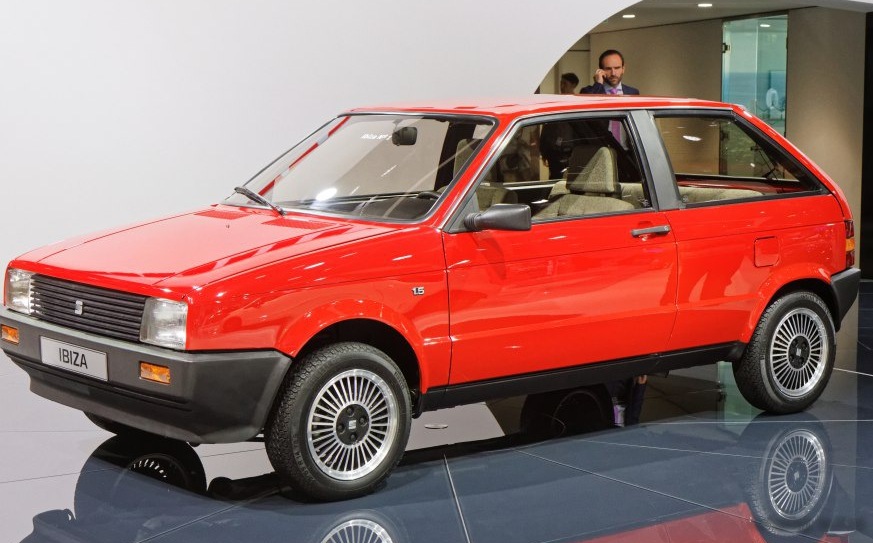
The Seat Ibiza I 1.5 i (90 hp) was a popular subcompact hatchback produced between 1986 and 1991, representing the first generation of the Ibiza model. Launched as part of the Volkswagen Group’s strategy to offer a modern, affordable hatchback, the Ibiza I was based on the Volkswagen Polo Mk2 platform (1HX0/A3). The 1.5 i 90 hp variant occupied a middle ground in the Ibiza lineup, offering a balance between affordability and performance, positioned above the base 70 hp models and below the more powerful 1.6-liter versions. It was aimed at buyers seeking a practical, economical, and reasonably well-equipped small car for daily commuting and family use.
Powertrain & Engine Architecture
The heart of the Seat Ibiza I 1.5 i (90 hp) was the 021B2 engine, a 1.5-liter inline four-cylinder gasoline engine. This engine was a naturally aspirated unit, meaning it did not utilize a turbocharger or supercharger. It featured a single overhead camshaft (SOHC) valvetrain with two valves per cylinder. Fuel delivery was managed by a carburetor, a common feature for vehicles of this era, though later iterations of the Ibiza I would transition to fuel injection. The engine produced 90 horsepower at 6000 rpm and 120 Nm (88.51 lb-ft) of torque at 4000 rpm. The engine’s bore and stroke measured 83 mm (3.27 in) and 67.5 mm (2.66 in) respectively, resulting in a displacement of 1461 cm³ (89.16 cu. in) and a compression ratio of 10.5:1.
While a five-speed manual transmission was the most common pairing for this engine, the focus of this article is the variant equipped with a three-speed automatic transmission. This automatic was a relatively simple hydraulic unit, designed for smooth, if not particularly sporty, operation. It featured standard torque converter technology and lacked the electronic controls found in more modern automatic gearboxes. The automatic transmission was geared towards comfort and ease of use, prioritizing smooth shifts over rapid acceleration.
Engine Oil and Coolant
The 021B2 engine required approximately 4 liters (4.23 US qt | 3.52 UK qt) of engine oil and 7.5 liters (7.93 US qt | 6.6 UK qt) of coolant to maintain optimal operating conditions. Regular oil changes and coolant flushes were crucial for ensuring the longevity of this engine.
Driving Characteristics
The Seat Ibiza I 1.5 i (90 hp) with the automatic transmission offered a comfortable, but not exhilarating, driving experience. Acceleration from 0 to 100 km/h (0-62 mph) took approximately 12.3 seconds, while 0-60 mph was achieved in around 11.7 seconds. The top speed was rated at 175 km/h (108.74 mph). The automatic transmission’s gear ratios were optimized for fuel efficiency and smooth cruising, rather than aggressive acceleration. Compared to the five-speed manual version, the automatic suffered a slight performance penalty due to the inherent power losses within the torque converter and the less-than-optimal gear ratios for maximizing acceleration. The automatic transmission did, however, make the Ibiza I more accessible to drivers unfamiliar or uncomfortable with manual gearboxes.
Handling was typical for a front-wheel-drive hatchback of the era. The suspension, consisting of spring struts at both the front and rear, provided a reasonably comfortable ride, but body roll was noticeable during cornering. The steering, a rack and pinion system, was light and easy to use, making it well-suited for urban driving.
Equipment & Trim Levels
The Seat Ibiza I 1.5 i (90 hp) automatic typically came with a base level of equipment, reflecting its position as a mainstream model. Standard features generally included cloth upholstery, a basic instrument cluster, and manually adjustable windows and door locks. Optional extras, depending on the market and year, could include a sunroof, upgraded stereo system, and central locking. Interior trim levels varied, with some models featuring more durable or aesthetically pleasing materials. The dashboard layout was functional and straightforward, prioritizing usability over stylistic flair.
Chassis & Braking
The chassis of the Seat Ibiza I was a monocoque construction, providing a good balance of strength and weight. The front suspension utilized spring struts, while the rear suspension also employed spring struts. The front brakes were disc brakes, offering better stopping power than the drum brakes found on the rear wheels. The 165/65 SR14 tires provided adequate grip for everyday driving conditions. The Ibiza I did not typically feature ABS (Anti-lock braking system) as standard equipment, although it may have been offered as an optional extra in some markets.
Market Reception & Comparison
The Seat Ibiza I 1.5 i (90 hp) automatic was generally well-received by automotive critics as a practical and affordable small car. It was praised for its fuel economy – approximately 6.4 l/100 km (36.8 US mpg, 44.1 UK mpg) combined – and its comfortable ride. However, the automatic transmission was sometimes criticized for its sluggish performance compared to the manual gearbox. Compared to other trims in the Ibiza lineup, the 1.5 i automatic offered a compromise between the base 70 hp models and the more powerful 1.6-liter versions. The 1.6-liter models provided noticeably more performance, but at a higher price point. The 1.9 TDI diesel versions, introduced later in the Ibiza I’s production run, offered superior fuel economy but lacked the refinement of the gasoline engines.
Technical Specifications
| Brand | Seat |
| Model | Ibiza |
| Generation | Ibiza I |
| Type (Engine) | 1.5 i (90 Hp) |
| Start of production | 1986 |
| End of production | 1991 |
| Body type | Hatchback |
| Seats | 5 |
| Doors | 3-5 |
| Fuel consumption (urban) | 8.8 l/100 km (26.7 US mpg, 32.1 UK mpg) |
| Fuel consumption (extra urban) | 4.8 l/100 km (49 US mpg, 58.9 UK mpg) |
| Fuel consumption (combined) | 6.4 l/100 km (36.8 US mpg, 44.1 UK mpg) |
| Fuel Type | Petrol (Gasoline) |
| Acceleration 0 – 100 km/h | 12.3 sec |
| Acceleration 0 – 62 mph | 12.3 sec |
| Acceleration 0 – 60 mph | 11.7 sec |
| Maximum speed | 175 km/h (108.74 mph) |
| Weight-to-power ratio | 10.2 kg/Hp |
| Weight-to-torque ratio | 7.6 kg/Nm |
| Power | 90 Hp @ 6000 rpm |
| Torque | 120 Nm @ 4000 rpm (88.51 lb.-ft. @ 4000 rpm) |
| Engine layout | Front, Transverse |
| Engine Model/Code | 021B2 |
| Engine displacement | 1461 cm3 (89.16 cu. in.) |
| Number of cylinders | 4 |
| Engine configuration | Inline |
| Cylinder Bore | 83 mm (3.27 in.) |
| Piston Stroke | 67.5 mm (2.66 in.) |
| Compression ratio | 10.5:1 |
| Number of valves per cylinder | 2 |
| Fuel injection system | Carburettor |
| Engine oil capacity | 4 l (4.23 US qt | 3.52 UK qt) |
| Coolant | 7.5 l (7.93 US qt | 6.6 UK qt) |
| Kerb Weight | 915 kg (2017.23 lbs.) |
| Max. weight | 1450 kg (3196.7 lbs.) |
| Trunk (boot) space – minimum | 320 l (11.3 cu. ft.) |
| Trunk (boot) space – maximum | 1200 l (42.38 cu. ft.) |
| Fuel tank capacity | 50 l (13.21 US gal | 11 UK gal) |
| Length | 3685 mm (145.08 in.) |
| Width | 1610 mm (63.39 in.) |
| Height | 1410 mm (55.51 in.) |
| Wheelbase | 2445 mm (96.26 in.) |
| Tires size | 165/65 SR14 |
Legacy
The Seat Ibiza I 1.5 i (90 hp) automatic, while not a performance icon, remains a fondly remembered vehicle for many. The 021B2 engine, when properly maintained, proved to be relatively reliable. However, like all carbureted engines, it required regular tuning and attention to ensure optimal performance. The automatic transmission, while simple, was generally durable, but could be prone to wear and tear over time. Today, these Ibizas are becoming increasingly rare and sought after by classic car enthusiasts. Their affordability, simplicity, and nostalgic appeal make them attractive options for those seeking a taste of 1980s motoring. Finding well-maintained examples can be challenging, and parts availability may be limited, but the Seat Ibiza I 1.5 i (90 hp) continues to hold a place in automotive history as a significant early offering from the Spanish automaker.
