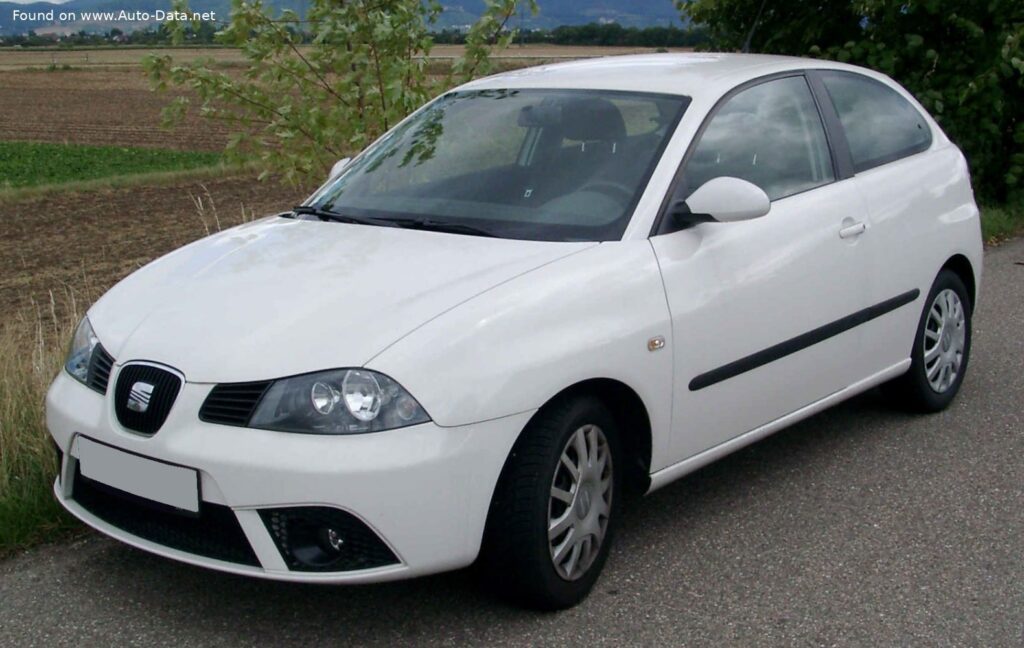
The Seat Ibiza III (facelift, introduced in 2006) 1.2, producing 60 horsepower, represented the entry point into the third-generation Ibiza range. Production of this specific variant ran from June 2007 to August 2008. Positioned as an affordable and economical option, it catered to buyers prioritizing fuel efficiency and low running costs over outright performance. This model was based on the Volkswagen Group’s PQ24 platform, also known as the 1HX0/A3 platform, shared with the Volkswagen Polo and Škoda Fabia. The 1.2-liter engine and five-speed manual transmission combination aimed to provide a practical and accessible vehicle for urban commuting and first-time car buyers.
The 1.2L BBM Engine and Powertrain
The heart of the Ibiza 1.2 was the BBM engine code, a 1.2-liter inline three-cylinder petrol engine. This engine was a key component of Volkswagen Group’s efforts to offer smaller, more fuel-efficient engines in their compact car lineup. The BBM featured multi-port fuel injection, a relatively simple system for its time, delivering fuel directly into the intake ports. The engine utilized a single overhead camshaft (SOHC) operating two valves per cylinder. This configuration contributed to its simplicity and reduced manufacturing costs. The engine’s 10.8:1 compression ratio was a compromise between efficiency and the need to run on readily available fuel grades.
The engine’s modest 60 hp output at 5200 rpm and 79.66 lb-ft of torque at 3000 rpm were delivered through a five-speed manual transmission. This transmission was a standard unit across several Volkswagen Group models, known for its durability and relatively smooth operation. The gearbox ratios were geared towards maximizing fuel economy rather than providing rapid acceleration. The front-wheel-drive configuration was standard for this model, contributing to its relatively light weight and predictable handling.
Engine Specifications in Detail
The BBM engine’s design prioritized compactness and light weight. It featured a cast iron block and an aluminum cylinder head. The bore and stroke measured 76.5 mm (3.01 in) and 86.9 mm (3.42 in) respectively, resulting in a total displacement of 1198 cm³ (73.11 cu. in). Engine oil capacity was 2.8 liters (2.96 US qt / 2.46 UK qt), and the recommended oil specification was determined by Volkswagen Group standards. The cooling system required 5.6 liters (5.92 US qt / 4.93 UK qt) of coolant.
Driving Characteristics
The Seat Ibiza 1.2’s driving experience was defined by its economy-focused nature. Acceleration was leisurely, taking 17.5 seconds to reach 62 mph (100 km/h) and approximately 16.6 seconds to reach 60 mph. The engine felt strained at higher speeds, and overtaking required careful planning. The five-speed manual transmission, while functional, didn’t offer particularly short ratios, further emphasizing the engine’s focus on fuel efficiency. The power delivery was relatively linear, but the limited torque meant that the engine needed to be revved to extract the most performance. In urban environments, the Ibiza 1.2 proved nimble and easy to maneuver, benefiting from its small size and light steering. On the highway, it felt less confident, particularly when fully loaded.
Compared to other Ibiza variants, such as the 1.4-liter or the later 1.6-liter models, the 1.2 offered significantly less power and performance. The higher-output engines provided a more responsive driving experience and were better suited for longer journeys. However, they also came with increased fuel consumption and higher insurance costs. The 1.2 was also noticeably slower than diesel-powered Ibiza models, which offered superior torque and fuel economy.
Equipment and Trim Levels
The Ibiza 1.2 typically came with a basic level of equipment, reflecting its position as the entry-level model. Standard features generally included power steering, central locking, front airbags, and an adjustable steering column. Interior upholstery was typically cloth, and the dashboard featured a simple, functional design. Air conditioning was often an optional extra, as were features like electric windows and a radio/CD player. Trim levels varied slightly depending on the market, but generally, the 1.2 was offered in a single, relatively spartan specification. Optional extras could include alloy wheels, fog lights, and upgraded audio systems.
Chassis and Braking
The Ibiza 1.2 utilized a MacPherson strut front suspension and a torsion beam rear suspension. This setup was a common configuration for compact cars of the era, offering a good balance between ride comfort and handling. The front brakes were ventilated discs, providing adequate stopping power for the vehicle’s weight and performance. However, the rear brakes were drums, which were less effective than disc brakes and could fade under heavy use. The vehicle’s curb weight of 1027 kg (2264.15 lbs) contributed to its relatively nimble handling. The front track measured 1535 mm (60.43 in), while the rear track was slightly narrower at 1524 mm (60 in). Ride height (ground clearance) was 130 mm (5.12 in).
Market Reception and Comparison
The Seat Ibiza 1.2 was generally well-received as an affordable and economical city car. Critics praised its fuel efficiency and low running costs, but often criticized its lack of power and performance. It was seen as a practical choice for buyers on a budget, but not as an exciting or engaging driving experience. Compared to rivals like the Ford Fiesta and Renault Clio, the Ibiza 1.2 offered a similar level of equipment and performance, but often at a slightly lower price point. Fuel economy figures were competitive, with combined fuel consumption averaging around 40.6 US mpg (48.7 UK mpg / 17.2 km/l). Reliability was generally good, although the three-cylinder engine could be prone to occasional issues if not properly maintained.
Technical Specifications
| Brand | Seat |
| Model | Ibiza |
| Generation | Ibiza III (facelift 2006) |
| Type (Engine) | 1.2 (60 Hp) |
| Start of production | June, 2007 |
| End of production | August, 2008 |
| Powertrain Architecture | Internal Combustion engine |
| Body type | Hatchback |
| Seats | 5 |
| Doors | 3-5 |
| Fuel consumption (urban) | 7.6 l/100 km (30.9 US mpg / 37.2 UK mpg / 13.2 km/l) |
| Fuel consumption (extra urban) | 4.8 l/100 km (49 US mpg / 58.9 UK mpg / 20.8 km/l) |
| Fuel consumption (combined) | 5.8 l/100 km (40.6 US mpg / 48.7 UK mpg / 17.2 km/l) |
| Fuel Type | Petrol (Gasoline) |
| Acceleration 0 – 100 km/h | 17.5 sec |
| Acceleration 0 – 62 mph | 17.5 sec |
| Acceleration 0 – 60 mph | 16.6 sec |
| Maximum speed | 159 km/h (98.8 mph) |
| Weight-to-power ratio | 17.1 kg/Hp |
| Weight-to-torque ratio | 9.5 kg/Nm |
| Power | 60 Hp @ 5200 rpm |
| Torque | 108 Nm @ 3000 rpm (79.66 lb.-ft. @ 3000 rpm) |
| Engine layout | Front, Transverse |
| Engine Model/Code | BBM |
| Engine displacement | 1198 cm3 (73.11 cu. in.) |
| Number of cylinders | 3 |
| Engine configuration | Inline |
| Cylinder Bore | 76.5 mm (3.01 in.) |
| Piston Stroke | 86.9 mm (3.42 in.) |
| Compression ratio | 10.8:1 |
| Number of valves per cylinder | 2 |
| Fuel injection system | Multi-port manifold injection |
| Engine aspiration | Naturally aspirated engine |
| Engine oil capacity | 2.8 l (2.96 US qt / 2.46 UK qt) |
| Coolant | 5.6 l (5.92 US qt / 4.93 UK qt) |
| Kerb Weight | 1027 kg (2264.15 lbs.) |
| Max. weight | 1527 kg (3366.46 lbs.) |
| Max load | 500 kg (1102.31 lbs.) |
| Trunk (boot) space – minimum | 265 l (9.36 cu. ft.) |
| Trunk (boot) space – maximum | 1030 l (36.37 cu. ft.) |
| Fuel tank capacity | 45 l (11.89 US gal / 9.9 UK gal) |
| Length | 3977 mm (156.57 in.) |
| Width | 1698 mm (66.85 in.) |
| Height | 1441 mm (56.73 in.) |
| Wheelbase | 2460 mm (96.85 in.) |
| Front track | 1535 mm (60.43 in.) |
| Rear track | 1524 mm (60 in.) |
| Ride height (ground clearance) | 130 mm (5.12 in.) |
| Drive wheel | Front wheel drive |
| Number of gears and type of gearbox | 5 gears, manual transmission |
| Front brakes | Ventilated discs |
| Rear brakes | Drum |
| Tires size | 185/60 R14; 195/50 R15 |
| Wheel rims size | 14; 15 |
Legacy
The Seat Ibiza III 1.2, while not a performance icon, remains a relatively common sight on used car markets. Its simplicity and fuel efficiency have contributed to its longevity. The BBM engine, while not without its quirks, proved to be reasonably durable with proper maintenance. Today, these vehicles are often sought after as affordable and reliable transportation for short commutes or as first cars for young drivers. However, potential buyers should be aware of the engine’s limited power and the potential for age-related issues with the suspension and braking systems. The 1.2 variant represents a pragmatic approach to motoring, prioritizing economy and practicality over driving excitement.