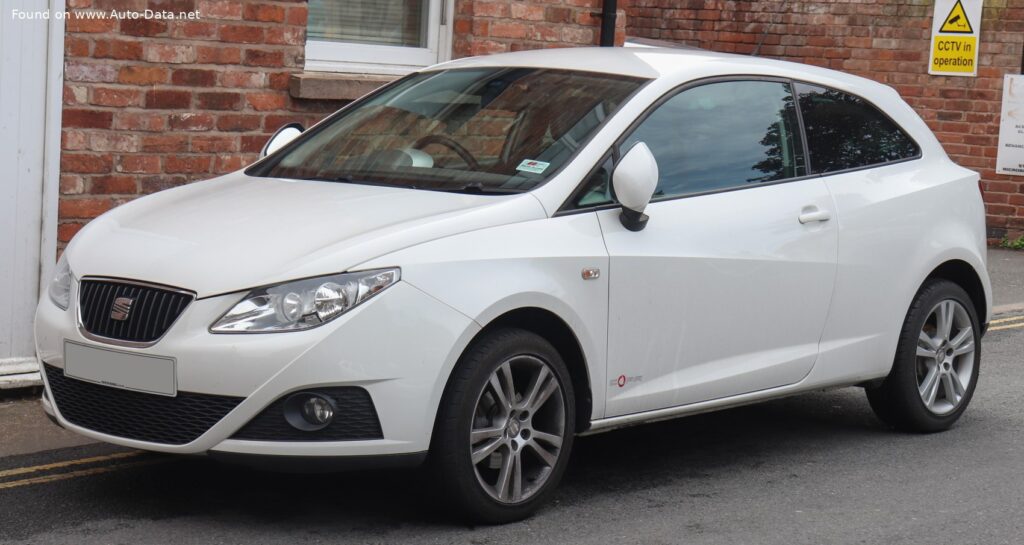
The SEAT Ibiza IV SC 1.6 MPI DSG represents a significant iteration of the popular Spanish automaker’s subcompact offering, specifically the “SportCoupe” variant from its fourth generation. Launched in 2008, this particular model, with its 1.6-liter Multi-Point Injection gasoline engine and advanced 7-speed Direct-Shift Gearbox (DSG), carved out a niche in the highly competitive European B-segment. Produced for a relatively short period, concluding in November 2009, the Ibiza IV SC underscored SEAT’s commitment to delivering stylish, sporty, and technologically current vehicles to its primary markets across Europe and beyond. While never officially sold in the United States, the Ibiza is a cornerstone of SEAT’s product lineup, embodying the brand’s youthful and passionate design philosophy within the Volkswagen Group portfolio. This generation, designed under the leadership of Luc Donckerwolke, moved the Ibiza’s styling forward, presenting a more angular and assertive aesthetic compared to its predecessors.
The Ibiza IV SC 1.6 MPI DSG: Positioning and Overview
The “SC” designation, signifying SportCoupe, highlighted its three-door body style, which offered a more dynamic and less utilitarian appeal than its five-door hatchback sibling. This configuration targeted younger buyers or those seeking a more personal, sport-oriented vehicle without sacrificing the practicalities inherent in a compact car. The integration of the DSG transmission, a sophisticated dual-clutch automatic gearbox, was a notable technological advancement for a vehicle in this class during its production run, promising both efficiency and engaging performance. The Seat Ibiza IV SC 1.6 MPI DSG was engineered to provide a compelling blend of everyday usability, spirited driving dynamics, and contemporary features, all wrapped in a distinctive European package. Within the Ibiza IV range, this variant occupied a mid-range position, offering a step up in performance and technology compared to the base 1.4-liter models, but remaining more accessible than the higher-performance FR trims.
Powertrain & Engine Architecture
At the core of this particular SEAT Ibiza IV SC was a naturally aspirated 1.6-liter (1598 cm³ or 97.52 cu. in.) Multi-Point Injection (MPI) gasoline engine, identified by the engine code BTS. This inline four-cylinder unit, with four valves per cylinder, was configured in a front, transverse layout, driving the front wheels. It produced a respectable 105 horsepower at 5600 revolutions per minute (rpm) and 112.85 lb.-ft. of torque at 3800 rpm. For a vehicle of its size and segment, these figures provided a lively, yet economical, performance profile suitable for urban commuting and highway cruising alike. The engine’s multi-port manifold injection system ensured efficient fuel delivery, contributing to its Euro 5 emission standard compliance, which was a strong environmental credential for its time.
The BTS Engine Code and Fuel Injection
The BTS engine, a common powerplant within the Volkswagen Group’s smaller offerings, is known for its relative simplicity and durability. The MPI system, while not as advanced as direct injection, offered a good balance of cost-effectiveness and performance. The valvetrain utilizes a single overhead camshaft (SOHC) design, contributing to its compact size and reduced complexity. The engine’s block is constructed from cast iron, providing robust strength and longevity. The cylinder head is made of aluminum alloy, helping to reduce overall weight.
The 7-Speed DSG Transmission
A standout feature of the powertrain was the sophisticated 7-speed DSG (Direct-Shift Gearbox) automatic transmission. This dual-clutch unit was a significant technological differentiator in the compact segment, offering rapid, smooth gear changes that traditionally only manual transmissions could provide with such efficiency. The DSG operates using two separate clutches – one for the odd-numbered gears and one for the even-numbered gears. This allows for pre-selection of the next gear, resulting in virtually seamless shifts. The transmission is electronically controlled, optimizing shift points for performance and fuel economy. The DSG used in the Ibiza IV SC is a 0AM variant, known for its reliability and responsiveness.
Driving Characteristics
The 1.8L / Automatic setup provided a balanced driving experience. While not overtly sporty, the 105 hp engine and 7-speed DSG offered sufficient power for everyday driving and occasional highway overtaking. The DSG transmission contributed to a more engaging driving experience than a traditional automatic, with quick and precise shifts. Compared to the 1.4-liter models, the 1.6 MPI offered noticeably more power and responsiveness. However, it lacked the outright performance of the FR trims, which featured more powerful engines and sport-tuned suspensions. The gear ratios were optimized for a blend of acceleration and fuel efficiency, with a relatively short final drive to enhance responsiveness. The steering was light and precise, making it easy to maneuver in urban environments. The suspension provided a comfortable ride, absorbing bumps and imperfections in the road surface effectively.
Equipment & Trim Levels
The Ibiza IV SC 1.6 MPI DSG typically came equipped with a reasonable level of standard features. These included air conditioning, power windows, central locking, an audio system with CD player, and ABS brakes. Interior upholstery was typically cloth, with a choice of color schemes. The dashboard featured a functional and modern design, with easy-to-read instrumentation. Optional extras available for this trim included alloy wheels, a sunroof, parking sensors, and upgraded audio systems. Higher trim levels, often denoted by “Sport” or “Style” packages, added features such as fog lights, leather steering wheel, and climate control. The SC variant often featured sport seats with enhanced bolstering for improved lateral support.
Chassis & Braking
The Ibiza IV SC featured a well-engineered chassis designed for agile handling and ride comfort. The front suspension utilized an independent McPherson strut setup with coil springs and an anti-roll bar, a common and effective design for precise steering and ride comfort. The rear suspension employed a torsion beam design, a compact and robust solution for front-wheel-drive compacts. Braking performance was handled by ventilated discs at the front and solid discs at the rear, augmented by an Anti-lock Braking System (ABS) for enhanced safety and control during emergency stops. The steering system was an electric power-assisted rack and pinion unit, providing light effort at low speeds for parking and more feedback at higher speeds. Tire options ranged from 185/60 R15 for comfort and efficiency, up to 215/40 R17 for improved grip and a sportier aesthetic, reflecting the car’s dynamic capabilities.
Market Reception & Comparison
Critics generally viewed the Ibiza IV SC 1.6 MPI DSG favorably, praising its stylish design, engaging driving dynamics, and advanced DSG transmission. Fuel economy was also a strong point, with the car achieving competitive figures in its class. Compared to other trims in the same lineup, the 1.6 MPI DSG offered a good balance of performance and efficiency. It was more economical than the FR trims, but provided more power and responsiveness than the base 1.4-liter models. Reliability was generally good, although some owners reported minor issues with the DSG transmission, such as occasional jerky shifts. However, these issues were often resolved with software updates. The Ibiza IV SC faced competition from established rivals such as the Volkswagen Polo, Ford Fiesta, Renault Clio, and Peugeot 207. It distinguished itself with its sporty styling and advanced technology.
Technical Specifications
| Brand | SEAT |
| Model | Ibiza IV SC |
| Type (Engine) | 1.6 MPI (105 Hp) DSG |
| Start of Production | 2008 |
| End of Production | November, 2009 |
| Body Type | Coupe (3 Doors) |
| Seats | 5 |
| Powertrain Architecture | Internal Combustion engine |
| Fuel Type | Petrol (Gasoline) |
| Engine Layout | Front, Transverse |
| Engine Model/Code | BTS |
| Engine Displacement | 1598 cm³ (1.6 Liters / 97.52 cu. in.) |
| Number of Cylinders | 4 (Inline) |
| Cylinder Bore | 3.01 in. (76.5 mm) |
| Piston Stroke | 3.42 in. (86.9 mm) |
| Number of Valves per Cylinder | 4 |
| Fuel Injection System | Multi-port manifold injection |
| Engine Aspiration | Naturally aspirated |
| Power | 105 Hp @ 5600 rpm |
| Power per Liter | 65.7 Hp/l |
| Torque | 112.85 lb.-ft. (153 Nm) @ 3800 rpm |
| Acceleration 0-60 mph | 9.6 sec |
| Acceleration 0-62 mph (0-100 km/h) | 10.1 sec |
| Maximum Speed | 116.82 mph (188 km/h) |
| Fuel Consumption (Urban) | 30.5 US mpg (7.7 l/100 km) |
| Fuel Consumption (Extra Urban) | 49 US mpg (4.8 l/100 km) |
| Fuel Consumption (Combined) | 40.6 US mpg (5.8 l/100 km) |
| Emission Standard | Euro 5 |
| Drivetrain Architecture | Front-wheel drive |
| Number of Gears & Gearbox Type | 7 gears, automatic transmission DSG |
| Front Suspension | Independent, McPherson with coil spring and anti-roll bar |
| Rear Suspension | Trailing arm |
| Front Brakes | Ventilated discs |
| Rear Brakes | Disc |
| Assisting Systems | ABS (Anti-lock braking system) |
| Steering Type | Steering rack and pinion |
| Power Steering | Electric Steering |
| Tires Size | 185/60 R15; 215/45 R16; 215/40 R17 |
| Wheel Rims Size | 15; 16; 17 |
| Length | 158.82 in. (4034 mm) |
| Width | 66.65 in. (1693 mm) |
| Height | 56.22 in. (1428 mm) |
| Wheelbase | 97.2 in. (2469 mm) |
Legacy
The SEAT Ibiza IV SC 1.6 MPI DSG, while a specific variant, contributed to the overall success and reputation of the fourth-generation Ibiza. The BTS engine, coupled with the 7-speed DSG, proved to be a reliable and efficient powertrain combination. In the used car market today, these models are generally well-regarded, offering a good balance of affordability, practicality, and driving enjoyment. Regular maintenance, particularly for the DSG transmission (including fluid changes), is crucial to ensure long-term reliability. The Ibiza IV SC remains a popular choice for buyers seeking a stylish and economical compact car with a touch of Spanish flair. Its legacy is one of a well-rounded and technologically advanced vehicle that helped to solidify SEAT’s position as a key player in the European automotive market.