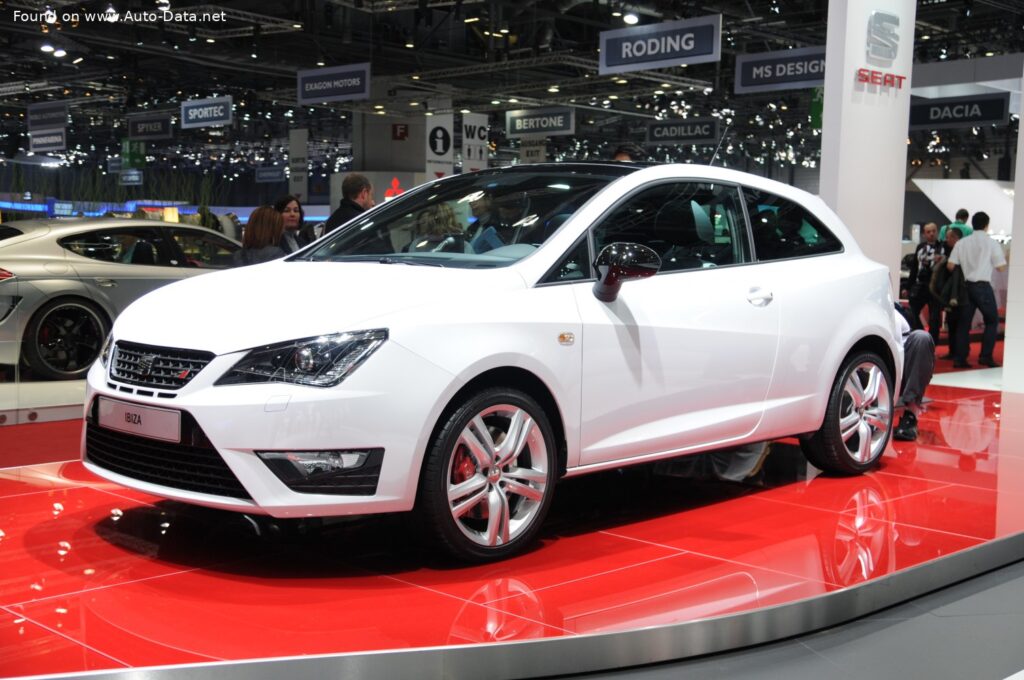
The Seat Ibiza IV SC (facelift 2012) 1.2 12V (70 Hp) represents a significant iteration of SEAT’s popular subcompact car, an essential player in the highly competitive European B-segment. Produced by the Spanish automaker SEAT, a subsidiary of the Volkswagen Group, the fourth-generation Ibiza, internally known as the 6J, received a mid-cycle refresh in 2012 to keep it competitive and align its styling with the brand’s evolving design language. The “SC” designation, standing for SportCoupé, specifically refers to the three-door variant, emphasizing a sportier and more dynamic aesthetic compared to its five-door hatchback counterpart. This particular model, equipped with a 1.2-liter 12-valve gasoline engine delivering 70 horsepower, was positioned as an economical and agile option, primarily targeting urban drivers and those seeking an accessible entry into the European new car market between its production years of 2012 and 2015.
The 1.2L 70 Hp Ibiza SC: Entry-Level Appeal
While SEAT vehicles are not typically sold in the United States, the brand holds a crucial position within the European automotive landscape, often serving as the Volkswagen Group’s more youthful and emotionally charged offering. The Ibiza, sharing its platform with the Volkswagen Polo and Skoda Fabia, benefited from robust engineering while carving out its own identity through distinctive styling and a focus on driving engagement. The 2012 facelift brought subtle yet impactful changes, refining its exterior appearance and enhancing interior quality and features, ensuring the Ibiza remained an attractive proposition in a segment dominated by strong contenders like the Ford Fiesta, Renault Clio, and Peugeot 208. The 1.2L 70 hp variant occupied the entry-level position in the Ibiza SC lineup, offering the most affordable access to the model range. It was designed for buyers prioritizing fuel economy and low running costs over outright performance.
Powertrain & Engine Architecture
At the heart of the Seat Ibiza IV SC (facelift 2012) 1.2 12V (70 Hp) lies a compact and efficient 1.2-liter naturally aspirated three-cylinder gasoline engine. This powerplant, identified by engine codes CGPA and CJLB, was engineered to deliver reliable performance with a strong emphasis on fuel economy and low emissions, a critical factor for European buyers. The engine produces a modest 70 horsepower at 5400 rpm and 82.61 lb.-ft. of torque at 3000 rpm. The engine utilizes a multi-port fuel injection system, delivering fuel directly into the intake ports. The valvetrain features two valves per cylinder, a relatively simple design contributing to its reliability and cost-effectiveness. Power is transmitted to the front wheels via a smooth-shifting 5-speed manual transmission, a common and cost-effective choice for vehicles in this segment. This drivetrain architecture contributes to the car’s commendable fuel efficiency. The engine’s compact size and lightweight construction contribute to the Ibiza SC’s overall agility.
Driving Characteristics
The 1.2L 70 hp engine in the Ibiza SC provides adequate, but not exhilarating, performance. Acceleration is best described as leisurely, with a 0-60 mph time of approximately 13.2 seconds. The engine’s torque peak at 3000 rpm means that most of its usable power is available in the mid-range, making it suitable for urban driving and overtaking on slower roads. Compared to higher-output versions of the Ibiza SC, such as those equipped with the 1.6-liter engine, the 1.2L feels noticeably slower, particularly when fully loaded or climbing hills. The 5-speed manual transmission is well-matched to the engine’s characteristics, with gear ratios optimized for fuel efficiency. The gearshift action is light and precise, enhancing the driving experience. While not a sporty performer, the Ibiza SC 1.2L offers a comfortable and predictable driving experience, prioritizing ease of use and low running costs over dynamic thrills.
Equipment & Trim Levels
The Ibiza SC 1.2 12V (70 Hp) typically came equipped with a reasonable level of standard features, reflecting its position as an entry-level model. Standard equipment generally included electric front windows, central locking, power steering, an ABS anti-lock braking system, and a basic audio system with MP3 compatibility. Interior upholstery was typically cloth, with a simple and functional dashboard design. Optional extras available for this trim included air conditioning, alloy wheels, a more advanced audio system with Bluetooth connectivity, and front fog lights. Higher trim levels, such as the Style or Sport trims, added features like upgraded interior trim, automatic headlights, and rain-sensing wipers. The overall interior ambiance was functional and well-built, though materials were generally of a lower quality compared to more expensive trims.
Chassis & Braking
The Seat Ibiza IV SC (facelift 2012) 1.2 12V (70 Hp) utilized a MacPherson strut front suspension with coil springs and an anti-roll bar, providing a comfortable and controlled ride. The rear suspension employed a torsion beam setup, a cost-effective and space-efficient solution. The braking system consisted of ventilated disc brakes at the front and drum brakes at the rear. ABS (Anti-lock Braking System) was standard, enhancing safety and stability during emergency braking. The steering was electric power-assisted, providing light and effortless maneuverability, particularly useful in urban environments. The chassis was tuned to prioritize comfort and stability over outright handling prowess, making it a forgiving and easy-to-drive vehicle. The relatively low weight of the 1.2L engine contributed to a balanced weight distribution, further enhancing its handling characteristics.
Market Reception & Comparison
Critics generally viewed the Seat Ibiza IV SC (facelift 2012) 1.2 12V (70 Hp) as a sensible and economical choice within the competitive B-segment. Its strengths lay in its fuel efficiency, low running costs, and surprisingly spacious interior for its size. However, it was often criticized for its lack of outright performance and relatively basic interior trim. Compared to other trims in the Ibiza lineup, such as the 1.6-liter versions, the 1.2L offered significantly lower fuel economy but also considerably less power. Against its direct competitors, like the Ford Fiesta and Renault Clio, the Ibiza SC 1.2L held its own in terms of fuel efficiency and value for money, but often lagged behind in terms of driving dynamics and interior refinement. Its reliability was generally considered good, benefiting from the Volkswagen Group’s engineering expertise.
Technical Specifications
| Category | Specification |
| Brand | Seat |
| Model | Ibiza |
| Generation | Ibiza IV SC (facelift 2012) |
| Type (Engine) | 1.2 12V (70 Hp) |
| Start of Production | 2012 |
| End of Production | 2015 |
| Fuel consumption (economy) – urban | 7.1 l/100 km (33.1 US mpg) |
| Fuel consumption (economy) – extra urban | 4.4 l/100 km (53.5 US mpg) |
| Fuel consumption (economy) – combined | 5.4 l/100 km (43.6 US mpg) |
| CO2 emissions | 125 g/km |
| Power | 70 Hp @ 5400 rpm |
| Torque | 112 Nm @ 3000 rpm (82.61 lb.-ft. @ 3000 rpm) |
| Engine displacement | 1198 cm3 (73.11 cu. in.) |
| Number of cylinders | 3 |
| Compression ratio | 10.5:1 |
| Kerb Weight | 1049 kg (2312.65 lbs.) |
| Acceleration 0 – 60 mph (Calculated) | 13.2 sec |
| Maximum speed | 163 km/h (101.28 mph) |
| Fuel tank capacity | 45 l (11.89 US gal) |
Legacy
The Seat Ibiza IV SC (facelift 2012) 1.2 12V (70 Hp) powertrain has proven to be relatively reliable in the long term. The 1.2-liter three-cylinder engine is known for its durability and low maintenance costs. Common issues are typically limited to wear and tear items, such as spark plugs, air filters, and timing chains. On the used car market today, these models are generally affordable and represent a good value for buyers seeking an economical and practical city car. However, potential buyers should be aware of the engine’s limited power output and the relatively basic interior trim. Despite its age, the Ibiza SC 1.2L remains a popular choice for first-time car buyers, students, and those seeking a reliable and fuel-efficient runabout. Its enduring appeal is a testament to its well-rounded design and the Volkswagen Group’s reputation for engineering quality.