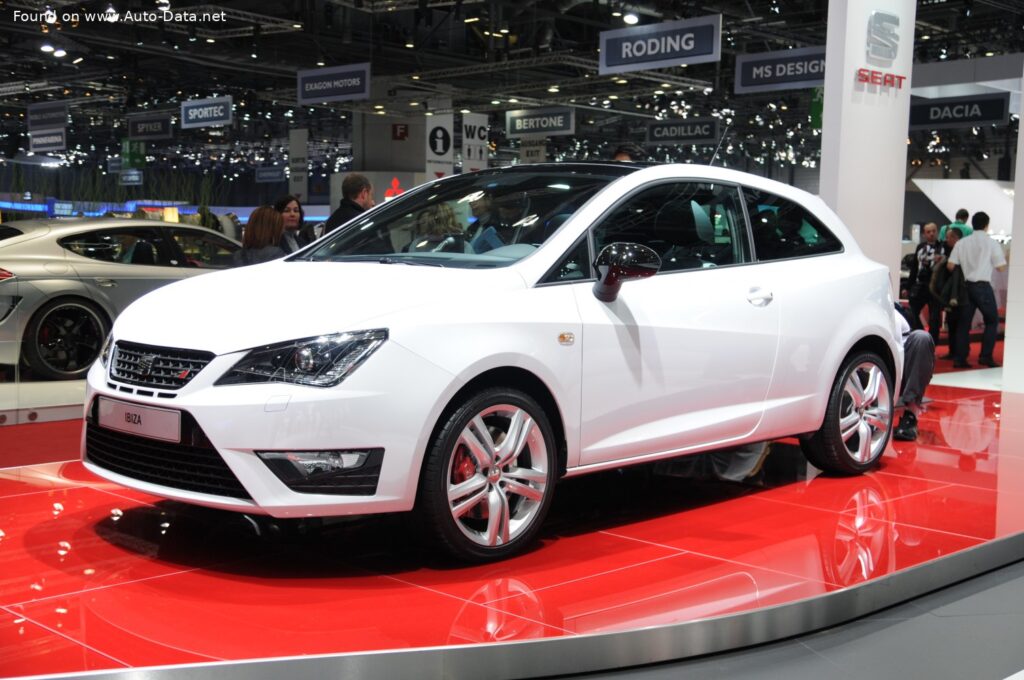
The Seat Ibiza IV SC (facelift 2012) 1.2 TDI (75 Hp) Start/Stop represents a significant offering within the European subcompact, or “supermini,” car segment. Produced by the Spanish automaker SEAT, a subsidiary of the Volkswagen Group, this model was part of the fourth generation Ibiza lineup, specifically the three-door “Sport Coupe” (SC) variant, which underwent a notable facelift in 2012. Positioned as a stylish and sportier alternative to its platform siblings like the Volkswagen Polo and Audi A1, the Ibiza aimed to attract younger buyers and those seeking a more dynamic driving experience without compromising practicality or efficiency. This 2012-2015 iteration, equipped with the economical 1.2-liter TDI diesel engine and start/stop technology, was particularly targeted towards consumers prioritizing low running costs and reduced environmental impact, a common demand in the European market.
Powertrain & Engine Architecture
The Seat Ibiza IV SC (facelift 2012) 1.2 TDI (75 Hp) Start/Stop is powered by a compact 1.2-liter (1199 cm³ or 73.17 cubic inches) three-cylinder inline turbodiesel engine, identified by the engine code CFWA. This engine is mounted front-transversely, driving the front wheels through a five-speed manual transmission. While its 75 horsepower output at 4200 rpm may seem modest by American standards, it was well-suited to the typical urban and extra-urban driving conditions found in Europe. The engine produces 180 Nm (132.76 lb-ft) of torque at a low 2000 rpm, providing respectable in-gear flexibility for city driving and highway cruising.
The CFWA engine utilizes a common rail direct fuel injection system and is equipped with a turbocharger and intercooler, contributing to its efficiency and responsiveness. A key feature is the standard Start & Stop System, which automatically shuts off the engine when the vehicle is stationary and restarts it upon clutch engagement, further reducing fuel consumption and emissions in stop-and-go traffic. This system, combined with a diesel particulate filter, allowed the Ibiza 1.2 TDI to achieve a combined fuel economy of 69.2 US mpg (3.4 l/100 km) and emit only 89 g/km of CO2, meeting the stringent Euro 5 emission standard. The engine features a cast iron block and aluminum cylinder head, and utilizes a timing belt for valve actuation. The fuel injection system operates at very high pressures to ensure efficient combustion and minimize particulate matter.
Driving Characteristics
The 1.2 TDI engine, paired with the five-speed manual transmission, delivers a driving experience focused on efficiency and usability rather than outright performance. Acceleration from 0 to 60 mph takes approximately 13.2 seconds, and the top speed is 107.5 mph (173 km/h). The engine’s torque is readily available from low RPMs, making it easy to navigate city streets and maintain speed on highways without frequent downshifting. Compared to higher-output Ibiza variants, such as those equipped with the 1.6-liter gasoline engine, the 1.2 TDI offers significantly better fuel economy but lacks the same level of responsiveness. The gear ratios are optimized for fuel efficiency, with a relatively long fifth gear for highway cruising. The engine can feel strained when climbing steep hills or when fully loaded with passengers and luggage.
Compared to a manual transmission equipped Ibiza, the automatic transmission (not available with this engine) would have offered greater convenience but at the expense of fuel economy and driver engagement. The manual transmission in the 1.2 TDI provides a more direct connection to the engine and allows the driver to maximize fuel efficiency by selecting the optimal gear for the driving conditions.
Equipment & Trim Levels
The Seat Ibiza IV SC (facelift 2012) 1.2 TDI (75 Hp) Start/Stop was typically offered in several trim levels, varying by market. Standard equipment generally included power steering, air conditioning, electric front windows, and an audio system with MP3 compatibility. Safety features included an Anti-lock Braking System (ABS) and front airbags. Higher trim levels added features such as alloy wheels, fog lights, a multi-function steering wheel, and an upgraded infotainment system with Bluetooth connectivity. Interior upholstery was typically cloth, with options for upgraded materials and color schemes. Optional extras included a sunroof, parking sensors, and a navigation system. The dashboard layout was relatively simple and functional, with a focus on ease of use. The SC variant, being the sport coupe, often featured sport seats as standard or as an option.
Chassis & Braking
The Ibiza IV SC utilizes an independent McPherson strut front suspension with a coil spring and anti-roll bar, providing responsive handling and a comfortable ride. The rear suspension employs a torsion beam setup, which is cost-effective and provides adequate stability for everyday driving. The front brakes are ventilated discs, offering good stopping power, while the rear brakes are drum brakes, a cost-saving measure common in this class of vehicle. The steering is rack and pinion with electric power assistance, providing light and precise steering feel. The vehicle’s compact dimensions – 159.17 inches in length, 66.65 inches in width, and 56.22 inches in height – contribute to its maneuverability in urban environments. Stabilizer bars were standard on most trims, enhancing body control during cornering.
Market Reception & Comparison
Critics generally praised the Seat Ibiza IV SC (facelift 2012) 1.2 TDI (75 Hp) Start/Stop for its fuel efficiency, low emissions, and stylish design. However, some reviewers noted that the engine lacked outright power, particularly when fully loaded or driving on steep inclines. Compared to other trims in the Ibiza lineup, the 1.2 TDI was positioned as the entry-level option, appealing to budget-conscious buyers and those prioritizing fuel economy. The 1.6-liter gasoline engine offered more performance but at the expense of fuel efficiency. The 2.0-liter TDI variants provided even more power but were significantly more expensive. Against competitors like the Ford Fiesta and Volkswagen Polo, the Ibiza offered a compelling combination of value, style, and efficiency. The Fiesta was often praised for its handling, while the Polo was known for its refinement. The Ibiza aimed to strike a balance between the two.
Technical Specifications
| Category | Specification |
| General Information | |
| Brand | Seat |
| Model | Ibiza |
| Generation | Ibiza IV SC (facelift 2012) |
| Type (Engine) | 1.2 TDI (75 Hp) start/stop |
| Production Start | 2012 |
| Production End | 2015 |
| Powertrain Architecture | Internal Combustion engine |
| Body Type | Coupe (3-door hatchback) |
| Seats | 5 |
| Doors | 3 |
| Performance Specs | |
| Fuel Consumption (Urban) | 4.1 l/100 km |
| Fuel Consumption (Extra Urban) | 3.0 l/100 km |
| Fuel Consumption (Combined) | 3.4 l/100 km |
| CO2 Emissions | 89 g/km |
| Fuel Type | Diesel |
| Acceleration 0-60 mph | 13.2 sec |
| Maximum Speed | 173 km/h (107.5 mph) |
| Emission Standard | Euro 5 |
| Weight-to-Power Ratio | 15.3 kg/Hp |
| Engine Specs | |
| Power | 75 Hp @ 4200 rpm |
| Torque | 180 Nm @ 2000 rpm (132.76 lb.-ft. @ 2000 rpm) |
| Engine Layout | Front, Transverse |
| Engine Model/Code | CFWA |
| Engine Displacement | 1199 cm³ (73.17 cu. in.) |
| Number of Cylinders | 3 |
| Engine Configuration | Inline |
| Cylinder Bore | 79.5 mm (3.13 in.) |
| Piston Stroke | 80.5 mm (3.17 in.) |
| Compression Ratio | 16.5:1 |
| Valves per Cylinder | 4 |
| Fuel Injection System | Diesel Commonrail |
| Engine Aspiration | Turbocharger, Intercooler |
| Engine Oil Capacity | 4.3 l (4.54 US qt) |
| Coolant Capacity | 8 l (8.45 US qt) |
| Engine Systems | Start & Stop System, Particulate filter |
| Space, Volume and Weights | |
| Kerb Weight | 1150 kg (2535.32 lbs.) |
| Max. Weight | 1620 kg (3571.49 lbs.) |
| Max Load | 470 kg (1036.17 lbs.) |
| Trunk (Boot) Space – minimum | 284 l (10.03 cu. ft.) |
| Fuel Tank Capacity | 45 l (11.89 US gal) |
| Dimensions | |
| Length | 4043 mm (159.17 in.) |
| Width | 1693 mm (66.65 in.) |
| Height | 1428 mm (56.22 in.) |
| Wheelbase | 2469 mm (97.2 in.) |
| Front Track | 1465 mm (57.68 in.) |
| Rear Track | 1457 mm (57.36 in.) |
| Minimum Turning Circle | 10.48 m (34.38 ft.) |
| Drivetrain, Brakes and Suspension | |
| Drivetrain Architecture | Internal combustion engine drives front wheels |
| Drive Wheel | Front-wheel drive |
| Gearbox | 5 gears, manual transmission |
| Front Suspension | Independent, McPherson with coil spring and anti-roll bar |
| Rear Suspension | Trailing arm |
| Front Brakes | Ventilated discs |
| Rear Brakes | Drum |
| Assisting Systems | ABS (Anti-lock braking system) |
| Steering Type | Steering rack and pinion |
| Power Steering | Electric Steering |
| Tire Sizes | 185/60 R15; 215/45 R16; 215/40 R17 |
| Wheel Rim Sizes | 6J x 15; 7J x 16; 7J x 17 |
Legacy
The Seat Ibiza IV SC (facelift 2012) 1.2 TDI (75 Hp) Start/Stop, while not sold in the United States, remains a popular and relatively reliable used car in Europe. The CFWA engine is known for its durability, provided it receives regular maintenance, including oil changes and timing belt replacements. The start/stop system can be prone to issues if not properly maintained, but these are generally minor. The Ibiza’s simple mechanical design makes it relatively easy and affordable to repair. In the used car market, these models are often sought after by first-time car buyers and those looking for an economical and practical city car. The combination of fuel efficiency, low running costs, and stylish design continues to make it a viable option for budget-conscious consumers. The Ibiza’s legacy lies in its contribution to the supermini segment, demonstrating that a small car can be both stylish, efficient, and enjoyable to drive.