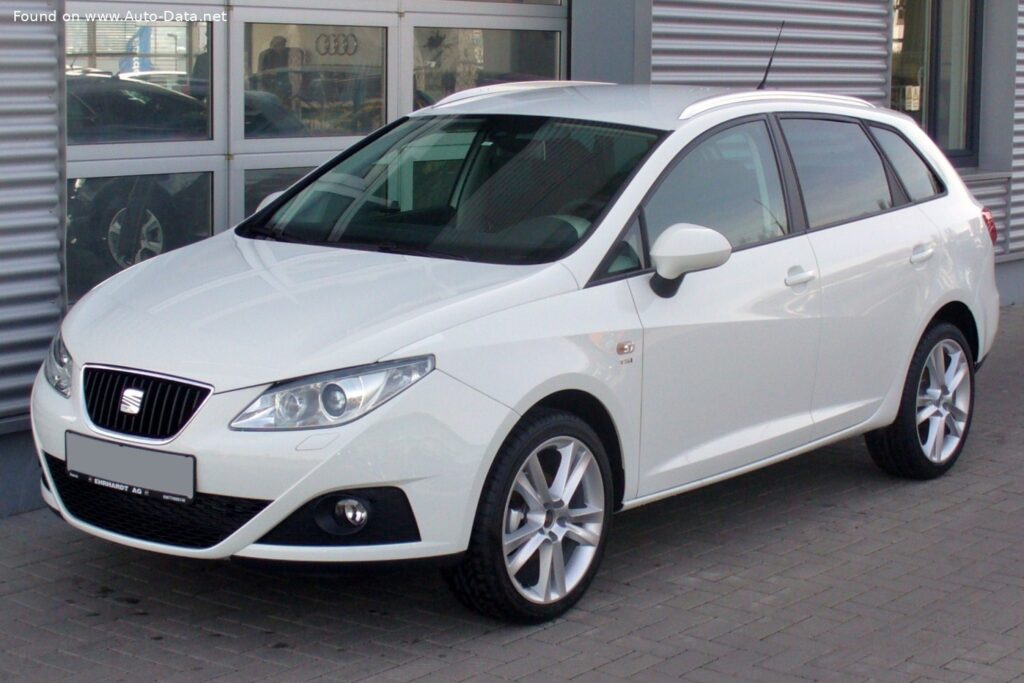
The Seat Ibiza IV ST 1.2 TDI (75 Hp) Start & Stop E-Ecomotive represents a significant offering within the highly competitive European compact car segment during its production run from 2010 to 2012. As part of the fourth generation of the Seat Ibiza, a cornerstone model for the Spanish brand, the ST (Sport Tourer or Station Wagon) variant was specifically designed to cater to a demographic demanding greater practicality and cargo capacity than the standard hatchback, without sacrificing the brand’s characteristic youthful design or Volkswagen Group’s renowned engineering. This particular iteration, with its 1.2-liter TDI diesel engine and E-Ecomotive suite of efficiency technologies, was a prime example of Seat’s commitment to delivering economical and environmentally conscious vehicles in markets where diesel power and low emissions were highly valued, particularly across Europe.
Seat Ibiza IV ST: A European Efficiency Champion
Seat, a subsidiary of the Volkswagen Group, has historically positioned itself as a brand offering stylish, sportier alternatives to its German counterparts, often sharing platforms and powertrains. The Ibiza IV ST, while benefiting from the robust PQ25 platform shared with the Volkswagen Polo V and Skoda Fabia II, carved out its own niche. The 1.2 TDI Start & Stop E-Ecomotive variant was a testament to the era’s focus on reducing fuel consumption and CO2 emissions, making it an attractive option for both private buyers and fleet operators seeking to minimize running costs and environmental impact in the European market.
Engine & Performance
At the heart of this efficient compact wagon was a sophisticated 1.2-liter (1199 cm3 or 73.17 cu. in.) three-cylinder inline TDI diesel engine, internally designated CFWA. This powerplant, a testament to modern diesel engineering, delivered a modest but effective 75 horsepower at 4000 rpm. While 75 horsepower might sound conservative, it was perfectly adequate for the urban and extra-urban driving conditions prevalent in Europe, especially when coupled with its impressive torque output.
The engine truly distinguished itself with its torque figures, producing 180 Nm (132.76 lb.-ft.) available across a broad and usable rev range from 1500 to 3450 rpm. This low-end torque was crucial for everyday drivability, providing ample pulling power for city traffic and making the car feel more responsive than its horsepower rating might suggest. Power was delivered to the front wheels via a smooth-shifting 5-speed manual transmission, a common and reliable setup for vehicles in this segment.
Key to the “E-Ecomotive” designation were several efficiency-enhancing technologies. The “Start & Stop” system automatically shut off the engine when the vehicle was stationary, such as at traffic lights, and restarted it seamlessly when the driver engaged the clutch. This feature, combined with a diesel particulate filter, contributed significantly to the vehicle’s outstanding fuel economy and low emissions. The official NEDC combined fuel consumption figure stood at an remarkable 3.4 liters per 100 kilometers, translating to an impressive 69.2 US miles per gallon. Urban consumption was rated at 4.1 l/100 km (57.4 US mpg), and extra-urban at an astounding 3.0 l/100 km (78.4 US mpg).
Performance figures reflected its economical tuning: acceleration from 0 to 62 mph (0-100 km/h) took 14.6 seconds, with 0-60 mph achievable in a calculated 13.9 seconds. The top speed was 173 km/h (107.5 mph). While not a performance car, its efficiency was its true strength, boasting CO2 emissions of just 89 g/km, meeting stringent Euro 5 emission standards and often qualifying for tax incentives in various European countries.
Design & Features
The Seat Ibiza IV ST adopted a station wagon (estate) body style, a practical and popular choice in European markets. Measuring 4227 mm (166.42 in.) in length, 1693 mm (66.65 in.) in width, and 1445 mm (56.89 in.) in height, the Ibiza ST offered a compact footprint that was easy to maneuver in crowded city environments, yet provided substantial interior volume. The 2469 mm (97.2 in.) wheelbase contributed to a stable ride and maximized cabin space for its class.
From a design perspective, the Ibiza IV ST maintained the sharp, angular lines and distinctive “Arrow Design” language that characterized the Ibiza range, giving it a more dynamic and youthful appearance compared to some of its more conservatively styled competitors. The five-door configuration provided easy access for passengers and cargo.
Inside, the Ibiza IV ST offered comfortable seating for five occupants. The primary advantage of the ST variant was its cargo capacity. With a minimum trunk space of 430 liters (15.19 cu. ft.), it significantly outstripped the hatchback model, providing ample room for luggage, groceries, or sports equipment. The rear seats could typically be folded down to further expand this capacity, making it a versatile option for small families or individuals needing extra utility.
Standard features for a car of its class and era included essential safety systems such as ABS (Anti-lock Braking System), a crucial component for maintaining control during hard braking. The electric power steering system offered light and precise steering, enhancing maneuverability and driving ease. The car rode on 175/70 R14 tires mounted on 5J x 14-inch wheel rims, a setup chosen for a balance of comfort, grip, and low rolling resistance to aid fuel economy. The suspension setup featured an independent McPherson strut system with coil springs and an anti-roll bar at the front, paired with a semi-dependent beam with a stabilizer at the rear, providing a comfortable yet composed ride.
Technical Specifications
| Category | Specification |
| General Information | |
| Brand | Seat |
| Model | Ibiza |
| Generation | Ibiza IV ST |
| Type (Engine) | 1.2 TDI (75 Hp) Start & Stop E-Ecomotive |
| Start of Production | 2010 year |
| End of Production | 2012 year |
| Powertrain Architecture | Internal Combustion engine |
| Body type | Station wagon (estate) |
| Seats | 5 |
| Doors | 5 |
| Performance Specs | |
| Fuel consumption (economy) – urban (NEDC) | 4.1 l/100 km |
| Fuel consumption (economy) – extra urban (NEDC) | 3.0 l/100 km |
| Fuel consumption (economy) – combined (NEDC) | 3.4 l/100 km |
| CO2 emissions (NEDC) | 89 g/km |
| Fuel Type | Diesel |
| Acceleration 0 – 100 km/h | 14.6 sec |
| Acceleration 0 – 62 mph | 14.6 sec |
| Acceleration 0 – 60 mph (Calculated) | 13.9 sec |
| Maximum speed | 173 km/h |
| Emission standard | Euro 5 |
| Engine Specs | |
| Power | 75 Hp @ 4000 rpm |
| Torque | 180 Nm @ 1500-3450 rpm |
| Engine displacement | 1199 cm3 |
| Number of cylinders | 3 |
Legacy and Market Impact
The Seat Ibiza IV ST 1.2 TDI (75 Hp) Start & Stop E-Ecomotive carved out a respectable niche in the fiercely competitive European B-segment (subcompact) market. While Seat models are not officially sold in the United States, their significance in Europe cannot be overstated. The Ibiza line, in particular, has consistently been Seat’s best-selling model, and the fourth generation ST variant extended its appeal to customers prioritizing practicality and low running costs. Its primary competitors included other compact station wagons such as the Skoda Fabia Combi, Renault Clio Estate, Peugeot 207 SW, and even stablemates like the Volkswagen Polo Variant.
The E-Ecomotive version, especially with the 1.2 TDI engine, was instrumental in reinforcing Seat’s image as a brand capable of delivering not just stylish and dynamic vehicles, but also highly efficient and environmentally responsible ones. Its exceptionally low CO2 emissions and outstanding fuel economy made it a popular choice for budget-conscious buyers, young families, and company fleets in countries with advantageous tax structures for low-emission vehicles. The inclusion of Start & Stop technology was a forward-thinking feature for its time, demonstrating Seat’s commitment to integrating advanced efficiency solutions across its range.
Historically, the Ibiza IV ST 1.2 TDI (75 Hp) Start & Stop E-Ecomotive is remembered as a practical, no-frills workhorse that delivered immense value in terms of cost of ownership. It showcased how a small-displacement, three-cylinder diesel engine, combined with intelligent efficiency technologies, could provide adequate performance for daily driving while achieving fuel economy figures that were once the exclusive domain of much smaller, less versatile vehicles. Its legacy lies in its contribution to the mainstream acceptance of advanced fuel-saving technologies and its role in offering an affordable, spacious, and economical option for European consumers seeking a blend of style, utility, and efficiency.