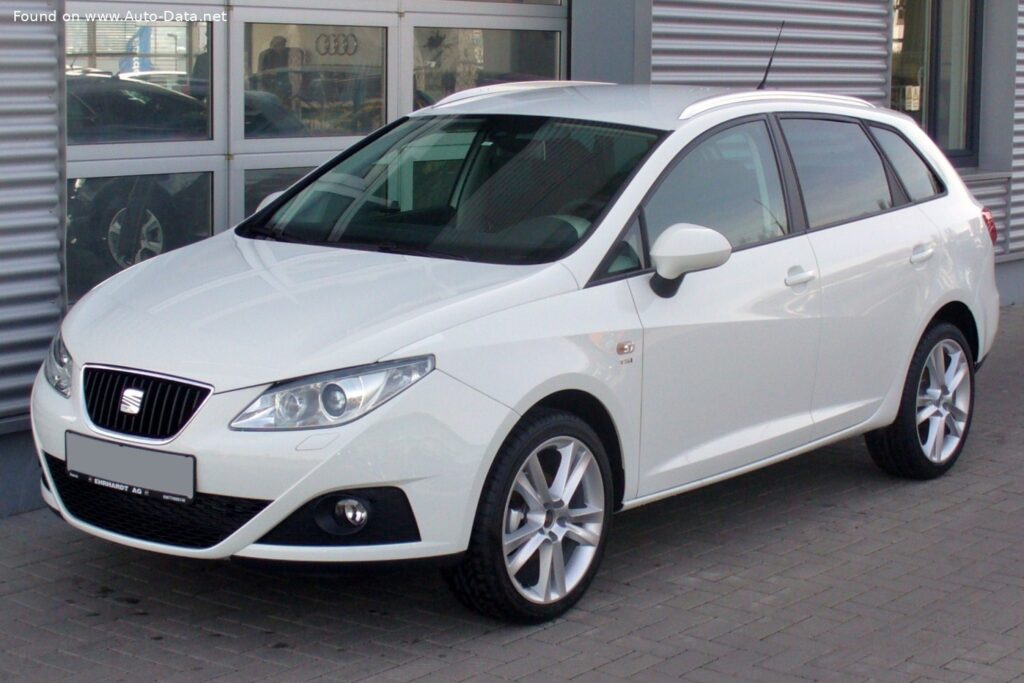
The Seat Ibiza IV ST 1.2 TSI (105 Hp) Start & Stop Ecomotive represents a compelling blend of practicality, efficiency, and driving dynamics within the highly competitive European subcompact segment. Produced between 2010 and 2012, this particular variant of the fourth-generation Ibiza, known internally as the 6J, showcased Seat’s commitment to offering versatile and environmentally conscious vehicles under the Volkswagen Group umbrella. As a Spanish brand, Seat’s primary market has always been Europe, where the Ibiza has consistently been one of its best-selling models, celebrated for its youthful styling and sporty character. The ST, or Sport Tourer, designation denotes the station wagon (estate) body style, expanding the Ibiza’s appeal to buyers needing more cargo capacity than the standard hatchback, without sacrificing the nimble footprint ideal for European city driving.
This model was a key player in Seat’s lineup, offering a sensible yet engaging option for young families, small businesses, or individuals seeking a compact vehicle with enhanced utility. Its 1.2-liter turbocharged engine, coupled with the “Start & Stop Ecomotive” technology, positioned it as an economical choice during a period when fuel efficiency and lower emissions were becoming increasingly important considerations for European consumers. The Ibiza IV ST was never officially sold in the United States, reflecting Seat’s strategic focus on European and select international markets. However, its engineering and design principles are emblematic of the advancements made in the subcompact class globally during the early 2010s.
Engine & Performance: The Efficient 1.2 TSI Powertrain
At the heart of the Seat Ibiza IV ST lies its sophisticated 1.2-liter TSI (Turbocharged Stratified Injection) inline-four engine, designated with the code CBZB. This powerplant was a testament to the Volkswagen Group’s pioneering efforts in engine downsizing, offering impressive performance and fuel economy from a relatively small displacement. The engine, positioned transversely at the front, delivered a robust 105 horsepower at 5000 revolutions per minute. More critically for daily usability, it produced a healthy 129.07 lb.-ft. of torque across a broad rev range, from a low 1550 rpm up to 4100 rpm. This wide torque band ensured excellent responsiveness and reduced the need for frequent gear changes, making it particularly well-suited for both urban commutes and highway cruising.
The implementation of a turbocharger and intercooler was instrumental in achieving this balance of power and efficiency, allowing the small engine to perform like a larger, naturally aspirated unit. Fuel delivery was handled by a direct injection system, which precisely atomized fuel directly into the combustion chambers, contributing to improved combustion efficiency and lower emissions. The engine featured a DOHC (Double Overhead Camshaft) valvetrain with four valves per cylinder, further enhancing breathing and overall engine performance. The engineering behind the CBZB engine was a prime example of how modern internal combustion engines could deliver both spirited performance and remarkable fuel economy, challenging the perception that smaller engines inherently meant sluggish driving.
Power was sent to the front wheels via a smooth-shifting 5-speed manual transmission, a common and reliable choice for this segment. This gearbox was well-matched to the engine’s torque characteristics, allowing drivers to extract the most from the 1.2 TSI. Performance figures were competitive for its class, with the Ibiza IV ST 1.2 TSI accelerating from 0 to 60 mph in a respectable 9.7 seconds and reaching a top speed of 118.06 mph. These figures underscored the effectiveness of the TSI technology in providing engaging performance without a penalty in fuel consumption.
A standout feature for this model was its “Start & Stop Ecomotive” system. This technology automatically shuts off the engine when the vehicle is stationary, such as at a traffic light, and instantly restarts it when the driver presses the clutch pedal. This system, combined with other efficiency measures like regenerative braking and low-rolling-resistance tires (depending on trim), resulted in impressive fuel economy figures: an urban consumption of 37.3 US mpg, an extra-urban figure of 53.5 US mpg, and a combined average of 46.1 US mpg. Furthermore, its CO2 emissions were kept to a low 119 g/km, allowing it to meet the stringent Euro 5 emission standard, a significant selling point in environmentally conscious European markets where vehicle taxation is often linked to CO2 output. This Ecomotive package made the Ibiza ST an attractive proposition for those prioritizing low running costs and a reduced environmental footprint.
Design & Features: Practicality Meets Sporty Style in the Seat Ibiza IV ST
The Seat Ibiza IV ST adopted the distinctive “Arrow Design” language pioneered by Seat’s then-design chief, Luc Donckerwolke. This aesthetic gave the Ibiza a sharp, dynamic, and youthful appearance, even in its more utilitarian station wagon form. The prominent V-shaped grille, angular headlights, and crisp character lines running along the flanks contributed to a sporty and modern look that differentiated it from many of its more conservatively styled rivals. The ST body type, with its five doors and five seats, extended the Ibiza’s length to 166.42 inches (4227 mm), significantly increasing its cargo capacity compared to the hatchback. The minimum trunk space stood at a generous 15.19 cubic feet (430 liters), making it a highly practical choice for hauling luggage, groceries, or sports equipment. With the rear seats folded down in a 60/40 split, this space could be expanded considerably, enhancing its versatility for larger loads.
Despite its practical nature, the Ibiza ST maintained a relatively compact footprint, with a width of 66.65 inches (1693 mm) and a height of 56.89 inches (1445 mm). Its wheelbase of 97.2 inches (2469 mm) contributed to stable handling and a comfortable ride for a vehicle in its class. The vehicle’s impressive turning circle of 34.38 feet (10.48 m) ensured excellent maneuverability in tight urban environments, a crucial attribute for city driving in Europe. Inside, the cabin, while designed for durability and functionality, offered a straightforward layout with clear instrumentation and ergonomic controls. Depending on the trim level, features could include air conditioning, power windows, an MP3-compatible audio system, and various safety features.
Underneath its stylish skin, the Ibiza IV ST featured a well-engineered chassis designed for a balance of comfort and agility, characteristic of Volkswagen Group platforms. The front suspension utilized an independent McPherson strut setup with coil springs and an anti-roll bar, providing precise steering and good body control. The rear employed a semi-dependent beam with a stabilizer for lateral stability, a cost-effective and space-efficient solution common in this segment that allowed for a flatter load floor and maximizing cargo volume. Braking performance was handled by ventilated discs at the front (256×22 mm) and solid discs at the rear (232×9 mm), augmented by an Anti-lock Braking System (ABS) for enhanced safety. The electric power steering system offered light and responsive steering, making parking and low-speed maneuvers effortless while providing adequate feedback at higher speeds. Standard tire sizes ranged from 185/60 R15 to 215/45 R16, mounted on 6J x 15 or 7J x 16 wheel rims, respectively, contributing to both aesthetics and handling dynamics.
Seat Ibiza IV ST Technical Specifications
| Category | Specification |
| General Information | |
| Brand | Seat |
| Model | Ibiza |
| Generation | Ibiza IV ST |
| Type (Engine) | 1.2 TSI (105 Hp) Start & Stop Ecomotive |
| Production Start | 2010 |
| Production End | 2012 |
| Powertrain Architecture | Internal Combustion Engine |
| Body Type | Station wagon (estate) |
| Seats | 5 |
| Doors | 5 |
| Performance Specs | |
| Fuel Consumption (Urban NEDC) | 6.3 l/100 km (37.3 US mpg) |
| Fuel Consumption (Extra Urban NEDC) | 4.4 l/100 km (53.5 US mpg) |
| Fuel Consumption (Combined NEDC) | 5.1 l/100 km (46.1 US mpg) |
| CO2 Emissions (NEDC) | 119 g/km |
| Fuel Type | Petrol (Gasoline) |
| Acceleration 0-60 mph | 9.7 sec |
| Maximum Speed | 190 km/h (118.06 mph) |
| Emission Standard | Euro 5 |
| Weight-to-Power Ratio | 10.2 kg/Hp (97.7 Hp/tonne) |
| Weight-to-Torque Ratio | 6.1 kg/Nm (162.8 Nm/tonne) |
| Engine Specs | |
| Power | 105 Hp @ 5000 rpm |
| Power per Liter | 87.7 Hp/l |
| Torque | 175 Nm (129.07 lb.-ft.) @ 1550-4100 rpm |
| Engine Layout | Front, Transverse |
| Engine Model/Code | CBZB |
| Engine Displacement | 1197 cm³ (1.2 liters / 73.05 cu. in.) |
| Number of Cylinders | 4 |
| Engine Configuration | Inline |
| Cylinder Bore | 71 mm (2.8 in.) |
| Piston Stroke | 75.6 mm (2.98 in.) |
| Compression Ratio | 10:1 |
| Valves per Cylinder | 4 |
| Fuel Injection System | Direct Injection |
| Engine Aspiration | Turbocharger, Intercooler |
| Valvetrain | DOHC |
| Engine Oil Capacity | 3.6 l (3.8 US qt) |
| Coolant Capacity | 5.6 l (5.92 US qt) |
| Engine Systems | Start & Stop System |
| Space, Volume and Weights | |
| Kerb Weight | 1075 kg (2369.97 lbs.) |
| Max. Weight | 1590 kg (3505.35 lbs.) |
| Max Load | 515 kg (1135.38 lbs.) |
| Trunk (boot) Space – Minimum | 430 l (15.19 cu. ft.) |
| Fuel Tank Capacity | 45 l (11.89 US gal) |
| Permitted Trailer Load with Brakes (12%) | 1000 kg (2204.62 lbs.) |
| Dimensions | |
| Length | 4227 mm (166.42 in.) |
| Width | 1693 mm (66.65 in.) |
| Height | 1445 mm (56.89 in.) |
| Wheelbase | 2469 mm (97.2 in.) |
| Front Track | 1465 mm (57.68 in.) |
| Rear Track | 1457 mm (57.36 in.) |
| Minimum Turning Circle | 10.48 m (34.38 ft.) |
| Drivetrain, Brakes and Suspension Specs | |
| Drivetrain Architecture | Front-wheel drive, Internal Combustion Engine |
| Drive Wheel | Front-wheel drive |
| Number of Gears and Type of Gearbox | 5 gears, Manual transmission |
| Front Suspension | Independent, McPherson with coil spring and anti-roll bar |
| Rear Suspension | Semi-dependent beam with stabilizer lateral stability |
| Front Brakes | Ventilated discs, 256×22 mm |
| Rear Brakes | Disc, 232×9 mm |
| Assisting Systems | ABS (Anti-lock braking system) |
| Steering Type | Steering rack and pinion |
| Power Steering | Electric Steering |
| Tires Size | 185/60 R15; 215/45 R16 |
| Wheel Rims Size | 6J x 15; 7J x 16 |
The Seat Ibiza IV ST 1.2 TSI (105 Hp) Start & Stop Ecomotive played a crucial role in expanding the appeal of the Ibiza lineup, demonstrating Seat’s ability to combine dynamic styling with practical utility and environmental consciousness. In its primary European markets, the Ibiza ST was well-received for offering a more versatile alternative to the ubiquitous hatchback, particularly for those needing extra cargo space without moving up to a larger, more expensive compact car. Its reputation was built on reliable Volkswagen Group engineering, attractive pricing, and a distinctive, sporty aesthetic that set it apart from some of its more conservative rivals. The Ibiza, in its various forms, has historically been Seat’s best-selling model, and the ST variant reinforced its position as a go-to choice in the subcompact segment for families and young professionals.
Competitors in the European subcompact estate segment during its production years included models like the Skoda Fabia Combi (its platform sibling, offering a more conservative approach), the Renault Clio Estate, and to some extent, the Peugeot 207 SW. The Ibiza ST carved out its niche by offering a slightly sportier demeanor and design flair compared to the Fabia, while often presenting a more value-oriented proposition than some of its French counterparts. Its Ecomotive credentials, particularly the Start & Stop system and low CO2 emissions, were significant advantages, appealing to buyers looking to minimize running costs and environmental impact, especially in countries with emissions-based taxation schemes. This focus on efficiency was a forward-looking strategy that aligned with evolving consumer preferences and regulatory pressures across Europe.
Historically, this generation of the Ibiza ST underscored Seat’s evolving identity within the VW Group. It showcased the brand’s pivot towards offering more technologically advanced and efficient powertrains, even in its entry-level models. The widespread adoption of the TSI engine family and fuel-saving technologies like Start & Stop in a mainstream model like the Ibiza was a forward-thinking move that helped establish new benchmarks for efficiency in the segment. It demonstrated that practicality did not have to come at the expense of engaging design or modern technology. While not sold in the United States, the Seat Ibiza IV ST remains a significant model in the European automotive landscape, remembered as a smart, practical, and efficient subcompact wagon that perfectly balanced everyday usability with a touch of Spanish flair. Its blend of modern technology, ample space for its class, and engaging driving characteristics ensured its lasting relevance in the used car market across Europe, where it continues to be a popular and economical choice for many drivers.