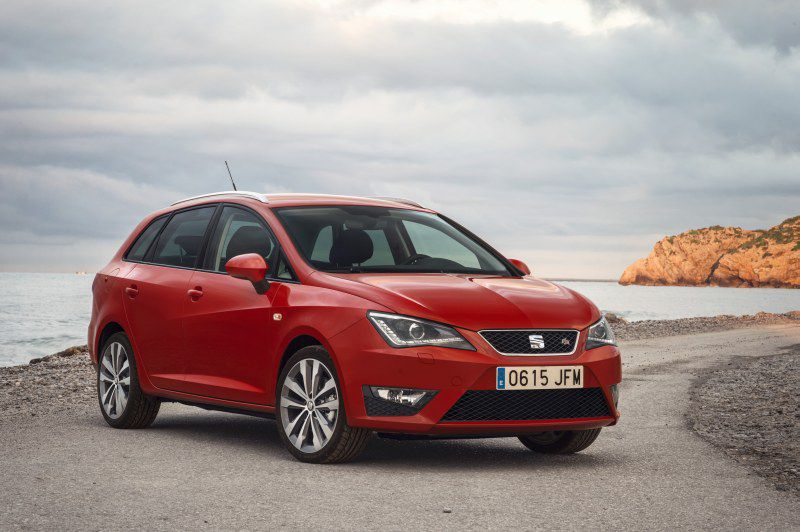
The Seat Ibiza IV ST (facelift 2015) represents a compelling iteration of the Spanish automaker SEAT’s popular subcompact offering, specifically in its station wagon (or estate, as it’s known in Europe) body style. As a prominent member of the Volkswagen Group, SEAT has long carved out a niche for itself by offering vehicles that blend German engineering with a distinctly Mediterranean flair. The Ibiza, SEAT’s longest-running and best-selling model, has consistently been a cornerstone of the European B-segment, competing vigorously in the compact car market.
This particular variant, produced from May 2015 to 2017, benefited from a significant mid-cycle refresh, bringing updated styling, enhanced technology, and refined powertrains to maintain its competitive edge. The “ST” designation stands for “Sport Tourer,” indicating its station wagon body, which provided a substantial increase in practicality and cargo volume compared to its hatchback sibling, without significantly increasing its overall footprint. This made the Ibiza ST an attractive proposition for European families and individuals seeking a versatile, economical, and urban-friendly vehicle. The 1.0-liter, 75 horsepower engine variant, in particular, was geared towards efficiency and affordability, perfectly suiting the needs of its primary European market where fuel economy and lower emissions are paramount.
Engine & Performance
Under the hood of the Seat Ibiza IV ST (facelift 2015) 1.0 (75 Hp) lies a compact and efficient 999 cubic centimeter (60.96 cu. in.) three-cylinder gasoline engine, identified by the internal code CHYB. This naturally aspirated unit is configured in an inline layout, mounted transversely at the front of the vehicle, driving the front wheels. Despite its modest displacement, it delivers a respectable 75 horsepower at 6200 rpm, reflecting SEAT’s commitment to extracting maximum efficiency and usable power from smaller engines. Torque output stands at 70.07 lb.-ft. (95 Nm), available across a broad rev range from 3000 to 4300 rpm, which aids in city driving and provides decent responsiveness at everyday speeds.
The engine utilizes a multi-port manifold injection system and features four valves per cylinder, contributing to its efficient combustion and adherence to the stringent Euro 6 emission standard. Power is channeled through a precise 5-speed manual transmission, a common and reliable choice for vehicles in this segment, offering drivers direct control over power delivery and further contributing to the car’s fuel efficiency.
In terms of performance, the Ibiza ST 1.0 (75 Hp) is not designed for outright speed but rather for economical and practical motoring. It accelerates from 0 to 60 mph in 14.1 seconds (0-100 km/h in 14.8 seconds), with a maximum speed of 106.88 mph (172 km/h). These figures are perfectly adequate for urban and suburban commuting, as well as comfortable highway cruising within European speed limits. More impressively, its fuel economy is rated at a combined 48 US mpg (4.9 l/100 km), making it a highly economical choice. The low CO2 emissions of 110 g/km further underscore its environmentally conscious design, a significant factor for taxation and ownership costs in many European countries. The weight-to-power ratio of 13.7 kg/Hp (73.2 Hp/tonne) and weight-to-torque ratio of 10.8 kg/Nm (92.8 Nm/tonne) highlight its lightweight construction (kerb weight of 2257.53 lbs. or 1024 kg), allowing the small engine to perform effectively without feeling overly strained.
Design & Features
The design of the Seat Ibiza IV ST (facelift 2015) reflects SEAT’s characteristic sharp lines and dynamic proportions, even in its more utilitarian station wagon form. The 2015 facelift brought subtle yet effective updates, including revised headlights (often with LED daytime running lights as an option), a refreshed grille, and updated wheel designs, giving the car a more modern and assertive look. Its dimensions – 166.77 inches (4236 mm) in length, 66.65 inches (1693 mm) in width, and 56.89 inches (1445 mm) in height – make it a compact vehicle, ideally suited for navigating congested European city streets and tight parking spaces. The 97.2-inch (2469 mm) wheelbase provides a stable ride while maintaining agility.
The primary appeal of the “ST” model is its enhanced practicality. The station wagon body style offers five doors and comfortable seating for five occupants. Crucially, it boasts a generous minimum trunk (boot) space of 15.19 cubic feet (430 liters), which is significantly more than the hatchback and competitive within its segment. This ample cargo capacity makes it a versatile choice for families, offering enough room for groceries, luggage, or sports equipment. The interior design, while functional, provides a pleasant cabin environment, with materials and finishes that are competitive for its class. Standard features would typically include air conditioning, power windows, and a basic infotainment system, with higher trims offering more advanced options like touchscreen displays and connectivity features.
On the chassis front, the Ibiza ST employs a robust and proven setup. The front suspension features an independent McPherson strut system with coil springs and an anti-roll bar, ensuring precise steering and good road holding. The rear utilizes a semi-independent setup with coil springs, balancing comfort with load-carrying capability. Steering is handled by a responsive rack and pinion system. Safety is addressed with ventilated disc brakes at the front and drum brakes at the rear, complemented by an Anti-lock Braking System (ABS) for enhanced stopping performance and control. Various tire size options were available, ranging from 175/70 R14 to 215/45 R16, mounted on 14, 15, or 16-inch wheel rims, allowing for customization in terms of ride comfort and handling characteristics.
Seat Ibiza IV ST (facelift 2015) Technical Specifications
| Brand | Seat |
| Model | Ibiza IV ST (facelift 2015) |
| Type (Engine) | 1.0 (75 Hp) |
| Production Years | May 2015 – 2017 |
| Body Type | Station wagon (Estate) |
| Seats | 5 |
| Doors | 5 |
| Fuel Consumption (Combined) | 4.9 l/100 km (48 US mpg) |
| CO2 Emissions | 110 g/km |
| Fuel Type | Petrol (Gasoline) |
| Acceleration 0 – 60 mph | 14.1 sec |
| Maximum Speed | 106.88 mph (172 km/h) |
| Emission Standard | Euro 6 |
| Weight-to-Power Ratio | 13.7 kg/Hp (73.2 Hp/tonne) |
| Weight-to-Torque Ratio | 10.8 kg/Nm (92.8 Nm/tonne) |
| Power | 75 Hp @ 6200 rpm |
| Power per Liter | 75.1 Hp/l |
| Torque | 70.07 lb.-ft. (95 Nm) @ 3000-4300 rpm |
| Engine Layout | Front, Transverse |
| Engine Model/Code | CHYB |
| Engine Displacement | 999 cm3 (60.96 cu. in.) |
| Number of Cylinders | 3 |
| Engine Configuration | Inline |
| Cylinder Bore | 2.93 in. (74.5 mm) |
| Piston Stroke | 3.01 in. (76.4 mm) |
| Compression Ratio | 10.5:1 |
| Valves per Cylinder | 4 |
| Fuel Injection System | Multi-port manifold injection |
| Engine Aspiration | Naturally aspirated engine |
| Engine Oil Capacity | 3.59 US qt (3.4 l) |
| Coolant Capacity | 8.45 US qt (8 l) |
| Kerb Weight | 2257.53 lbs. (1024 kg) |
| Max. Weight (GVWR) | 3461.26 lbs. (1570 kg) |
| Max Load | 1203.72 lbs. (546 kg) |
| Trunk (Boot) Space – Minimum | 15.19 cu. ft. (430 l) |
| Fuel Tank Capacity | 11.89 US gal (45 l) |
| Length | 166.77 in. (4236 mm) |
| Width | 66.65 in. (1693 mm) |
| Height | 56.89 in. (1445 mm) |
| Wheelbase | 97.2 in. (2469 mm) |
| Front Track | 57.68 in. (1465 mm) |
| Rear Track | 57.36 in. (1457 mm) |
| Minimum Turning Circle | 32.81 ft. (10 m) |
| Drivetrain Architecture | Internal combustion engine drives the front wheels |
| Drive Wheel | Front-wheel drive |
| Gearbox Type | 5 gears, manual transmission |
| Front Suspension | Independent, McPherson with coil spring and anti-roll bar |
| Rear Suspension | Semi-independent, coil spring |
| Front Brakes | Ventilated discs |
| Rear Brakes | Drum |
| Assisting Systems | ABS (Anti-lock braking system) |
| Steering Type | Steering rack and pinion |
| Tire Sizes | 175/70 R14; 185/60 R15; 215/45 R16 |
| Wheel Rim Sizes | 14; 15; 16 inches |
Legacy and Market Impact
The Seat Ibiza IV ST (facelift 2015) 1.0 (75 Hp) played a crucial role in SEAT’s product lineup, particularly in the European market where compact station wagons held significant appeal before the widespread dominance of crossovers. It offered a compelling alternative for consumers who needed the practicality of a larger vehicle but preferred the maneuverability and fuel efficiency of a subcompact. Its primary competitors included other B-segment wagons like the Skoda Fabia Combi (from its VW Group stablemate), the Renault Clio Estate, and to some extent, the Dacia Logan MCV, all vying for the attention of budget-conscious families and fleet buyers.
The Ibiza ST gained a reputation for being a reliable, well-built, and practical car, benefiting from the robust engineering foundations provided by the Volkswagen Group. Its economical 1.0-liter engine, combined with its spacious trunk and compact dimensions, made it an ideal choice for urban dwellers and those with active lifestyles who still needed to navigate tight city streets. While not a performance leader, its handling was generally praised for being agile and engaging, characteristic of SEAT’s sportier brand image compared to its VW and Skoda counterparts.
Historically, the Ibiza ST helped SEAT expand the appeal of the Ibiza nameplate beyond just the popular hatchback. It demonstrated SEAT’s ability to offer versatile body styles that catered to diverse customer needs, reinforcing the brand’s position as a youthful and dynamic option within the competitive European automotive landscape. Its production run, concluding in 2017, marked the end of the Ibiza ST variant, as SEAT, like many manufacturers, shifted its focus towards SUV and crossover models for the subsequent generation of the Ibiza, reflecting evolving market preferences. Nevertheless, the Ibiza IV ST (facelift 2015) remains a testament to SEAT’s commitment to delivering practical, efficient, and well-designed vehicles for its core European audience.