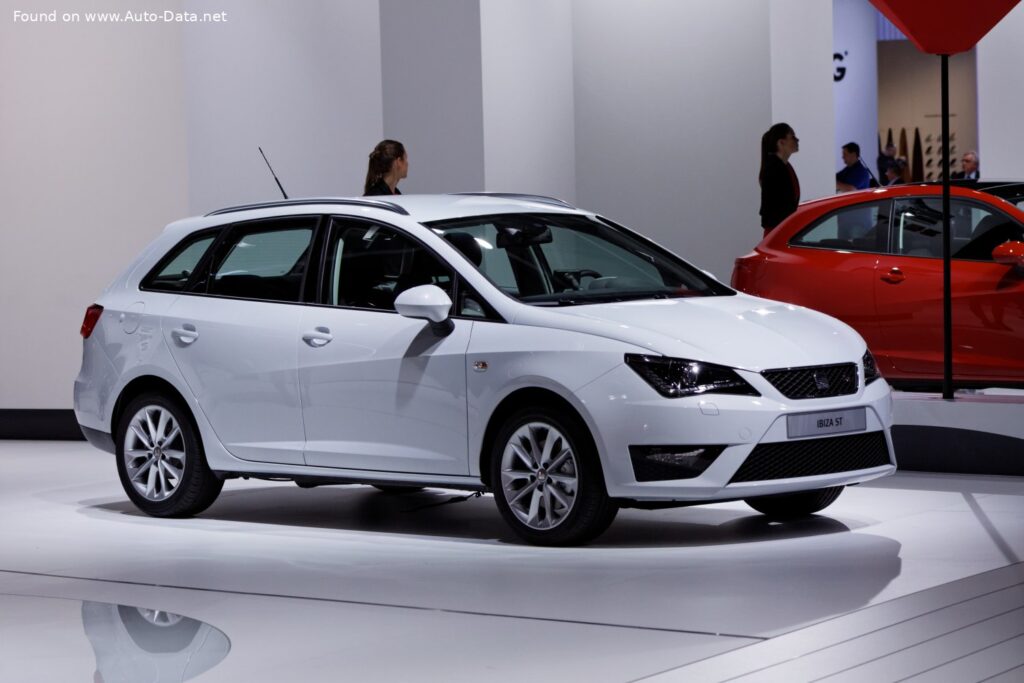
The Seat Ibiza IV ST (facelift 2012) represents a significant iteration in the lineage of Seat’s popular subcompact car, the Ibiza. As a brand within the Volkswagen Group, Seat primarily caters to European and select international markets, offering vehicles known for their sporty design and accessible price point. The fourth generation Ibiza, introduced in 2008, received a mid-cycle refresh in 2012, bringing updated styling and minor mechanical tweaks. This particular variant, the “ST” (Sport Tourer or Station Wagon), carved out a niche for itself by offering enhanced practicality and cargo space within the typically hatchback-dominated B-segment (subcompact class). Produced from 2012 to 2015, the Ibiza ST was a compelling choice for European families and individuals seeking the maneuverability of a small car combined with the versatility of a station wagon, embodying efficiency and functional design for its target demographic.
The Seat Ibiza IV ST (facelift 2012): A European Subcompact
The Ibiza nameplate has been a cornerstone of Seat’s offerings for decades, and the fourth generation, particularly the ST variant, aimed to broaden its appeal. Unlike many American market segments, the European B-segment (subcompact) heavily features station wagon options, catering to a demand for practicality within a smaller footprint. The Ibiza ST successfully blended Seat’s design ethos with the functional requirements of a family vehicle, offering a compelling alternative to larger, more expensive options.
Engine & Performance
Powering the Seat Ibiza IV ST (facelift 2012) is a 1.2-liter three-cylinder gasoline engine, identified by engine codes CGPA or CJLB. This naturally aspirated unit was designed with fuel economy and reliability as primary objectives. It produces a peak output of 70 horsepower at 5400 revolutions per minute (rpm) and a maximum torque of 82.61 lb.-ft. (112 Nm) at 3000 rpm. While not a performance-focused engine, the torque delivery at lower rpm provides adequate drivability for urban and suburban environments.
The powertrain utilizes a front-engine, front-wheel-drive configuration, coupled with a five-speed manual transmission. Acceleration from 0 to 60 mph is achieved in approximately 13.9 seconds, with a top speed of 101.28 mph (163 km/h). These figures reflect the vehicle’s intended purpose as a practical and economical commuter. Fuel efficiency is a key strength, achieving a combined fuel consumption of 42.8 US mpg (5.5 l/100 km). Extra-urban driving yields up to 52.3 US mpg (4.5 l/100 km), while city driving returns around 32.2 US mpg (7.3 l/100 km). CO2 emissions are rated at 128 g/km, meeting Euro 5 emission standards. The engine employs multi-port manifold fuel injection for precise fuel delivery and efficient combustion.
Design & Features
The 2012 facelift brought subtle but noticeable aesthetic updates to the fourth-generation Ibiza, aligning it with Seat’s evolving design language. The Ibiza ST retained the sharp, dynamic lines characteristic of Seat’s “auto emoción” design philosophy. The defining feature of the ST variant is its extended rear section, providing significantly increased cargo volume compared to the standard hatchback. This body style directly addressed the demand for more versatile compact vehicles.
The Ibiza ST measures 166.77 inches (4236 mm) in length, 66.65 inches (1693 mm) in width, and 56.89 inches (1445 mm) in height, with a wheelbase of 97.2 inches (2469 mm). Its compact dimensions ensure maneuverability in congested urban environments, with a turning circle of 34.38 feet (10.48 m). The station wagon body style provides a minimum trunk space of 15.19 cubic feet (430 liters), expandable by folding the rear seats. The vehicle comfortably accommodates five passengers.
Standard features included an Anti-lock Braking System (ABS), essential for safe braking. The front suspension utilizes an independent McPherson strut design with coil springs and an anti-roll bar, while the rear employs a semi-independent setup with coil springs, offering a balanced ride and handling. Braking is provided by ventilated discs at the front and drum brakes at the rear. Wheel and tire options ranged from 175/70 R14 to 215/40 R17, allowing for customization. The interior focused on ergonomic design and durable materials, typical of Volkswagen Group vehicles, providing a comfortable and intuitive driving experience.
Technical Specifications: Seat Ibiza IV ST (facelift 2012) 1.2 (70 Hp)
| Category | Specification |
| General Information | |
| Brand | Seat |
| Model | Ibiza |
| Generation | Ibiza IV ST (facelift 2012) |
| Type (Engine) | 1.2 (70 Hp) |
| Start of Production | 2012 |
| End of Production | 2015 |
| Powertrain Architecture | Internal Combustion engine |
| Body type | Station wagon (estate) |
| Seats | 5 |
| Doors | 5 |
| Performance Specs | |
| Fuel consumption (economy) – urban | 7.3 l/100 km (32.2 US mpg) |
| Fuel consumption (economy) – extra urban | 4.5 l/100 km (52.3 US mpg) |
| Fuel consumption (economy) – combined | 5.5 l/100 km (42.8 US mpg) |
| CO2 emissions | 128 g/km |
| Fuel Type | Petrol (Gasoline) |
| Acceleration 0 – 60 mph | 13.9 sec |
| Maximum speed | 163 km/h (101.28 mph) |
| Emission standard | Euro 5 |
| Weight-to-power ratio | 15.9 kg/Hp |
| Weight-to-torque ratio | 9.9 kg/Nm |
| Engine Specs | |
| Power | 70 Hp @ 5400 rpm |
| Power per liter | 58.4 Hp/l |
| Torque | 112 Nm @ 3000 rpm (82.61 lb.-ft. @ 3000 rpm) |
| Engine layout | Front, Transverse |
| Engine Model/Code | CGPA, CJLB |
| Engine displacement | 1198 cm3 (1.2 liters / 73.11 cu. in.) |
| Number of cylinders | 3 |
| Engine configuration | Inline |
| Cylinder Bore | 76.5 mm (3.01 in.) |
| Piston Stroke | 86.9 mm (3.42 in.) |
| Compression ratio | 10.5:1 |
| Number of valves per cylinder | 4 |
| Fuel injection system | Multi-port manifold injection |
| Engine aspiration | Naturally aspirated engine |
| Engine oil capacity | 3 l (3.17 US qt) |
| Coolant | 5.6 l (5.92 US qt) |
| Space, Volume and Weights | |
| Kerb Weight | 1110 kg (2447.13 lbs.) |
| Max. weight | 1565 kg (3450.23 lbs.) |
| Max load | 455 kg (1003.1 lbs.) |
| Trunk (boot) space – minimum | 430 l (15.19 cu. ft.) |
| Fuel tank capacity | 45 l (11.89 US gal) |
| Dimensions | |
| Length | 4236 mm (166.77 in.) |
| Width | 1693 mm (66.65 in.) |
| Height | 1445 mm (56.89 in.) |
| Wheelbase | 2469 mm (97.2 in.) |
| Front track | 1465 mm (57.68 in.) |
| Rear (Back) track | 1457 mm (57.36 in.) |
| Minimum turning circle (turning diameter) | 10.48 m (34.38 ft.) |
| Drivetrain, Brakes and Suspension Specs | |
| Drivetrain Architecture | The Internal combustion engine (ICE) drives the front wheels of the vehicle. |
| Drive wheel | Front wheel drive |
| Number of gears and type of gearbox | 5 gears, manual transmission |
| Front suspension | Independent, type McPherson with coil spring and anti-roll bar |
| Rear suspension | Semi-independent, coil spring |
| Front brakes | Ventilated discs |
| Rear brakes | Drum |
| Assisting systems | ABS (Anti-lock braking system) |
| Steering type | Steering rack and pinion |
| Tires size | 175/70 R14; 185/60 R15; 215/45 R16; 215/40 R17 |
| Wheel rims size | 5.0J x 14; 6.0J x 15; 7.0J x 16; 7.0J x 17 |
Legacy and Market Impact
The Seat Ibiza, and specifically the IV generation ST variant, played a significant role in Seat’s strategy within the competitive European subcompact segment. The Ibiza ST offered a practical, stylish, and economical alternative to traditional hatchbacks, providing the added utility of a station wagon without a substantial increase in cost or size. Competitors included the Skoda Fabia Combi, Renault Clio Estate, and Peugeot 207 SW. The Ibiza ST distinguished itself with its distinctive Spanish design and sporty character.
The 1.2-liter engine appealed to buyers prioritizing low running costs and fuel efficiency, particularly in markets with fuel-based taxation. Its combination of a spacious trunk, five-door accessibility, and compact dimensions made it ideal for young families or individuals needing extra cargo space. The Ibiza ST contributed to Seat’s reputation for delivering practical and engaging vehicles. While station wagons have declined in popularity in favor of SUVs, the Ibiza ST remains a testament to a time when subcompact wagons offered a compelling blend of versatility and efficiency.