
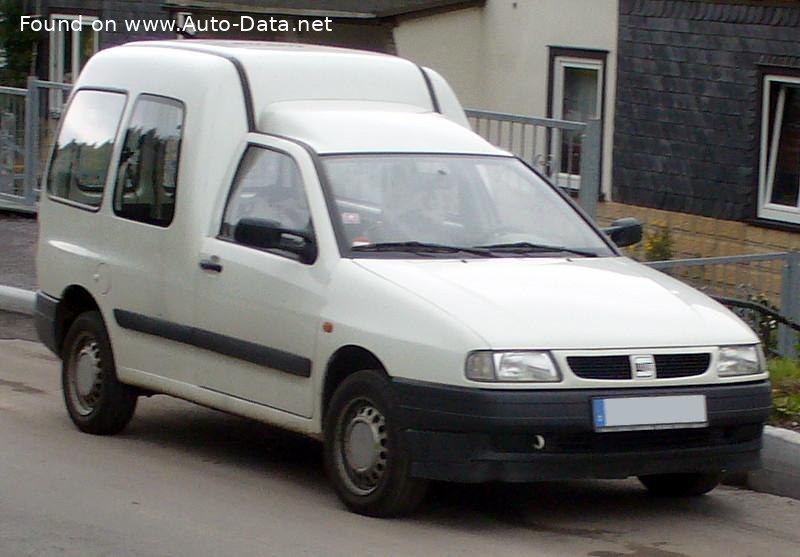
The Seat Inca (9K) 1.9 SDi (64 Hp) represents a significant chapter in the history of compact utility vehicles, particularly within the European market. Produced by the Spanish automaker SEAT, a subsidiary of the Volkswagen Group, the Inca (9K) was introduced in 1999 and remained in production until October 2004. Classified primarily as a minivan, this generation of the Inca was a versatile offering, available in both passenger-oriented and commercial panel van configurations. Based on the robust platform shared with the SEAT Ibiza and Cordoba, as well as the Volkswagen Caddy (Mk2), the Inca was engineered for practicality, durability, and fuel efficiency – characteristics highly valued in its target markets. While never officially sold in the United States, the Seat Inca (9K) 1.9 SDi (64 Hp) carved out a niche for itself as a reliable and economical solution for small businesses and families seeking a no-frills, spacious vehicle across Europe and other international markets.
Seat Inca (9K) 1.9 SDi (64 Hp): A European Workhorse
The Seat Inca (9K) was designed to address the growing demand for compact, versatile vehicles capable of serving both commercial and personal needs. Its development was heavily influenced by the Volkswagen Group’s engineering expertise, leveraging shared components and technologies to create a cost-effective and reliable vehicle. The Inca’s success stemmed from its ability to provide a practical solution for a wide range of users, from small business owners requiring a dependable work vehicle to families seeking an affordable and spacious mode of transport.
Engine & Performance
Under the hood, the Seat Inca (9K) 1.9 SDi (64 Hp) featured a 1.9-liter (1896 cm3 or 115.7 cubic inches) inline four-cylinder diesel engine, designated with codes AEY or AYQ. This naturally aspirated engine produced 64 horsepower at 4200 revolutions per minute, with a peak torque of 94.41 lb.-ft. available between 2200 and 2800 rpm. The direct injection SDi (Suction Diesel Injection) system prioritized simplicity, reliability, and fuel economy over outright performance. Power was delivered to the front wheels via a five-speed manual transmission, optimized for efficiency and ease of maintenance.
Acceleration figures reflected the engine’s utilitarian focus, with an estimated 0-60 mph time of 19.3 seconds and a top speed of 89.48 mph. However, these numbers were considered acceptable for a vehicle designed for urban and light commercial duties. The naturally aspirated engine provided a linear power delivery, avoiding the turbo lag often associated with turbocharged diesel engines. Fuel efficiency was a major strength, with combined fuel consumption rated at an impressive 39.9 US mpg (5.9 liters per 100 km). Extra-urban driving yielded even better results at 47 US mpg (5 liters per 100 km), while urban driving achieved 31.4 US mpg (7.5 liters per 100 km). A 14.27 US gallon (54-liter) fuel tank provided excellent range. CO2 emissions were rated at 159 g/km, a reasonable figure for its time. The engine’s robust design, featuring a compression ratio of 19.5:1 and a SOHC valvetrain with two valves per cylinder, underscored its engineering for longevity and low running costs.
Design & Features
The design philosophy behind the Seat Inca (9K) was unequivocally rooted in practicality and utility. As a 3-door minivan, the passenger version offered seating for five, making it a viable option for families. Its boxy, functional body shape, measuring 165.63 inches in length, 66.77 inches in width, and 72.28 inches in height, maximized interior volume. The generous height provided ample headroom and a large cargo area, particularly in the commercial variants. The 102.4-inch wheelbase contributed to a stable ride.
The exterior styling was straightforward and unpretentious. Large windows in the passenger version offered good visibility, while the high roofline facilitated easy loading and unloading. The chassis featured an independent McPherson strut front suspension with coil springs and an anti-roll bar for adequate comfort and handling. The rear suspension, however, highlighted its commercial roots: a rigid axle with robust leaf springs, designed to cope with significant loads up to 1311.75 lbs (595 kg). Braking duties were handled by disc brakes at the front and drum brakes at the rear. Steering was a hydraulic rack and pinion system, offering direct and reliable feedback. The vehicle rode on 175/65 R14 tires mounted on 5.5J x 14 wheel rims. While the interior was sparse by modern standards, it was ergonomically designed for ease of use, with durable materials intended to withstand daily use.
Technical Specifications
| Category | Specification |
| General Information | |
| Brand | Seat |
| Model | Inca |
| Generation | Inca (9K) |
| Engine Type | 1.9 SDi (64 Hp) |
| Production Start | 1999 |
| Production End | October, 2004 |
| Powertrain Architecture | Internal Combustion engine |
| Body type | Minivan |
| Seats | 5 |
| Doors | 3 |
| Performance Specs | |
| Fuel consumption (economy) – urban | 7.5 l/100 km (31.4 US mpg) |
| Fuel consumption (economy) – extra urban | 5 l/100 km (47 US mpg) |
| Fuel consumption (economy) – combined | 5.9 l/100 km (39.9 US mpg) |
| CO2 emissions | 159 g/km |
| Fuel Type | Diesel |
| Acceleration 0 – 60 mph | 19.3 sec |
| Acceleration 0 – 62 mph (0-100 km/h) | 20.3 sec |
| Maximum speed | 89.48 mph (144 km/h) |
| Weight-to-power ratio | 17.7 kg/Hp, 56.4 Hp/tonne |
| Weight-to-torque ratio | 8.9 kg/Nm, 112.8 Nm/tonne |
| Engine Specs | |
| Power | 64 Hp @ 4200 rpm |
| Power per liter | 33.8 Hp/l |
| Torque | 94.41 lb.-ft. @ 2200-2800 rpm (128 Nm) |
| Engine layout | Front, Transverse |
| Engine Model/Code | AEY, AYQ |
| Engine displacement | 1.9 Liters (1896 cm3, 115.7 cu. in.) |
| Number of cylinders | 4 |
| Engine configuration | Inline |
| Cylinder Bore | 3.13 in. (79.5 mm) |
| Piston Stroke | 3.76 in. (95.5 mm) |
| Compression ratio | 19.5:1 |
| Number of valves per cylinder | 2 |
| Fuel injection system | Direct injection |
| Engine aspiration | Naturally aspirated engine |
| Valvetrain | SOHC |
| Engine oil capacity | 4.76 US qt (4.5 l) |
| Coolant capacity | 5.28 US qt (5 l) |
| Space, Volume and Weights | |
| Kerb Weight | 2502.25 – 2568.39 lbs. (1135-1165 kg) |
| Max. weight | 3814 lbs. (1730 kg) |
| Max load | 1245.61 – 1311.75 lbs. (565-595 kg) |
| Fuel tank capacity | 14.27 US gal (54 l) |
| Max. roof load | 154.32 lbs. (70 kg) |
| Permitted trailer load with brakes (12%) | 2204.62 lbs. (1000 kg) |
| Permitted trailer load without brakes | 1102.31 lbs. (500 kg) |
| Dimensions | |
| Length | 165.63 in. (4207 mm) |
| Width | 66.77 in. (1696 mm) |
| Height | 72.28 in. (1836 mm) |
| Wheelbase | 102.4 in. (2601 mm) |
| Front track | 56.54 in. (1436 mm) |
| Rear (Back) track | 57.17 in. (1452 mm) |
| Front overhang | 33.82 in. (859 mm) |
| Rear overhang | 29.41 in. (747 mm) |
| Minimum turning circle (turning diameter) | 34.45 ft. (10.5 m) |
| Drivetrain, Brakes and Suspension Specs | |
| Drivetrain Architecture | Front wheel drive, Internal Combustion engine |
| Drive wheel | Front wheel drive |
| Number of gears and type of gearbox | 5 gears, manual transmission |
| Front suspension | Independent, type McPherson with coil spring and anti-roll bar |
| Rear suspension | Rigid axle suspension, Leaf spring |
| Front brakes | Disc |
| Rear brakes | Drum |
| Steering type | Steering rack and pinion |
| Power steering | Hydraulic Steering |
| Tires size | 175/65 R14 |
| Wheel rims size | 5.5J x 14 |
Legacy and Market Impact
The Seat Inca (9K) 1.9 SDi (64 Hp) played a crucial role in SEAT’s product lineup, particularly in its primary European markets. It was positioned as a versatile and economical option within the burgeoning “leisure activity vehicle” (LAV) segment, which combined the practicality of a commercial van with the comfort and features suitable for private use. Its direct competitors included other European compact vans and MPVs such as the Renault Kangoo, Citroën Berlingo, Peugeot Partner, Fiat Doblò, and later, the Opel Combo and Ford Transit Connect. In this highly competitive segment, the Inca distinguished itself through its robust Volkswagen Group engineering, proven diesel reliability, and competitive pricing.
The Inca’s reputation was built on its unwavering reliability, excellent fuel efficiency, and straightforward design. It was a no-nonsense vehicle that delivered on its promise of dependable transport, whether for tradespeople hauling tools and materials or for families needing ample space for children and luggage. Its modest performance figures were offset by its low running costs and ease of maintenance, making it a popular choice for budget-conscious buyers and fleets. The SDi engine, while not powerful, was celebrated for its longevity and ability to perform consistently even under heavy loads, a testament to its industrial design.
Upon the discontinuation of the Inca in 2004, its legacy was effectively continued by the Volkswagen Caddy, which evolved to fill the same market segment with updated technology and design. While the Seat Inca (9K) 1.9 SDi (64 Hp) might not be a familiar sight on American roads, its impact as a durable, efficient, and highly practical utility vehicle across Europe and beyond cemented its place as a significant model in SEAT’s history and in the evolution of the compact van segment. It remains a prime example of how thoughtful engineering and a focus on core utility can create a vehicle with enduring appeal and a lasting reputation for dependability.
