
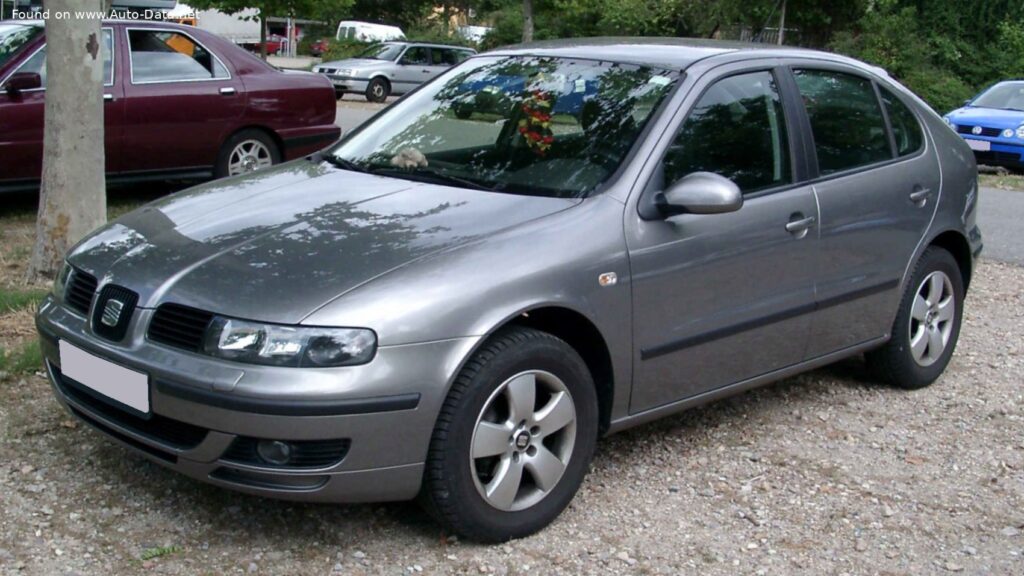
The Seat Leon I (1M) 1.8 20V (125 Hp) Automatic represents a pivotal model for the Spanish automaker SEAT, a subsidiary of the Volkswagen Group. Launched in November 1999 and produced until May 2005, the first-generation Leon, internally designated 1M, was SEAT’s ambitious entry into the highly competitive European C-segment compact car market. While never officially sold in the United States, the Leon quickly established itself as a dynamic and stylish alternative to its Volkswagen Golf and Audi A3 platform siblings across Europe and other international markets. It embodied SEAT’s “Auto Emoción” philosophy, aiming to inject passion and sportiness into practical family motoring.
Built on the robust and versatile A4 (PQ34) platform shared with numerous Volkswagen Group models, the Leon I (1M) benefited from proven engineering and a wide array of powertrains. The specific variant under review, the 1.8 20V with 125 horsepower and an automatic transmission, offered a blend of accessible performance and ease of driving, appealing to a broad segment of buyers seeking a comfortable daily driver with a touch of Spanish flair. This article delves into the technical prowess, design philosophy, and enduring legacy of this significant European hatchback.
Engine & Performance of the Seat Leon I (1M)
At the heart of the Seat Leon I (1M) 1.8 20V (125 Hp) Automatic lies a naturally aspirated 1.8-liter (1781 cm3 or 108.68 cu. in.) inline-four gasoline engine. This engine configuration, known for its “20V” designation, signifies a sophisticated cylinder head design featuring five valves per cylinder (three intake, two exhaust), a technology popularized by the Volkswagen Group in the late 1990s and early 2000s to enhance breathing efficiency and power delivery across the rev range. With a compression ratio of 10.3:1 and multi-port manifold injection, this DOHC (Double Overhead Camshaft) engine, bearing codes like AGN or APG, was engineered for a balance of refinement and power.
The engine produced a respectable 125 horsepower at 6000 rpm, translating to a power-per-liter output of 70.2 HP/l, which was competitive for a naturally aspirated unit of its time. Torque figures stood at 125.39 lb.-ft. (170 Nm) delivered at 4200 rpm, providing a strong mid-range pull. Power was routed to the front wheels via a conventional 4-speed automatic transmission, prioritizing smooth shifts and driving convenience over outright acceleration.
Performance metrics for this variant reflected its role as a comfortable cruiser rather than a performance hot hatch. The 0-60 mph sprint was achieved in an estimated 11.4 seconds (0-100 km/h in 12 seconds), and the car could reach a maximum speed of 122.41 mph (197 km/h). While not blisteringly fast, these figures were more than adequate for everyday driving and highway cruising in Europe. The weight-to-power ratio of 10.4 kg/Hp (96.4 Hp/tonne) and a weight-to-torque ratio of 7.6 kg/Nm (131.1 Nm/tonne) further underscore its balanced nature.
Fuel efficiency, measured by European standards, translated to a combined cycle of 28 US mpg (8.4 l/100 km). Urban driving saw consumption around 19.6 US mpg (12 l/100 km), while extra-urban conditions improved significantly to 35.1 US mpg (6.7 l/100 km). With a 14.53 US gallon (55-liter) fuel tank, the Leon offered a decent cruising range, making it suitable for longer journeys.
Design & Features of the Seat Leon I (1M)
The design of the first-generation Seat Leon I (1M) was penned by Italian automotive designer Walter de Silva, who would later go on to shape iconic models for Alfa Romeo and Volkswagen. The Leon adopted a distinctive five-door hatchback body style, characterized by its flowing lines, aggressive front fascia with prominent headlights, and a subtly sculpted profile that gave it a sportier stance than many of its contemporaries. Its compact dimensions – 164.72 inches (4184 mm) in length, 68.58 inches (1742 mm) in width, and 56.65 inches (1439 mm) in height – made it agile for city driving while offering sufficient interior space. The wheelbase measured 98.94 inches (2513 mm), contributing to a stable ride.
Inside, the Leon I (1M) offered a functional and ergonomic cabin designed to accommodate five occupants comfortably. The interior styling, while sharing some common Volkswagen Group components, featured SEAT’s distinct touch, often incorporating red illumination for instruments and a sporty three-spoke steering wheel. The trunk space was practical, offering a minimum of 12.01 cu. ft. (340 liters) with the rear seats up, expandable to 23.17 cu. ft. (656 liters) when folded down, highlighting its versatility as a family vehicle.
In terms of features, the Leon I (1M) 1.8 20V Automatic came equipped with essential safety and convenience technologies for its era. Standard safety features included an Anti-lock Braking System (ABS) with ventilated discs at the front and solid discs at the rear, providing reliable stopping power. The suspension setup, featuring a wishbone design at the front and a coil spring arrangement at the rear, contributed to a compliant ride and responsive handling, staying true to SEAT’s dynamic brand image. Steering was a hydraulic rack and pinion system, known for offering good feedback to the driver. The car rode on 195/65 R15 tires mounted on 15-inch wheel rims.
Technical Specifications
| Category | Specification |
| Brand | Seat |
| Model | Leon I (1M) |
| Type (Engine) | 1.8 20V (125 Hp) Automatic |
| Production Start | November, 1999 |
| Production End | May, 2005 |
| Body Type | Hatchback |
| Seats | 5 |
| Doors | 5 |
| Fuel Type | Petrol (Gasoline) |
| Engine Layout | Front, Transverse |
| Engine Model/Code | AGN, APG |
| Engine Displacement | 1.8 liters (1781 cm3 / 108.68 cu. in.) |
| Number of Cylinders | 4, Inline |
| Valves per Cylinder | 5 |
| Valvetrain | DOHC |
| Bore x Stroke | 3.19 in. (81 mm) x 3.4 in. (86.4 mm) |
| Compression Ratio | 10.3:1 |
| Fuel Injection System | Multi-port manifold injection |
| Engine Aspiration | Naturally aspirated |
| Power | 125 HP @ 6000 rpm |
| Torque | 125.39 lb.-ft. (170 Nm) @ 4200 rpm |
| Power per Liter | 70.2 Hp/l |
| Acceleration 0-60 mph | 11.4 seconds |
| Maximum Speed | 122.41 mph (197 km/h) |
| Fuel Economy (Urban) | 19.6 US mpg (12 l/100 km) |
| Fuel Economy (Extra Urban) | 35.1 US mpg (6.7 l/100 km) |
| Fuel Economy (Combined) | 28 US mpg (8.4 l/100 km) |
| Fuel Tank Capacity | 14.53 US gallons (55 liters) |
| Drivetrain Architecture | Front-wheel drive (ICE drives front wheels) |
| Gearbox | 4-speed automatic transmission |
| Front Suspension | Wishbone |
| Rear Suspension | Coil spring |
| Front Brakes | Ventilated discs |
| Rear Brakes | Disc |
| Assisting Systems | ABS (Anti-lock Braking System) |
| Steering Type | Steering rack and pinion, Hydraulic Power Steering |
| Tires Size | 195/65 R15 |
| Wheel Rims Size | 15 inches |
| Kerb Weight | 2859.4 lbs. (1297 kg) |
| Max. Weight | 3725.81 lbs. (1690 kg) |
| Max Load | 866.42 lbs. (393 kg) |
| Trunk Space (Min/Max) | 12.01 – 23.17 cu. ft. (340 – 656 liters) |
| Length | 164.72 in. (4184 mm) |
| Width | 68.58 in. (1742 mm) |
| Height | 56.65 in. (1439 mm) |
| Wheelbase | 98.94 in. (2513 mm) |
| Front Track | 59.57 in. (1513 mm) |
| Rear Track | 58.74 in. (1492 mm) |
| Engine Oil Capacity | 4.76 US qt (4.5 liters) |
| Coolant Capacity | 5.28 US qt (5 liters) |
Legacy and Market Impact of the Seat Leon I (1M)
The Seat Leon I (1M) made a significant mark in the European compact car segment, successfully establishing SEAT as a brand capable of delivering stylish, well-engineered, and dynamically engaging vehicles. Before the Leon, SEAT’s identity within the Volkswagen Group was somewhat less defined, often perceived as a budget alternative. The Leon, however, changed this perception, injecting a much-needed dose of “Auto Emoción” into the brand’s image.
Competing in a fiercely contested market, the Leon I (1M) faced formidable rivals such as its platform siblings, the Volkswagen Golf Mk4, Audi A3 (8L), and Skoda Octavia (1U), as well as other popular European hatchbacks like the Ford Focus Mk1, Opel Astra G, Peugeot 307, and Renault Mégane II. What set the Leon apart was its more assertive styling and a suspension tune that, while comfortable enough for daily use, offered a noticeably sportier driving feel than the Golf, albeit not as refined as the A3. This balance resonated with buyers looking for a car that was both practical and fun to drive.
The 1.8 20V (125 Hp) Automatic variant, in particular, carved out a niche for itself as a sensible choice for those who appreciated the Leon’s aesthetics and handling but preferred the convenience of an automatic transmission for urban commutes and relaxed cruising. While not the most powerful or fastest in the lineup (which included turbocharged 1.8T and V6 Cupra R versions), it offered a smooth, competent, and reliable powertrain, leveraging the Volkswagen Group’s reputation for mechanical durability.
The success of the first-generation Leon laid the groundwork for future generations, solidifying SEAT’s position as the sporty, youthful arm of the Volkswagen Group. It helped expand SEAT’s sales beyond its traditional Spanish market, gaining considerable popularity in countries like Germany, the UK, and Italy. Today, the Leon I (1M) is regarded by enthusiasts as a modern classic, appreciated for its robust VW Group underpinnings, distinctive de Silva design, and its role in shaping SEAT’s brand identity. Its legacy continues to influence the design and engineering philosophy of subsequent SEAT models, proving that a well-executed compact hatchback can leave a lasting impression on the automotive landscape.
