
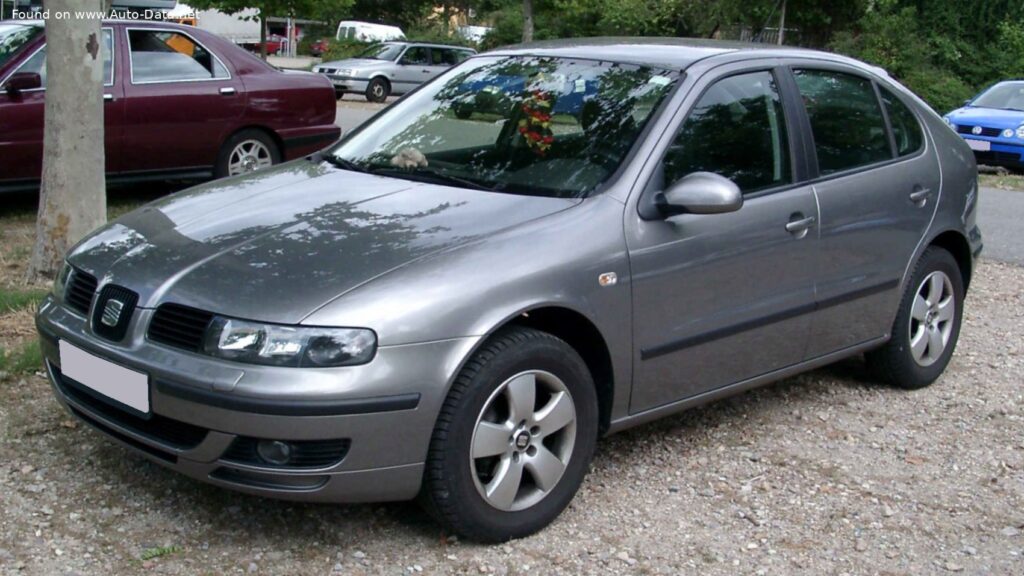
The Seat Leon I (1M) 1.8 T 20V (180 Hp) represents a pivotal model in the history of the Spanish automotive manufacturer SEAT, a brand fully integrated into the Volkswagen Group. Launched in August 1999, the first-generation Leon, internally designated 1M, quickly established itself as a dynamic and sporty contender in the highly competitive European C-segment compact car market. While SEAT models were not officially sold in the United States, the Leon shared its robust and versatile PQ34 platform with well-known vehicles like the Volkswagen Golf Mk4, Audi A3 (8L), and Škoda Octavia, leveraging the Volkswagen Group’s engineering prowess to deliver a compelling package.
Seat Leon I (1M) 1.8 T 20V: A European Hot Hatch
This particular variant, equipped with the potent 1.8-liter 20-valve turbocharged engine, was positioned as a performance-oriented option within the Leon lineup, offering a blend of spirited driving dynamics, practical hatchback utility, and an assertive design penned by the renowned Italian designer Giorgetto Giugiaro. Produced until May 2005, the Seat Leon I (1M) 1.8 T 20V (180 Hp) aimed to capture the essence of a “hot hatch” for the mainstream European consumer, providing accessible performance and a distinctive character that set it apart from its more conservative platform siblings.
Engine & Performance
At the heart of the Seat Leon I (1M) 1.8 T 20V (180 Hp) lies one of the Volkswagen Group’s most iconic engines of its era: the 1.8-liter, 20-valve turbocharged inline-four. This powerplant, known by various codes such as APP, AJQ, ARY, and AUQ, was a marvel of engineering for its time, featuring five valves per cylinder (three intake, two exhaust) for improved breathing and efficiency. Coupled with a turbocharger, this setup delivered an impressive 180 horsepower at 5500 rpm, translating to a substantial 101.1 horsepower per liter – a testament to its advanced design.
Crucially, the engine’s turbocharging provided a significant boost in torque, producing 235 Nm (173.33 lb.-ft.) from a remarkably low 1950 rpm. This broad torque band ensured excellent responsiveness and strong acceleration across the rev range, making the Leon feel agile and eager to perform. Power was channeled to the front wheels through a precise 6-speed manual transmission, offering drivers an engaging and direct connection to the car’s capabilities. The drivetrain architecture, featuring a front, transverse-mounted engine, was optimized for efficient power delivery and packaging.
Performance figures were highly competitive for a compact hatchback of its generation. The Leon 1.8 T 20V could accelerate from 0 to 60 mph in a brisk 7.3 seconds (0-100 km/h in 7.7 seconds) and reach a top speed of 142.29 mph (229 km/h). Despite its sporting intentions, the engine also offered reasonable fuel economy for a turbocharged unit, achieving a combined rating of 29.8 US mpg (7.9 l/100 km). Urban driving yielded approximately 20.1 US mpg (11.7 l/100 km), while extra-urban cycles saw efficiency improve to 36.2 US mpg (6.5 l/100 km), demonstrating a balanced approach to performance and daily usability.
Design & Features
The design of the Seat Leon I (1M) was a significant departure from its predecessor, the SEAT Córdoba-based Toledo, and a bold statement for the brand. Penned by Giorgetto Giugiaro, the 5-door hatchback body type exuded a sporty and aggressive stance, characterized by its distinctive “arrow” nose, sharp lines, and a muscular profile. Unlike its more conservative Volkswagen and Audi siblings, the Leon embraced a more passionate and youthful aesthetic, reflecting SEAT’s brand identity as the “sporty” arm of the Volkswagen Group.
Measuring 164.72 inches in length, 68.58 inches in width, and 56.65 inches in height, with a wheelbase of 98.94 inches, the Leon offered a compact footprint that was ideal for European city driving while still providing ample interior space for five occupants. The interior echoed the exterior’s sporty theme, with a driver-focused cockpit, supportive seating, and clear instrumentation. While not overtly luxurious, the cabin featured solid build quality typical of Volkswagen Group products, ensuring durability and a pleasant driving environment.
Key features for its era included a hydraulic power steering system, offering precise and communicative feedback, and an Anti-lock Braking System (ABS) for enhanced safety during emergency stops. The braking system comprised ventilated discs at the front and solid discs at the rear, providing strong and consistent stopping power to match the car’s performance capabilities. The suspension setup, featuring wishbones at the front and coil springs at the rear, provided a firm yet compliant ride, striking a good balance between handling agility and ride comfort. The vehicle rolled on 205/55 R16 tires, offering a good compromise of grip and ride quality.
Practicality was also a strong suit, with a minimum trunk capacity of 12.01 cubic feet (340 liters), expandable to a generous 23.17 cubic feet (656 liters) with the rear seats folded down, making it suitable for a variety of cargo needs. The 55-liter (14.53 US gal) fuel tank provided a respectable cruising range.
Technical Specifications
| General Information | |
| Brand | Seat |
| Model | Leon |
| Generation | Leon I (1M) |
| Type (Engine) | 1.8 T 20V (180 Hp) |
| Start of Production | August, 1999 |
| End of Production | May, 2005 |
| Powertrain Architecture | Internal Combustion engine |
| Body Type | Hatchback |
| Seats | 5 |
| Doors | 5 |
| Performance Specifications | |
| Fuel Consumption (Urban) | 11.7 l/100 km (20.1 US mpg) |
| Fuel Consumption (Extra Urban) | 6.5 l/100 km (36.2 US mpg) |
| Fuel Consumption (Combined) | 7.9 l/100 km (29.8 US mpg) |
| Fuel Type | Petrol (Gasoline) |
| Acceleration 0 – 60 mph | 7.3 sec |
| Acceleration 0 – 100 km/h | 7.7 sec |
| Maximum Speed | 229 km/h (142.29 mph) |
| Weight-to-Power Ratio | 7.3 kg/Hp (136.2 Hp/tonne) |
| Weight-to-Torque Ratio | 5.6 kg/Nm (177.8 Nm/tonne) |
| Engine Specifications | |
| Power | 180 Hp @ 5500 rpm |
| Power per liter | 101.1 Hp/l |
| Torque | 235 Nm @ 1950 rpm (173.33 lb.-ft.) |
| Engine Layout | Front, Transverse |
| Engine Model/Code | APP, AJQ, ARY, AUQ |
| Engine Displacement | 1781 cm3 (1.8 Liters / 108.68 cu. in.) |
| Number of Cylinders | 4 |
| Engine Configuration | Inline |
| Cylinder Bore | 81 mm (3.19 in.) |
| Piston Stroke | 86.4 mm (3.4 in.) |
| Compression Ratio | 9.5:1 |
| Number of Valves per Cylinder | 5 |
| Fuel Injection System | Multi-port manifold injection |
| Engine Aspiration | Turbocharger |
| Valvetrain | DOHC |
| Engine Oil Capacity | 3.5 l (3.7 US qt) |
| Coolant Capacity | 7 l (7.4 US qt) |
| Space, Volume and Weights | |
| Kerb Weight | 1322 kg (2914.51 lbs.) |
| Max. Weight | 1775 kg (3913.21 lbs.) |
| Max Load | 453 kg (998.69 lbs.) |
| Trunk (Boot) Space – Minimum | 340 l (12.01 cu. ft.) |
| Trunk (Boot) Space – Maximum | 656 l (23.17 cu. ft.) |
| Fuel Tank Capacity | 55 l (14.53 US gal) |
| Dimensions | |
| Length | 4184 mm (164.72 in.) |
| Width | 1742 mm (68.58 in.) |
| Height | 1439 mm (56.65 in.) |
| Wheelbase | 2513 mm (98.94 in.) |
| Front Track | 1513 mm (59.57 in.) |
| Rear (Back) Track | 1492 mm (58.74 in.) |
| Drivetrain, Brakes and Suspension Specifications | |
| Drivetrain Architecture | Front-wheel drive, Internal Combustion engine |
| Drive Wheel | Front wheel drive |
| Number of Gears and Type of Gearbox | 6 gears, manual transmission |
| Front Suspension | Wishbone |
| Rear Suspension | Coil spring |
| Front Brakes | Ventilated discs |
| Rear Brakes | Disc |
| Assisting Systems | ABS (Anti-lock braking system) |
| Steering Type | Steering rack and pinion |
| Power Steering | Hydraulic Steering |
| Tires Size | 205/55 R16 |
The Seat Leon I (1M) 1.8 T 20V (180 Hp) left a significant mark on the European automotive landscape, solidifying SEAT’s reputation as a manufacturer of sporty and value-driven vehicles. Its combination of a powerful turbocharged engine, agile handling, and distinctive styling helped it carve out a niche in the highly competitive compact car segment. For many, this model was a more spirited alternative to its Volkswagen Group stablemates, offering a similar level of engineering sophistication but with a more flamboyant character.
In its primary European market, the Leon 1.8 T 20V competed directly with a host of established and emerging hot hatches. Its main rivals included the Volkswagen Golf GTI (Mk4), which shared much of its underlying technology but often came with a more premium price tag and a subtler aesthetic. Other competitors included the Audi A3 1.8T, the Ford Focus ST170, and various performance-oriented versions of French rivals like the Renault Mégane and Peugeot 306/307. The Leon consistently offered a compelling proposition, often delivering comparable performance at a more accessible price point.
The success of the first-generation Leon, particularly its performance variants, was instrumental in establishing the Cupra sub-brand (though the 180 Hp model was not explicitly badged Cupra, it shared the performance ethos). It demonstrated SEAT’s capability to produce vehicles that were not only practical but also genuinely exciting to drive. This model helped to define SEAT’s identity and laid the groundwork for future generations of the Leon, which continued to evolve the brand’s sporty image. Its robust PQ34 platform ensured a solid foundation, contributing to its reliability and widespread acceptance.
Although the Seat Leon I (1M) 1.8 T 20V (180 Hp) was never officially imported into the United States, its mechanical siblings like the Volkswagen Golf and Jetta, built on the same platform and often sharing similar engine technology (including the 1.8T), were very popular. This allowed American enthusiasts to appreciate the underlying engineering that made the Leon such a success in Europe. Its legacy is one of a well-engineered, engaging, and stylish compact car that played a crucial role in SEAT’s journey to becoming a recognized player in the performance hatchback arena.
