
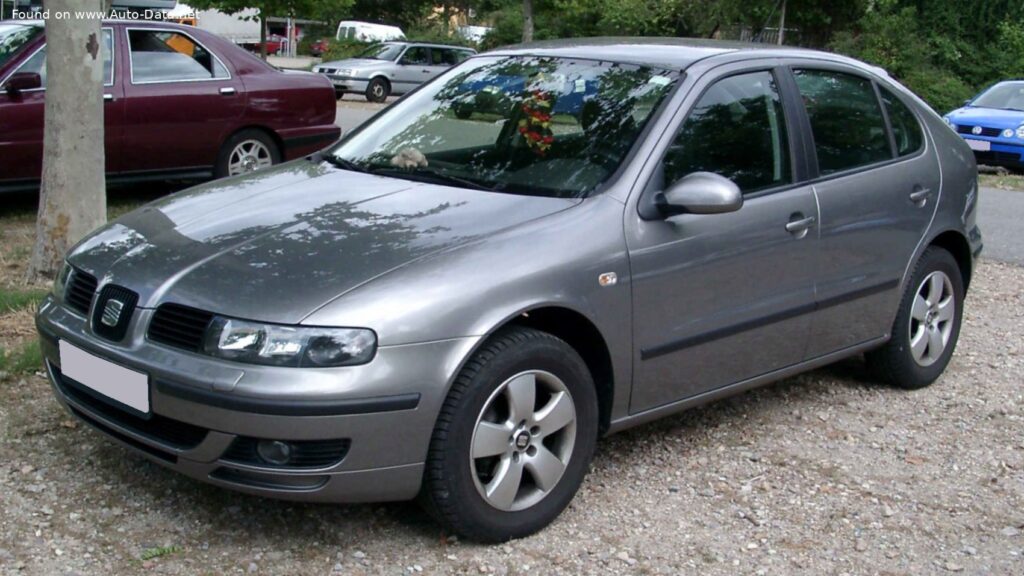
The Seat Leon I (1M) 1.8 T 20V 4 (180 Hp) represents a compelling chapter in the history of European hot hatchbacks. Introduced in August 1999 and produced until May 2005, the first-generation Seat Leon, internally designated 1M, quickly carved out a niche for itself within the highly competitive compact car segment. As a brand within the Volkswagen Group, Seat was positioned to offer a more emotional, sporty, and youthful alternative to its German and Czech siblings, primarily the Volkswagen Golf and Skoda Octavia. While never officially imported to the United States market, the Leon 1M gained significant traction in Europe, particularly among enthusiasts seeking a blend of performance, practicality, and distinctive Spanish flair. The 1.8 T 20V 4 variant, with its robust turbocharged engine and advanced all-wheel-drive system, stood as a performance flagship for the model, offering an engaging driving experience that rivaled more expensive German offerings.
Engineering and Performance of the Seat Leon I (1M) 1.8 T 20V 4 (180 Hp)
At the heart of the performance-oriented Seat Leon I (1M) 1.8 T 20V 4 (180 Hp) was a proven and highly regarded powertrain from the Volkswagen Group: the 1.8-liter (1781 cm3 or 108.68 cu. in.) turbocharged inline-four engine. Known by various internal codes such as APP, AJQ, ARY, and AUQ, this engine was a marvel of its time, featuring a sophisticated DOHC (Double Overhead Camshaft) valvetrain with an impressive five valves per cylinder (hence “20V”). This multi-valve design, combined with a turbocharger, allowed the engine to produce a potent 180 horsepower at 5500 rpm.
Perhaps even more impactful than its peak horsepower was the engine’s torque delivery. A healthy 235 Newton-meters (equivalent to 173.33 lb.-ft.) of torque was available from a remarkably low 1950 rpm, providing a broad and accessible powerband. This characteristic made the Leon 1.8 T feel eager and responsive in everyday driving, eliminating much of the turbo lag often associated with earlier turbocharged engines. Power was efficiently transmitted to all four wheels via a precise 6-speed manual transmission and an all-wheel-drive (4×4) system, a significant advantage in terms of traction and handling, especially in adverse conditions or spirited driving.
The performance figures for the Seat Leon I (1M) 1.8 T 20V 4 (180 Hp) were impressive for its class. It could accelerate from 0 to 60 mph in a brisk 7.4 seconds (0-100 km/h in 7.8 seconds) and reach a top speed of 139.19 mph (224 km/h). These numbers placed it firmly in the “hot hatch” category, capable of challenging established rivals. Despite its performance aspirations, the Leon also offered reasonable fuel economy for a turbocharged AWD vehicle of its era, with a combined rating of 24.5 US mpg (9.6 l/100 km) on gasoline. Its weight-to-power ratio stood at 8.1 kg/Hp (123 Hp/tonne), underscoring its dynamic capabilities.
Design and Features of the Seat Leon I (1M)
The Seat Leon I (1M) was built on the Volkswagen Group’s widely used A4 (PQ34) platform, sharing its underpinnings with the likes of the fourth-generation VW Golf, Audi A3 (8L), and Skoda Octavia. However, Seat’s design team, led by Giorgetto Giugiaro initially and later by Walter de Silva, imbued the Leon with a distinctively sportier and more aggressive aesthetic. The 5-door hatchback body type featured sweeping lines, a pronounced shoulder line, and a more aerodynamic profile compared to some of its boxier competitors. Its compact dimensions – 164.72 inches (4184 mm) in length, 68.58 inches (1742 mm) in width, and 56.65 inches (1439 mm) in height – contributed to its agile appearance and maneuverability.
Inside, the Leon offered a practical and driver-focused cabin. With seating for five occupants, it balanced everyday usability with a hint of sportiness. The trunk space was versatile, offering a minimum of 9.53 cu. ft. (270 liters) and expanding to a generous 23.17 cu. ft. (656 liters) with the rear seats folded, making it suitable for both daily commutes and weekend excursions. The interior design, while sharing some components with other VW Group cars, featured unique trim and upholstery options that reinforced Seat’s more youthful brand image.
Driving Dynamics and Safety
The chassis of the Seat Leon I (1M) 1.8 T 20V 4 (180 Hp) was tuned to complement its powerful engine and all-wheel-drive system. It featured a front wishbone suspension setup and a rear coil spring arrangement, providing a good balance between ride comfort and handling precision. The hydraulic rack and pinion steering offered direct feedback, enhancing the driver’s connection to the road. Stopping power was ensured by ventilated disc brakes at the front and disc brakes at the rear, augmented by an Anti-lock Braking System (ABS), a crucial safety feature for preventing wheel lock-up during hard braking. The 205/55 R16 tires provided a good contact patch, further contributing to the car’s grip and stability. The combination of a potent turbocharged engine, all-wheel drive, a capable chassis, and a manual transmission made the Leon 1.8 T 20V 4 a genuinely engaging driver’s car, particularly appreciated by enthusiasts in its primary European market.
Technical Specifications: Seat Leon I (1M) 1.8 T 20V 4 (180 Hp)
| Category | Specification |
| Brand | Seat |
| Model | Leon |
| Generation | Leon I (1M) |
| Type (Engine) | 1.8 T 20V 4 (180 Hp) |
| Start of Production | August, 1999 |
| End of Production | May, 2005 |
| Powertrain Architecture | Internal Combustion engine |
| Body type | Hatchback |
| Seats | 5 |
| Doors | 5 |
| Fuel consumption (economy) – urban | 13 l/100 km |
| Fuel consumption (economy) – extra urban | 7.4 l/100 km |
| Fuel consumption (economy) – combined | 9.6 l/100 km |
| Fuel Type | Petrol (Gasoline) |
| Acceleration 0 – 60 mph | 7.4 sec |
| Acceleration 0 – 100 km/h | 7.8 sec |
| Maximum speed | 224 km/h |
| Weight-to-power ratio | 8.1 kg/Hp |
| Engine Specs | |
| Power | 180 Hp @ 5500 rpm. |
| Power per liter | 101.1 Hp/l |
| Torque | 235 Nm @ 1950 rpm. |
| Engine layout | Front, Transverse |
| Engine Model/Code | APP, AJQ, ARY, AUQ |
| Engine displacement | 1781 cm3 |
| Number of cylinders | 4 |
| Engine configuration | Inline |
| Cylinder Bore | 81 mm |
| Piston Stroke | 86.4 mm |
| Compression ratio | 9.5:1 |
| Number of valves per cylinder | 5 |
| Fuel injection system | Multi-port manifold injection |
| Engine aspiration | Turbocharger |
| Valvetrain | DOHC |
| Space, Volume and Weights | |
| Kerb Weight | 1464 kg |
| Max. weight | 1912 kg |
| Trunk (boot) space – minimum | 270 l |
| Trunk (boot) space – maximum | 656 l |
| Dimensions | |
| Length | 4184 mm |
| Width | 1742 mm |
| Height | 1439 mm |
Legacy and Market Position of the Seat Leon I (1M)
The first-generation Seat Leon, particularly in its more potent forms like the 1.8 T 20V 4 (180 Hp) and the even higher-performance Cupra variants, played a crucial role in shaping Seat’s brand identity. It solidified the Spanish marque’s reputation for producing sporty, engaging, and stylish cars that offered excellent value within the Volkswagen Group’s extensive portfolio. For many European buyers, the Leon presented a more passionate and visually appealing alternative to the somewhat more conservative VW Golf, while still benefiting from the robust engineering and reliability of the VW platform.
In the competitive European hot hatch market, the Leon 1.8 T 20V 4 (180 Hp) found itself up against a diverse array of rivals. These included direct platform mates such as the Audi A3 1.8T Quattro and the Volkswagen Golf GTI (Mk4), offering a more affordable entry into AWD turbocharged performance. Beyond the VW Group, it competed with front-wheel-drive performance hatches like the Ford Focus ST170, the Renault Clio Sport, and the Peugeot 306 GTI-6. What set the 180 HP Leon apart was its unique combination of a powerful turbo engine, the grip and stability of all-wheel drive, and its distinctive styling.
The Leon’s success in motorsport, particularly in touring car championships, further enhanced its sporty image and desirability. Its robust mechanicals and tunable engine made it a favorite among aftermarket enthusiasts, contributing to a vibrant tuning scene. Even years after its production ceased, the Leon I (1M) remains a respected model among car aficionados, particularly those who appreciate its blend of performance, practicality, and the distinct character that Seat brought to the compact segment. Its legacy endures as a testament to Seat’s ability to inject passion and driving excitement into a mainstream platform, laying the groundwork for subsequent, equally successful generations of the Leon.
