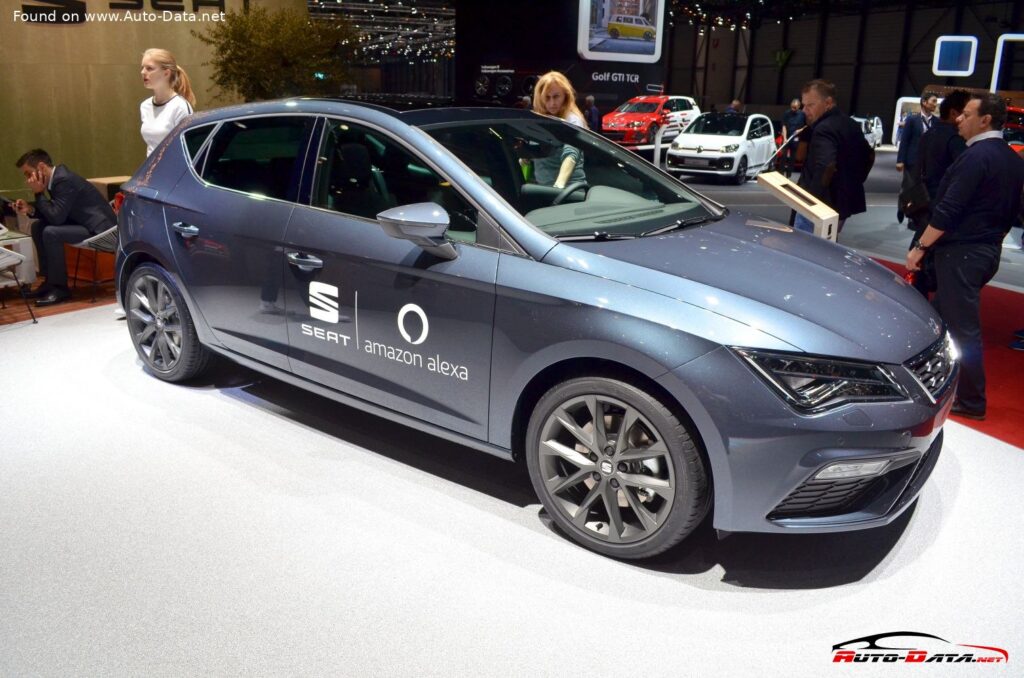
The SEAT Leon III, particularly the facelifted version introduced in 2016, represents a significant evolution in the Spanish automaker’s compact hatchback offering. Positioned within the highly competitive C-segment, the Leon aimed to blend sporty aesthetics with practical functionality and modern technology. The FR 2.0 TDI (184 Hp) DSG variant, produced from 2016 to 2020, was a popular choice, offering a balance of performance and fuel efficiency through its turbocharged diesel engine and dual-clutch transmission. While SEAT is not officially sold in the United States, the Leon is a mainstay in European markets, competing with vehicles like the Volkswagen Golf, Ford Focus, and Opel Astra.
SEAT Leon III (Facelift 2016) FR 2.0 TDI: An Overview
The Leon III, launched in 2012, was the first generation to fully embrace SEAT’s design language under the ownership of the Volkswagen Group. The 2016 facelift brought revised styling, updated technology, and refined engine options. The FR trim level, signifying “Formula Racing,” denotes a sportier aesthetic and enhanced driving dynamics. The 2.0 TDI engine, coupled with the DSG (Direct-Shift Gearbox) automatic transmission, provided a compelling combination of power and efficiency, making it a favored choice for drivers seeking a versatile and engaging compact car.
Engine & Performance
The heart of the Leon FR 2.0 TDI is a 1968 cc (120.09 cu. in.) inline-four cylinder diesel engine, designated CUPA or CUNA. This engine produces 184 horsepower (Hp) at 3500-4000 rpm and a substantial 380 Nm (280.27 lb.-ft.) of torque between 1750 and 3000 rpm. The turbocharger and intercooler work in concert to deliver responsive performance across a broad rev range. The engine’s common rail direct injection system ensures precise fuel delivery, contributing to both power output and fuel economy. Paired with the six-speed DSG automatic transmission, the Leon FR 2.0 TDI achieves a 0-100 km/h (0-62 mph) acceleration time of 7.5 seconds, and a 0-60 mph time of 7.1 seconds. Its maximum speed is electronically limited to 226 km/h (140.43 mph). Fuel consumption is rated at 4.6 l/100 km (51.1 US mpg, 61.4 UK mpg), with CO2 emissions of 120 g/km, meeting Euro 6 emission standards.
Design & Features
The SEAT Leon III facelift maintains the hatchback body style, offering five seats and five doors. The FR trim adds distinctive styling cues, including sportier bumpers, side skirts, and alloy wheels (available in 17, 18, or 19-inch sizes). Inside, the FR features sport seats, a leather-wrapped steering wheel, and aluminum pedals. The 2016 facelift brought improvements to the infotainment system, with available touchscreen displays and smartphone integration. Safety features include ABS (Anti-lock Braking System), and a comprehensive airbag system. The Leon’s interior prioritizes a driver-focused layout with intuitive controls. Trunk space is a practical 380 liters (13.42 cu. ft.), expandable with the rear seats folded down. The vehicle’s dimensions are 4281 mm (168.54 in.) in length, 1816 mm (71.5 in.) in width, and 1444 mm (56.85 in.) in height, with a wheelbase of 2634 mm (103.7 in.).
Technical Specifications
| Brand | Seat |
| Model | Leon |
| Generation | Leon III (facelift 2016) |
| Type (Engine) | FR 2.0 TDI (184 Hp) DSG |
| Start of production | 2016 |
| End of production | 2020 |
| Powertrain Architecture | Internal Combustion engine |
| Body type | Hatchback |
| Seats | 5 |
| Doors | 5 |
| Fuel consumption (combined) | 4.6 l/100 km |
| Fuel consumption (US mpg) | 51.1 US mpg |
| Fuel consumption (UK mpg) | 61.4 UK mpg |
| CO2 emissions | 120 g/km |
| Fuel Type | Diesel |
| Acceleration 0 – 100 km/h | 7.5 sec |
| Acceleration 0 – 62 mph | 7.5 sec |
| Acceleration 0 – 60 mph | 7.1 sec |
| Maximum speed | 226 km/h (140.43 mph) |
| Emission standard | Euro 6 |
| Weight-to-power ratio | 7.1 kg/Hp |
| Power | 184 Hp @ 3500-4000 rpm |
| Torque | 380 Nm @ 1750-3000 rpm (280.27 lb.-ft.) |
| Engine layout | Front, Transverse |
| Engine Model/Code | CUPA, CUNA |
| Engine displacement | 1968 cm3 (120.09 cu. in.) |
| Number of cylinders | 4 |
| Engine configuration | Inline |
| Cylinder Bore | 81 mm (3.19 in.) |
| Piston Stroke | 95.5 mm (3.76 in.) |
| Compression ratio | 15.8:1 |
| Number of valves per cylinder | 4 |
| Fuel injection system | Diesel Commonrail |
| Engine aspiration | Turbocharger, Intercooler |
| Engine oil capacity | 4.6 l (4.86 US qt | 4.05 UK qt) |
| Coolant | 8 l (8.45 US qt | 7.04 UK qt) |
| Kerb Weight | 1315 kg (2899.08 lbs.) |
| Max. weight | 1900 kg (4188.78 lbs.) |
| Max load | 585 kg (1289.7 lbs.) |
| Trunk (boot) space – minimum | 380 l (13.42 cu. ft.) |
| Fuel tank capacity | 50 l (13.21 US gal | 11 UK gal) |
| Permitted trailer load with brakes (12%) | 1600 kg (3527.4 lbs.) |
| Length | 4281 mm (168.54 in.) |
| Width | 1816 mm (71.5 in.) |
| Height | 1444 mm (56.85 in.) |
| Wheelbase | 2634 mm (103.7 in.) |
| Front track | 1534-1538 mm (60.39 – 60.55 in.) |
| Rear (Back) track | 1511-1512 mm (59.49 – 59.53 in.) |
| Minimum turning circle | 10.3 m (33.79 ft.) |
| Drivetrain Architecture | Front wheel drive |
| Number of gears and type of gearbox | 6 gears, automatic transmission DSG |
| Front suspension | Independent, type McPherson with coil spring and anti-roll bar |
| Rear suspension | Independent multi-link suspension |
| Front brakes | Ventilated discs |
| Rear brakes | Disc |
| Tires size | 225/45 R17; 225/40 R18; 225/35 R19 |
| Wheel rims size | 17; 18; 19 |