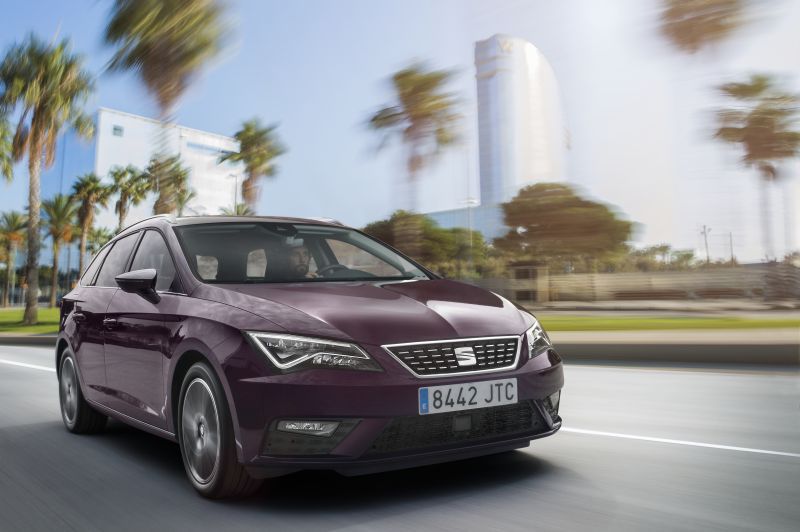
The SEAT Leon III ST, specifically the facelifted 2016 model equipped with the 1.2 TSI (86 Hp) engine, represents a compelling offering in the European compact family car segment. As a brand within the Volkswagen Group, SEAT (Sociedad Española de Automóviles de Turismo) is renowned for infusing a distinctive sporty character and contemporary design into its vehicles, often sharing platforms and powertrains with its German counterparts while carving out its own identity. This particular iteration of the Leon, produced from 2016 to 2018, falls into the third generation and showcases the practical ‘ST’ (Sport Tourer) station wagon body style. It was engineered to appeal to a broad demographic seeking a blend of everyday usability, fuel efficiency, and a dynamic driving experience, all wrapped in a stylish package that was not formally sold in the United States but enjoyed considerable success across European markets. The Seat Leon III ST (facelift 2016) 1.2 TSI (86 Hp) exemplifies SEAT’s commitment to delivering accessible yet well-engineered automobiles.
Engineering and Performance of the Seat Leon III ST (facelift 2016) 1.2 TSI (86 Hp)
At the heart of the Seat Leon III ST (facelift 2016) 1.2 TSI (86 Hp) lies a meticulously engineered powertrain designed for efficiency and smooth operation. The designation “TSI” indicates Volkswagen Group’s advanced turbocharged stratified injection technology, which combines direct fuel injection with turbocharging to deliver robust performance from a relatively small displacement engine. This specific variant features a 1.2-liter (1197 cm³ or 73.05 cu. in.) inline four-cylinder engine, a configuration known for its inherent balance and refinement. With 86 horsepower produced between 4300 and 5300 rpm, and a substantial 118.01 lb.-ft. of torque available from a low 1400 rpm all the way up to 3500 rpm, the engine provides ample low-end grunt, making it responsive in city driving and relaxed on the highway. The wide torque band is a hallmark of turbocharged engines, ensuring flexible performance without the constant need for downshifting.
Power is delivered to the front wheels via a precise 5-speed manual transmission, a common choice in European markets for its engaging driving feel and efficiency. This drivetrain architecture, where the internal combustion engine drives the front wheels, is typical for compact vehicles, offering excellent packaging, lower manufacturing costs, and reliable traction. Performance figures for this model are respectable for its class and power output: the Leon ST accelerates from 0 to 60 mph in a calculated 11.5 seconds, while its maximum speed reaches 110.6 mph. These figures underscore its role as a practical family vehicle rather than a performance-oriented machine, prioritizing fuel economy and everyday drivability.
Fuel efficiency is a key strength of the 1.2 TSI engine, with a combined fuel consumption rating of 46.1 US mpg (5.1 liters per 100 km). This impressive economy, coupled with CO2 emissions of 119 g/km, positions the Leon ST as an environmentally conscious choice, meeting the stringent Euro 6 emission standard. The engine’s design, featuring direct injection, a turbocharger, and an intercooler, maximizes combustion efficiency and power delivery while minimizing fuel consumption. The engine oil capacity is 4.23 US quarts, and the cooling system holds 8.45 US quarts, reflecting standard maintenance requirements for modern compact engines. The vehicle’s weight-to-power ratio stands at 13.5 kg/Hp (74.3 Hp/tonne), and its weight-to-torque ratio is 7.2 kg/Nm (138.2 Nm/tonne), indicating a well-balanced power-to-weight characteristic for its segment.
Design and Features of the Leon III ST (facelift 2016)
The design of the Seat Leon III ST (facelift 2016) is a testament to SEAT’s contemporary aesthetic, characterized by sharp lines, a dynamic stance, and a focus on functionality. The station wagon, or ‘estate’ as it’s known in Europe, body type offers significant practicality for families and individuals requiring substantial cargo space. With five doors and seating for five occupants, it strikes an optimal balance between passenger comfort and utility. The facelift introduced subtle enhancements to the exterior, including revised lighting signatures and minor grille adjustments, keeping the Leon fresh and competitive within its segment.
Dimensionally, the Leon ST measures 179.09 inches in length, 71.5 inches in width, and 57.24 inches in height. Its wheelbase extends to 103.78 inches, contributing to a stable ride and generous interior volume. The front track varies between 60.55 and 60.98 inches, while the rear track spans 59.37 to 59.84 inches, providing a confident footprint on the road. A minimum turning circle of 33.79 feet ensures good maneuverability in urban environments and tight parking spaces, a crucial attribute for European driving conditions.
Inside, the Leon ST emphasizes ergonomic design and practicality. The minimum trunk (boot) space is a generous 20.73 cubic feet (587 liters), which can be expanded significantly by folding the rear seats, making it highly versatile for carrying luggage, groceries, or sports equipment. The fuel tank capacity of 13.21 US gallons (50 liters) provides an excellent driving range, complementing its fuel-efficient engine. The vehicle’s kerb weight is 2552.95 lbs. (1158 kg), while its maximum permissible weight is 3968.32 lbs. (1800 kg), allowing for a maximum load of 1415.37 lbs. (642 kg). It also boasts a permitted trailer load with brakes (12%) of 2425.08 lbs. (1100 kg), adding to its utility.
Underneath, the Leon ST features a well-tuned suspension system designed to balance comfort and dynamic handling. The front utilizes an independent McPherson strut setup with coil springs and an anti-roll bar, providing precise steering response and good body control. The rear employs a semi-independent suspension with coil springs, a cost-effective and space-efficient solution that still offers competent ride quality. Braking is handled by ventilated discs at the front and disc brakes at the rear, augmented by an Anti-lock Braking System (ABS) for enhanced safety during emergency stops. The steering system is a rack and pinion type with electric power steering, offering light effort at low speeds for easy parking and more feedback at higher speeds for confident highway driving. The vehicle can be fitted with tire sizes ranging from 195/65 R15 to 225/45 R17, paired with corresponding 15, 16, or 17-inch wheel rims, allowing for customization of ride and handling characteristics.
Technical Specifications
| Brand | Seat |
| Model | Leon |
| Generation | Leon III ST (facelift 2016) |
| Type (Engine) | 1.2 TSI (86 Hp) |
| Start of production | 2016 year |
| End of production | 2018 year |
| Powertrain Architecture | Internal Combustion engine |
| Body type | Station wagon (estate) |
| Seats | 5 |
| Doors | 5 |
| Fuel consumption (combined) | 46.1 US mpg (5.1 l/100 km) |
| CO2 emissions | 119 g/km |
| Fuel Type | Petrol (Gasoline) |
| Acceleration 0 – 60 mph | 11.5 sec |
| Acceleration 0 – 100 km/h | 12.1 sec |
| Maximum speed | 110.6 mph (178 km/h) |
| Emission standard | Euro 6 |
| Weight-to-power ratio | 13.5 kg/Hp (74.3 Hp/tonne) |
| Weight-to-torque ratio | 7.2 kg/Nm (138.2 Nm/tonne) |
| Power | 86 Hp @ 4300-5300 rpm |
| Power per liter | 71.8 Hp/l |
| Torque | 118.01 lb.-ft. @ 1400-3500 rpm (160 Nm) |
| Engine layout | Front, Transverse |
| Engine Model/Code | CJZB, CYVA |
| Engine displacement | 1.2 liters (1197 cm³ / 73.05 cu. in.) |
| Number of cylinders | 4 |
| Engine configuration | Inline |
| Cylinder Bore | 2.8 in. (71 mm) |
| Piston Stroke | 2.98 in. (75.6 mm) |
| Compression ratio | 10.5:1 |
| Number of valves per cylinder | 4 |
| Fuel injection system | Direct injection |
| Engine aspiration | Turbocharger, Intercooler |
| Engine oil capacity | 4.23 US qt (4 l) |
| Coolant capacity | 8.45 US qt (8 l) |
| Kerb Weight | 2552.95 lbs. (1158 kg) |
| Max. weight | 3968.32 lbs. (1800 kg) |
| Max load | 1415.37 lbs. (642 kg) |
| Trunk (boot) space – minimum | 20.73 cu. ft. (587 l) |
| Fuel tank capacity | 13.21 US gal (50 l) |
| Permitted trailer load with brakes (12%) | 2425.08 lbs. (1100 kg) |
| Length | 179.09 in. (4549 mm) |
| Width | 71.5 in. (1816 mm) |
| Height | 57.24 in. (1454 mm) |
| Wheelbase | 103.78 in. (2636 mm) |
| Front track | 60.55 – 60.98 in. (1538-1549 mm) |
| Rear (Back) track | 59.37 – 59.84 in. (1508-1520 mm) |
| Minimum turning circle (turning diameter) | 33.79 ft. (10.3 m) |
| Drivetrain Architecture | Front wheel drive (ICE drives front wheels) |
| Drive wheel | Front wheel drive |
| Number of gears and type of gearbox | 5 gears, manual transmission |
| Front suspension | Independent, McPherson with coil spring and anti-roll bar |
| Rear suspension | Semi-independent, coil spring |
| Front brakes | Ventilated discs |
| Rear brakes | Disc |
| Assisting systems | ABS (Anti-lock braking system) |
| Steering type | Steering rack and pinion |
| Power steering | Electric Steering |
| Tires size | 195/65 R15; 205/55 R16; 225/45 R17 |
| Wheel rims size | 15; 16; 17 |