
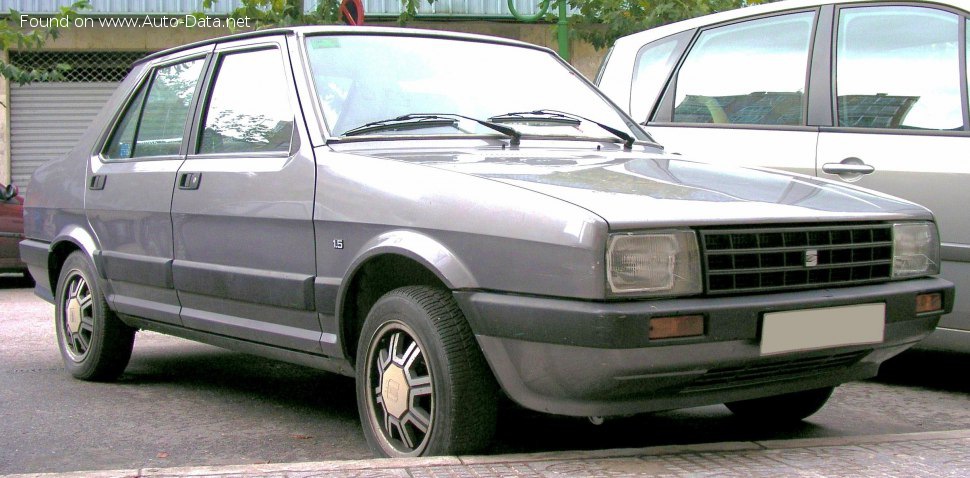
The SEAT Malaga (023A) 1.5, produced from 1984 to 1991, was a compact sedan primarily aimed at the European market. SEAT, at the time a Spanish manufacturer partially owned by the Volkswagen Group, positioned the Malaga as an affordable and practical family car. While never officially sold in the United States, the Malaga represents a significant step in SEAT’s development and its integration into the broader Volkswagen automotive landscape. It was based on the SEAT Ritmo, itself a licensed Fiat Ritmo, and offered a budget-friendly alternative to other European sedans of the era. The 1.5-liter engine variant, producing 90 horsepower, was a popular choice, balancing fuel economy with adequate performance for everyday driving.
SEAT Malaga (023A) 1.5: Overview and Market Position
The Malaga filled a crucial niche in the European automotive market during the 1980s. Spain, at the time, had a developing automotive industry and a demand for locally produced vehicles. The Malaga, along with other SEAT models, provided that domestic option. It competed with vehicles like the Renault 9, Peugeot 305, and Ford Escort, offering a similar level of practicality and affordability. The car’s design, while somewhat conservative, prioritized functionality and durability over stylistic flair. Its relatively simple mechanicals made it easy to maintain and repair, appealing to cost-conscious buyers. The Malaga was a key model in establishing SEAT as a recognizable brand before its full integration into the Volkswagen Group.
Engine & Performance
The SEAT Malaga 1.5 was powered by a 1.5-liter inline four-cylinder gasoline engine, designated the 021A.2000. This engine produced 90 horsepower at 6000 rpm and 120 Nm (88.51 lb.-ft.) of torque at 4000 rpm. While not a performance car, the engine provided sufficient power for comfortable cruising and everyday driving. The engine featured a carburettor fuel injection system, a common technology for the time, and a compression ratio of 10.5:1. Power delivery was relatively linear, making it predictable and easy to control. Acceleration from 0 to 100 km/h (0-62 mph) took approximately 13 seconds, and the car had a top speed of 170 km/h (105.63 mph). Fuel economy was a strong point, with combined fuel consumption rated at 6.5 l/100 km (36.2 US mpg or 43.5 UK mpg). The engine’s transverse front-wheel-drive layout contributed to its relatively compact size and efficient packaging.
Design & Features
The SEAT Malaga was a traditional four-door sedan with a relatively boxy design. Its styling was functional rather than flamboyant, reflecting the prevailing design trends of the early 1980s. The interior was similarly practical, offering seating for five passengers. Features were basic by modern standards, but included comfortable seating and a reasonably spacious cabin. Safety features were limited compared to contemporary vehicles, with the Malaga lacking features like airbags or anti-lock brakes as standard equipment. However, it did offer disc brakes on the front wheels and drum brakes on the rear. The Malaga’s trunk offered a minimum capacity of 510 liters (18.01 cu. ft.), providing ample space for luggage and other cargo. Hydraulic power steering was available, enhancing ease of maneuverability. The Malaga’s design prioritized affordability and practicality, making it a sensible choice for families and individuals seeking a reliable and economical mode of transportation.
Technical Specifications
| General Information | |
| Brand | SEAT |
| Model | Malaga |
| Generation | Malaga (023A) |
| Type (Engine) | 1.5 (90 Hp) |
| Start of production | November, 1984 |
| End of production | 1991 |
| Powertrain Architecture | Internal Combustion engine |
| Body type | Sedan |
| Seats | 5 |
| Doors | 4 |
| Performance Specs | |
| Fuel consumption (urban) | 9 l/100 km (26.1 US mpg, 31.4 UK mpg, 11.1 km/l) |
| Fuel consumption (extra urban) | 4.9 l/100 km (48 US mpg, 57.6 UK mpg, 20.4 km/l) |
| Fuel consumption (combined) | 6.5 l/100 km (36.2 US mpg, 43.5 UK mpg, 15.4 km/l) |
| Fuel Type | Petrol (Gasoline) |
| Acceleration 0 – 100 km/h | 13 sec |
| Acceleration 0 – 62 mph | 13 sec |
| Acceleration 0 – 60 mph | 12.4 sec |
| Maximum speed | 170 km/h (105.63 mph) |
| Engine Specs | |
| Power | 90 Hp @ 6000 rpm |
| Power per litre | 61.6 Hp/l |
| Torque | 120 Nm @ 4000 rpm (88.51 lb.-ft. @ 4000 rpm) |
| Engine layout | Front, Transverse |
| Engine Model/Code | 021A.2000 |
| Engine displacement | 1461 cm3 (89.16 cu. in.) |
| Number of cylinders | 4 |
| Engine configuration | Inline |
| Cylinder Bore | 83 mm (3.27 in.) |
| Piston Stroke | 67.5 mm (2.66 in.) |
| Compression ratio | 10.5:1 |
| Number of valves per cylinder | 2 |
| Fuel injection system | Carburettor |
| Engine aspiration | Naturally aspirated |
| Engine oil capacity | 4 l (4.23 US qt | 3.52 UK qt) |
| Coolant capacity | 7.5 l (7.93 US qt | 6.6 UK qt) |
| Dimensions & Weights | |
| Trunk (boot) space (minimum) | 510 l (18.01 cu. ft.) |
| Fuel tank capacity | 50 l (13.21 US gal | 11 UK gal) |
| Length | 4275 mm (168.31 in.) |
| Width | 1650 mm (64.96 in.) |
| Height | 1390 mm (54.72 in.) |
| Wheelbase | 2445 mm (96.26 in.) |
| Front track | 1420 mm (55.91 in.) |
| Rear track | 1390 mm (54.72 in.) |
| Drivetrain, Brakes & Suspension | |
| Drivetrain Architecture | Front wheel drive, Internal Combustion engine (ICE) |
| Drive wheel | Front wheel drive |
| Number of gears & gearbox type | 5 gears, manual transmission |
| Front suspension | Coil spring |
| Rear suspension | Leaf spring |
| Front brakes | Disc |
| Rear brakes | Drum |
| Assisting systems | ABS (Anti-lock braking system) |
| Steering type | Steering rack and pinion |
| Power steering | Hydraulic |
| Tires size | 165/65 SR14 |
