
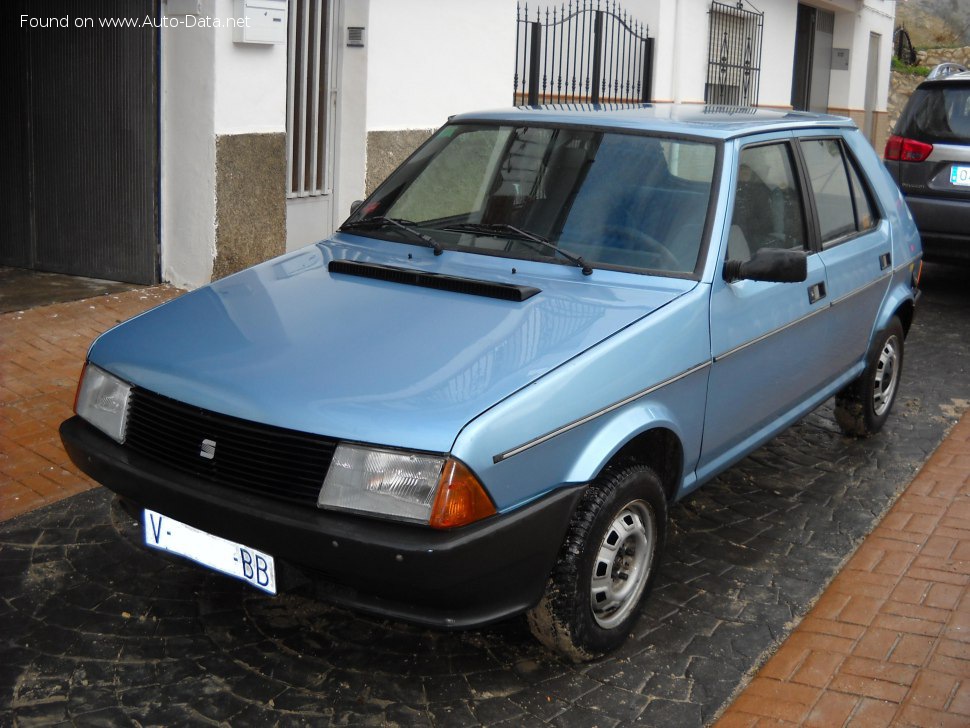
The SEAT Ronda, produced between 1982 and 1986, was a small family car manufactured by the Spanish automaker SEAT, which was then part of the Volkswagen Group. Designed as a replacement for the aging SEAT Fura, the Ronda represented a significant step forward for SEAT, offering a more modern and practical vehicle for the European market. While never officially sold in the United States, the Ronda was an important model for SEAT, helping to establish the brand and pave the way for its later successes. The 1.2-liter version, producing 64 horsepower, was a common variant, aimed at providing economical transportation for families and individuals.
SEAT Ronda (022A) 1.2: A European Compact
The Ronda occupied the subcompact or supermini segment in Europe, competing with vehicles like the Renault 5, Peugeot 205, and Fiat Uno. It was based on the Volkswagen Polo Mk2 platform, benefiting from German engineering and reliability. The Ronda was primarily marketed in Spain and other European countries, offering a blend of affordability, practicality, and relatively modern styling for its time. Its five-door hatchback body style provided good interior space and versatility, making it a popular choice for small families.
Engine & Performance
The 1.2-liter engine powering the Ronda (specifically the 022A variant) was a naturally aspirated, inline-four cylinder unit, designated the 124 B6.000. Displacing 1193 cubic centimeters (72.8 cubic inches), it produced 64 horsepower at 5800 rpm and 86 Nm (63.43 lb.-ft.) of torque at 3500 rpm. This engine utilized a carburetor fuel injection system and a single overhead camshaft (SOHC) valvetrain with two valves per cylinder. While not a performance car, the 1.2-liter engine provided adequate power for everyday driving. Acceleration from 0 to 100 km/h (0-62 mph) took approximately 17 seconds, and the car had a top speed of 148 km/h (91.96 mph). The engine’s power-to-weight ratio was 14 kg/Hp, and the torque-to-weight ratio was 10.4 kg/Nm. Fuel economy was a key consideration, with urban consumption rated at 9.3 l/100 km (25.3 US mpg) and extra-urban consumption at 5.1 l/100 km (46.1 US mpg).
Design & Features
The SEAT Ronda featured a practical and functional design. Its five-door hatchback configuration offered easy access to the interior and a relatively spacious cabin for its size. The exterior styling was typical of early 1980s European cars, with a boxy shape and relatively simple lines. Inside, the Ronda offered seating for five passengers, although rear passenger space was somewhat limited. The dashboard layout was straightforward and functional, with basic instrumentation and controls. Safety features were limited by the standards of the time, but the Ronda did include disc brakes on the front wheels and drum brakes on the rear. The Ronda’s trunk offered 370 liters (13.07 cu. ft.) of space with the rear seats up, expanding to 1250 liters (44.14 cu. ft.) with the rear seats folded down. Power steering, utilizing a hydraulic system, was available, enhancing the driving experience. The Ronda’s McPherson strut front suspension and independent coil spring rear suspension provided a reasonable level of ride comfort.
Technical Specifications
| Brand | Seat |
| Model | Ronda |
| Generation | Ronda (022A) |
| Type (Engine) | 1.2 (64 Hp) |
| Start of production | August, 1983 |
| End of production | May, 1985 |
| Powertrain Architecture | Internal Combustion engine |
| Body type | Hatchback |
| Seats | 5 |
| Doors | 5 |
| Fuel consumption (urban) | 9.3 l/100 km (25.3 US mpg) |
| Fuel consumption (extra urban) | 5.1 l/100 km (46.1 US mpg) |
| Fuel Type | Petrol (Gasoline) |
| Acceleration 0 – 100 km/h | 17 sec |
| Acceleration 0 – 62 mph | 17 sec |
| Acceleration 0 – 60 mph | 16.2 sec |
| Maximum speed | 148 km/h (91.96 mph) |
| Weight-to-power ratio | 14 kg/Hp |
| Weight-to-torque ratio | 10.4 kg/Nm |
| Power | 64 Hp @ 5800 rpm |
| Power per litre | 53.6 Hp/l |
| Torque | 86 Nm @ 3500 rpm (63.43 lb.-ft. @ 3500 rpm) |
| Engine layout | Front, Transverse |
| Engine Model/Code | 124 B6.000 |
| Engine displacement | 1193 cm3 (72.8 cu. in.) |
| Number of cylinders | 4 |
| Engine configuration | Inline |
| Compression ratio | 9.5:1 |
| Number of valves per cylinder | 2 |
| Fuel injection system | Carburettor |
| Engine aspiration | Naturally aspirated |
| Valvetrain | SOHC |
| Kerb Weight | 895 kg (1973.14 lbs.) |
| Max. weight | 1400 kg (3086.47 lbs.) |
| Max load | 505 kg (1113.33 lbs.) |
| Trunk (boot) space – minimum | 370 l (13.07 cu. ft.) |
| Trunk (boot) space – maximum | 1250 l (44.14 cu. ft.) |
| Fuel tank capacity | 46 l (12.15 US gal | 10.12 UK gal) |
| Length | 4011 mm (157.91 in.) |
| Width | 1650 mm (64.96 in.) |
| Height | 1400 mm (55.12 in.) |
| Wheelbase | 2448 mm (96.38 in.) |
| Minimum turning circle | 9.4 m (30.84 ft.) |
| Drivetrain Architecture | Front wheel drive |
| Number of gears | 5 gears, manual transmission |
| Front suspension | Independent type McPherson |
| Rear suspension | Independent coil spring |
| Front brakes | Disc |
| Rear brakes | Drum |
| Steering type | Steering rack and pinion |
| Power steering | Hydraulic |
The SEAT Ronda, particularly the 1.2-liter version, represents a significant piece of automotive history for SEAT. It demonstrated the company’s ability to produce a modern and competitive vehicle, and it laid the groundwork for its future growth and success in the European automotive market. While not a high-performance vehicle, the Ronda offered a practical, affordable, and reliable transportation solution for a wide range of drivers.
