
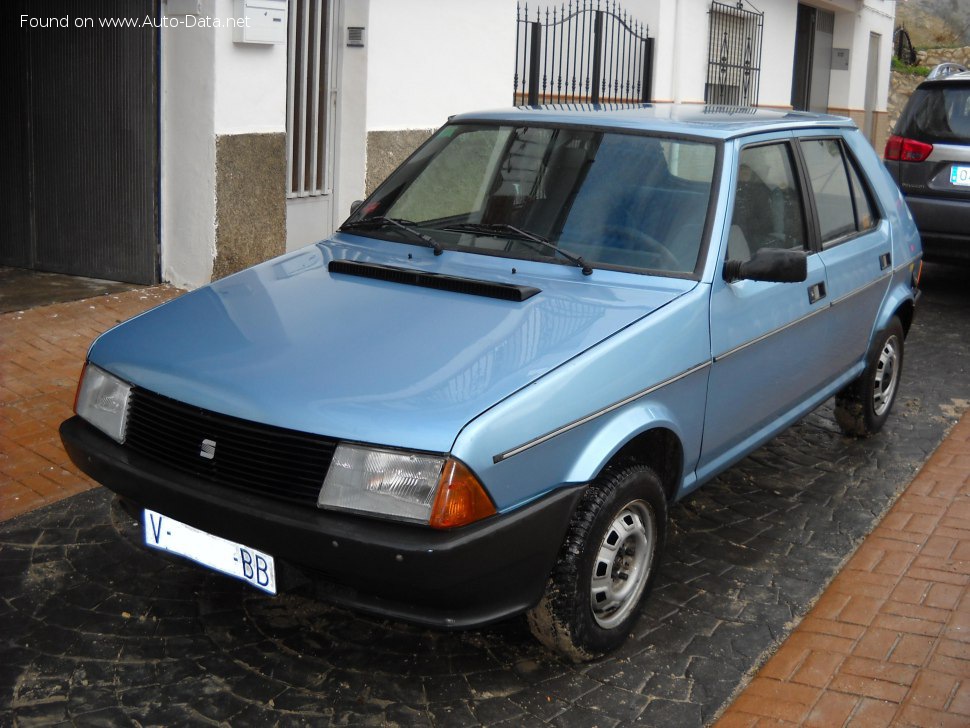
The SEAT Ronda (022A) 1.5, produced between 1984 and 1986, was a small family hatchback primarily aimed at the European market. Developed as a more affordable alternative to the SEAT Ibiza, the Ronda represented SEAT’s attempt to broaden its appeal and compete more effectively in the burgeoning hatchback segment. While not officially sold in the United States, understanding the Ronda provides insight into the development of SEAT as a brand and the automotive landscape of 1980s Europe. It was based on the Fiat Ritmo, a car SEAT manufactured under license, and offered a practical and economical transportation solution for families.
SEAT Ronda (022A) 1.5: Overview and Market Position
The Ronda occupied a crucial position in SEAT’s lineup during a period of significant change for the Spanish automaker. Prior to the 1980s, SEAT primarily produced vehicles based on Fiat designs. The Ronda, while still leveraging Fiat technology, represented a step towards greater independence in design and engineering. It was positioned as a budget-friendly option, offering a balance of practicality, fuel efficiency, and affordability. The 1.5-liter engine variant, producing 85 horsepower, was a popular choice, providing adequate performance for everyday driving. The car’s five-door hatchback configuration and seating for five made it a versatile option for small families.
Engine & Performance
The SEAT Ronda 1.5 (022A) was powered by an inline four-cylinder, 1.5-liter (1461 cm3 or 89.16 cu. in.) naturally aspirated gasoline engine. This engine produced 85 horsepower (Hp) at 5600 rpm and 116 Newton-meters (85.56 lb.-ft.) of torque at 3500 rpm. The engine featured a single overhead camshaft (SOHC) valvetrain with two valves per cylinder and utilized a carburetor fuel injection system, typical for vehicles of that era. Power delivery was adequate for its intended purpose, and the engine offered reasonable fuel economy. The Ronda 1.5 could accelerate from 0 to 100 km/h (0 to 62 mph) in 12.8 seconds, and achieve a maximum speed of 166 km/h (103.15 mph). A five-speed manual transmission was the only gearbox option available, providing drivers with full control over the powertrain. The weight-to-power ratio was 10.8 kg/Hp, and the weight-to-torque ratio was 7.9 kg/Nm.
Design & Features
The SEAT Ronda featured a practical and functional five-door hatchback body style. Its design was largely dictated by the need for affordability and maximizing interior space. The exterior styling was relatively simple and understated, reflecting the design trends of the early 1980s. Inside, the Ronda offered a basic but functional interior with seating for five passengers. Safety features were limited by the standards of the time, but included front disc brakes and rear drum brakes. Hydraulic steering provided a degree of driver assistance. The Ronda’s trunk offered a minimum capacity of 370 liters (13.07 cu. ft.), expandable to 1250 liters (44.14 cu. ft.) with the rear seats folded down. The vehicle’s dimensions were 4011 mm (157.91 in.) in length, 1650 mm (64.96 in.) in width, and 1400 mm (55.12 in.) in height. The wheelbase measured 2448 mm (96.38 in.).
Technical Specifications
| Brand | Seat |
| Model | Ronda |
| Generation | Ronda (022A) |
| Type (Engine) | 1.5 (85 Hp) |
| Start of production | October, 1984 |
| End of production | December, 1986 |
| Powertrain Architecture | Internal Combustion engine |
| Body type | Hatchback |
| Seats | 5 |
| Doors | 5 |
| Fuel consumption (urban) | 9.1 l/100 km (25.8 US mpg, 31 UK mpg, 11 km/l) |
| Fuel consumption (extra urban) | 4.9 l/100 km (48 US mpg, 57.6 UK mpg, 20.4 km/l) |
| Fuel Type | Petrol (Gasoline) |
| Acceleration 0 – 100 km/h | 12.8 sec |
| Acceleration 0 – 62 mph | 12.8 sec |
| Acceleration 0 – 60 mph | 12.2 sec |
| Maximum speed | 166 km/h (103.15 mph) |
| Weight-to-power ratio | 10.8 kg/Hp |
| Weight-to-torque ratio | 7.9 kg/Nm |
| Power | 85 Hp @ 5600 rpm |
| Power per litre | 58.2 Hp/l |
| Torque | 116 Nm @ 3500 rpm (85.56 lb.-ft. @ 3500 rpm) |
| Engine layout | Front, Transverse |
| Engine displacement | 1461 cm3 (89.16 cu. in.) |
| Number of cylinders | 4 |
| Engine configuration | Inline |
| Compression ratio | 10.5:1 |
| Number of valves per cylinder | 2 |
| Fuel injection system | Carburettor |
| Engine aspiration | Naturally aspirated |
| Valvetrain | SOHC |
| Kerb Weight | 915 kg (2017.23 lbs) |
| Max. weight | 1450 kg (3196.7 lbs) |
| Max load | 535 kg (1179.47 lbs) |
| Trunk (boot) space – minimum | 370 l (13.07 cu. ft.) |
| Trunk (boot) space – maximum | 1250 l (44.14 cu. ft.) |
| Fuel tank capacity | 46 l (12.15 US gal, 10.12 UK gal) |
| Length | 4011 mm (157.91 in.) |
| Width | 1650 mm (64.96 in.) |
| Height | 1400 mm (55.12 in.) |
| Wheelbase | 2448 mm (96.38 in.) |
| Minimum turning circle | 9.4 m (30.84 ft.) |
| Drivetrain Architecture | Front wheel drive |
| Number of gears | 5 gears, manual transmission |
| Front suspension | Independent type McPherson |
| Rear suspension | Independent coil spring |
| Front brakes | Disc |
| Rear brakes | Drum |
| Steering type | Steering rack and pinion |
| Power steering | Hydraulic |
| Tires size | 165/65 R14 |
| Wheel rims size | 5.5J x 14 |
The SEAT Ronda, while not a groundbreaking vehicle, played a significant role in SEAT’s evolution. It provided affordable transportation for European families and helped establish SEAT as a viable competitor in the compact hatchback market. Its simple design, reliable engine, and practical features made it a popular choice for those seeking a no-frills, economical vehicle.
