
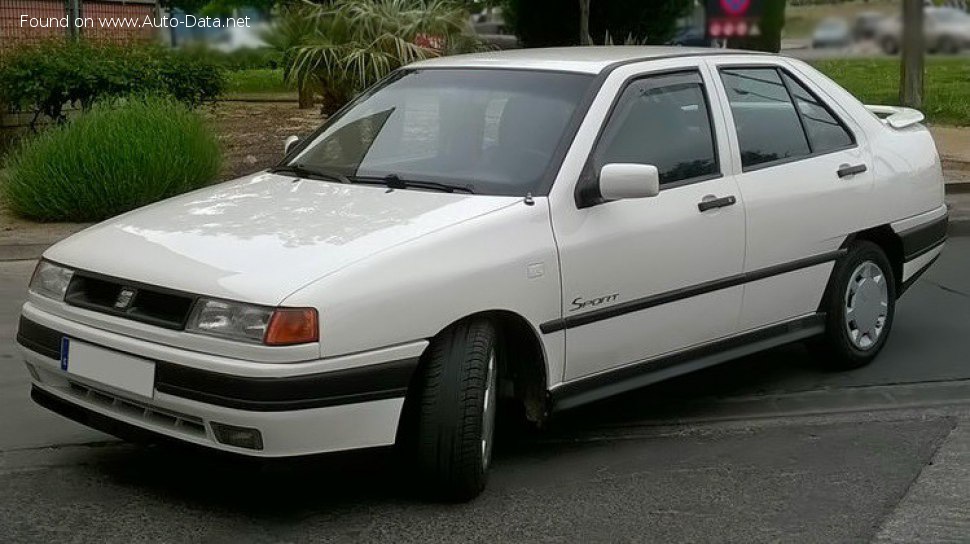
The SEAT Toledo I (1L) 1.6 i, produced between 1991 and 1995, represents a pivotal moment for the Spanish automaker. While SEAT is now a subsidiary of the Volkswagen Group, during this period it was undergoing a transformation, aiming to establish itself as a modern European car manufacturer. The Toledo, named after the historic Spanish city, was SEAT’s first attempt at a contemporary, mass-market sedan, designed to compete with established rivals like the Ford Escort and Opel Astra. Importantly, the Toledo was not widely sold in the United States; its primary market was Europe, where it offered a practical and relatively affordable option in the compact sedan segment. This article details the technical specifications and characteristics of the 1.6-liter version of the first-generation Toledo.
SEAT Toledo I (1L) 1.6 i: Overview and Market Position
The Toledo I (1L) was a significant departure for SEAT, which had previously focused on producing licensed versions of Fiat models. The Toledo was the first entirely SEAT-designed vehicle in decades, showcasing the company’s growing engineering capabilities. It was based on the Volkswagen Golf Mk2 platform, benefiting from German engineering principles while maintaining a distinct Spanish design flair. The 1.6 i variant, equipped with a 75 horsepower engine, was a popular choice, offering a balance between performance and fuel economy for European drivers. The Toledo aimed to provide a spacious and comfortable interior, along with a reasonably sized trunk, making it a practical family car. Its introduction marked SEAT’s ambition to become a major player in the European automotive market.
Engine & Performance
The heart of the Toledo I (1L) 1.6 i is a 1.6-liter inline four-cylinder gasoline engine, designated as the 1F. This naturally aspirated engine produces 75 horsepower at 5500 rpm and 125 Nm (92.2 lb.-ft.) of torque at 2600 rpm. The engine utilizes a single-point fuel injection system, a common technology for the early 1990s, and features an overhead camshaft (OHC) valvetrain with two valves per cylinder. The engine’s displacement of 1595 cm³ (97.33 cu. in.) and a compression ratio of 9:1 contribute to its modest power output. Performance figures include a 0-100 km/h (0-62 mph) acceleration time of 13.3 seconds and a top speed of 170 km/h (105.63 mph). While not particularly sporty, the engine provided adequate power for everyday driving and highway cruising. The weight-to-power ratio of 13.1 kg/Hp and weight-to-torque ratio of 7.9 kg/Nm reflect the car’s relatively modest performance capabilities. The engine requires 4 liters (4.23 US qt) of engine oil and 6.2 liters (6.55 US qt) of coolant.
Design & Features
The SEAT Toledo I (1L) is a four-door, five-seater sedan with a traditional three-box design. Its styling, penned by Giorgetto Giugiaro’s Italdesign, was considered modern and elegant for its time, featuring clean lines and a relatively understated aesthetic. The Toledo offered a spacious interior for its class, with comfortable seating and a well-designed dashboard. A key feature of the Toledo was its large trunk capacity, ranging from 550 liters (19.42 cu. ft.) with the rear seats up to 1360 liters (48.03 cu. ft.) with the rear seats folded down. Safety features for the era were relatively basic, but the Toledo did include an Anti-lock Braking System (ABS) as an option, which was becoming increasingly common on European cars. The steering system is a hydraulic power steering rack and pinion, providing reasonable maneuverability. The vehicle rides on 175/70 R13 tires. The Toledo’s design prioritized practicality and comfort, making it a suitable choice for families and those seeking a reliable and spacious sedan.
Technical Specifications
| General Information | |
| Brand | SEAT |
| Model | Toledo |
| Generation | Toledo I (1L) |
| Type (Engine) | 1.6 i (75 Hp) |
| Start of production | May, 1991 |
| End of production | September, 1995 |
| Powertrain Architecture | Internal Combustion engine |
| Body type | Sedan |
| Seats | 5 |
| Doors | 4 |
| Performance Specs | |
| Fuel consumption (combined) | 7.5 l/100 km (31.4 US mpg, 37.7 UK mpg, 13.3 km/l) |
| Fuel Type | Petrol (Gasoline) |
| Acceleration 0 – 100 km/h | 13.3 sec |
| Acceleration 0 – 62 mph | 13.3 sec |
| Acceleration 0 – 60 mph | 12.6 sec |
| Maximum speed | 170 km/h (105.63 mph) |
| Weight-to-power ratio | 13.1 kg/Hp |
| Weight-to-torque ratio | 7.9 kg/Nm |
| Engine Specs | |
| Power | 75 Hp @ 5500 rpm |
| Power per litre | 47 Hp/l |
| Torque | 125 Nm @ 2600 rpm (92.2 lb.-ft. @ 2600 rpm) |
| Engine layout | Front, Transverse |
| Engine Model/Code | 1F |
| Engine displacement | 1595 cm³ (97.33 cu. in.) |
| Number of cylinders | 4 |
| Engine configuration | Inline |
| Cylinder Bore | 81 mm (3.19 in.) |
| Piston Stroke | 77.4 mm (3.05 in.) |
| Compression ratio | 9:1 |
| Number of valves per cylinder | 2 |
| Fuel injection system | Single-point injection |
| Engine aspiration | Naturally aspirated |
| Valvetrain | OHC |
| Engine oil capacity | 4 l (4.23 US qt | 3.52 UK qt) |
| Coolant | 6.2 l (6.55 US qt | 5.46 UK qt) |
| Space, Volume and Weights | |
| Kerb Weight | 985 kg (2171.55 lbs.) |
| Max. weight | 1495 kg (3295.91 lbs.) |
| Max load | 510 kg (1124.36 lbs.) |
| Trunk (boot) space – minimum | 550 l (19.42 cu. ft.) |
| Trunk (boot) space – maximum | 1360 l (48.03 cu. ft.) |
| Fuel tank capacity | 55 l (14.53 US gal | 12.1 UK gal) |
| Dimensions | |
| Length | 4321 mm (170.12 in.) |
| Width | 1662 mm (65.43 in.) |
| Height | 1424 mm (56.06 in.) |
| Wheelbase | 2471 mm (97.28 in.) |
| Front track | 1429 mm (56.26 in.) |
| Rear track | 1422 mm (55.98 in.) |
| Drivetrain, Brakes and Suspension | |
| Drivetrain Architecture | Front wheel drive, Internal Combustion engine |
| Drive wheel | Front wheel drive |
| Number of gears | 5 gears, manual transmission |
| Front suspension | Wishbone |
| Rear suspension | Coil spring |
| Front brakes | Disc |
| Rear brakes | Drum |
| Assisting systems | ABS (Anti-lock braking system) |
| Steering type | Steering rack and pinion |
| Power steering | Hydraulic |
| Tires size | 175/70 R13 |
