
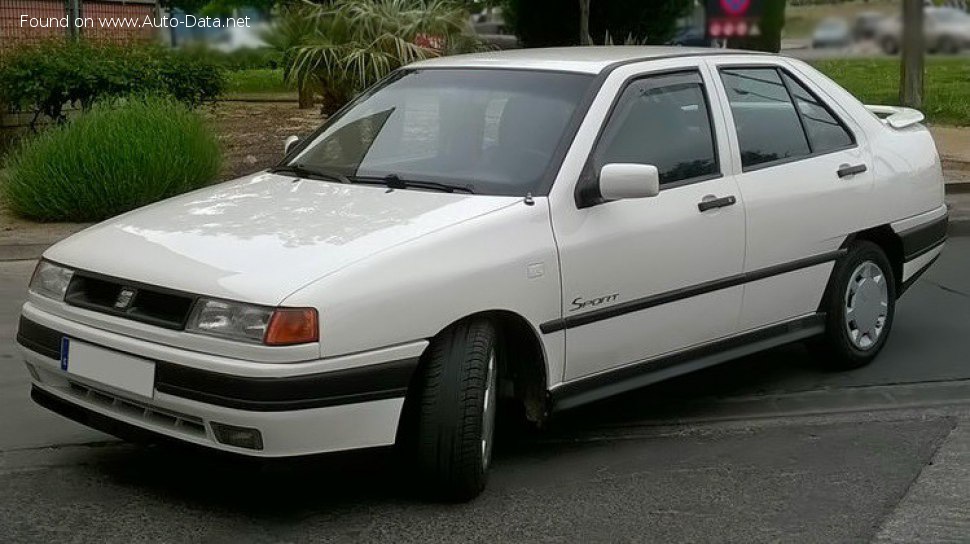
The SEAT Toledo I (1L), specifically the 1.9 D variant producing 64 horsepower, represents a significant step in SEAT’s development as an independent automaker. Introduced in August 1994 and continuing through September 1995, this model was primarily aimed at the European market, offering a practical and affordable sedan option. The Toledo, named after a historic Spanish city, was SEAT’s first self-designed vehicle after decades under the control of Fiat. It served as a crucial model in establishing SEAT’s brand identity and technological capabilities before its acquisition by the Volkswagen Group. This generation of the Toledo offered a blend of modest performance, fuel efficiency, and a surprisingly spacious interior for its class.
SEAT Toledo I (1L) 1.9 D: A European Compact Sedan
The Toledo I (1L) occupied the compact sedan segment in Europe, competing with vehicles like the Renault 19, Peugeot 305, and Opel Kadett. Unlike many of its contemporaries, the Toledo distinguished itself with a hatchback-inspired design, offering greater practicality and cargo access than traditional sedans. This design choice, combined with its relatively affordable price point, made it a popular choice for families and individuals seeking a versatile vehicle. The 1.9 D model, powered by a diesel engine, was particularly favored for its fuel economy and durability, characteristics highly valued in the European market.
Engine & Performance
The heart of the Toledo I (1L) 1.9 D is a 1.9-liter inline four-cylinder diesel engine, designated the 1Y engine code. This naturally aspirated engine produces 64 horsepower at 4400 rpm and 124 Nm (91.46 lb.-ft.) of torque at 2000 rpm. While not a performance-oriented vehicle, the engine provides adequate power for everyday driving. Acceleration from 0 to 100 km/h (0-62 mph) takes 16.5 seconds, and 0 to 60 mph is achieved in approximately 15.7 seconds. The top speed is rated at 165 km/h (102.53 mph). The engine’s design incorporates precombustion chamber injection, a common diesel technology of the era, contributing to its relatively efficient combustion process. The power-to-weight ratio is 16.4 kg/Hp, and the torque-to-weight ratio is 8.5 kg/Nm. Fuel economy is a strong point, achieving 5.8 liters per 100 kilometers (40.6 US mpg or 48.7 UK mpg).
Design & Features
The SEAT Toledo I (1L) features a four-door sedan body style with a distinctive hatchback-like rear end. This design provides a large trunk opening and increased cargo versatility. The vehicle comfortably seats five passengers. The exterior styling is relatively conservative, reflecting the design trends of the early 1990s. Inside, the Toledo offers a functional and straightforward interior layout. Safety features for the time included a hydraulic steering system and an Anti-lock Braking System (ABS), which was becoming increasingly common on European vehicles. The Toledo’s interior space was a key selling point, offering a generous 550 liters (19.42 cu. ft.) of trunk space, expandable to 1360 liters (48.03 cu. ft.) with the rear seats folded down. The vehicle’s dimensions are 4321 mm (170.12 in.) in length, 1662 mm (65.43 in.) in width, and 1424 mm (56.06 in.) in height.
Technical Specifications
| Brand | Seat |
| Model | Toledo |
| Generation | Toledo I (1L) |
| Type (Engine) | 1.9 D (64 Hp) |
| Start of production | August, 1994 |
| End of production | September, 1995 |
| Powertrain Architecture | Internal Combustion engine |
| Body type | Sedan |
| Seats | 5 |
| Doors | 4 |
| Fuel consumption (combined) | 5.8 l/100 km |
| Fuel consumption (US mpg) | 40.6 US mpg |
| Fuel consumption (UK mpg) | 48.7 UK mpg |
| Fuel consumption (km/l) | 17.2 km/l |
| Fuel Type | Diesel |
| Acceleration 0 – 100 km/h | 16.5 sec |
| Acceleration 0 – 62 mph | 16.5 sec |
| Acceleration 0 – 60 mph | 15.7 sec |
| Maximum speed | 165 km/h |
| Maximum speed (mph) | 102.53 mph |
| Weight-to-power ratio | 16.4 kg/Hp |
| Weight-to-torque ratio | 8.5 kg/Nm |
| Power | 64 Hp @ 4400 rpm |
| Power per litre | 33.8 Hp/l |
| Torque | 124 Nm @ 2000 rpm |
| Torque (lb.-ft.) | 91.46 lb.-ft. @ 2000 rpm |
| Engine layout | Front, Transverse |
| Engine Model/Code | 1Y |
| Engine displacement | 1896 cm3 |
| Engine displacement (cu. in.) | 115.7 cu. in. |
| Number of cylinders | 4 |
| Engine configuration | Inline |
| Cylinder Bore | 79.5 mm |
| Cylinder Bore (in.) | 3.13 in. |
| Piston Stroke | 95.5 mm |
| Piston Stroke (in.) | 3.76 in. |
| Compression ratio | 22.5:1 |
| Number of valves per cylinder | 2 |
| Fuel injection system | Precombustion chamber injection |
| Engine aspiration | Naturally aspirated engine |
| Valvetrain | OHC |
| Engine oil capacity | 4.5 l |
| Engine oil capacity (US qt) | 4.76 US qt |
| Engine oil capacity (UK qt) | 3.96 UK qt |
| Coolant | 6.2 l |
| Coolant (US qt) | 6.55 US qt |
| Coolant (UK qt) | 5.46 UK qt |
| Kerb Weight | 1050 kg |
| Kerb Weight (lbs.) | 2314.85 lbs. |
| Max. weight | 1550 kg |
| Max. weight (lbs.) | 3417.17 lbs. |
| Max load | 500 kg |
| Max load (lbs.) | 1102.31 lbs. |
| Trunk (boot) space – minimum | 550 l |
| Trunk (boot) space – minimum (cu. ft.) | 19.42 cu. ft. |
| Trunk (boot) space – maximum | 1360 l |
| Trunk (boot) space – maximum (cu. ft.) | 48.03 cu. ft. |
| Fuel tank capacity | 55 l |
| Fuel tank capacity (US gal) | 14.53 US gal |
| Fuel tank capacity (UK gal) | 12.1 UK gal |
| Length | 4321 mm |
| Length (in.) | 170.12 in. |
| Width | 1662 mm |
| Width (in.) | 65.43 in. |
| Height | 1424 mm |
| Height (in.) | 56.06 in. |
| Wheelbase | 2471 mm |
| Wheelbase (in.) | 97.28 in. |
| Front track | 1429 mm |
| Front track (in.) | 56.26 in. |
| Rear (Back) track | 1422 mm |
| Rear (Back) track (in.) | 55.98 in. |
| Drivetrain Architecture | The Internal combustion engine (ICE) drives the front wheels of the vehicle. |
| Drive wheel | Front wheel drive |
| Number of gears and type of gearbox | 5 gears, manual transmission |
| Front suspension | Wishbone |
| Rear suspension | Coil spring |
| Front brakes | Disc |
| Rear brakes | Drum |
| Assisting systems | ABS (Anti-lock braking system) |
| Steering type | Steering rack and pinion |
| Power steering | Hydraulic Steering |
| Tires size | 175/70 R13 |
