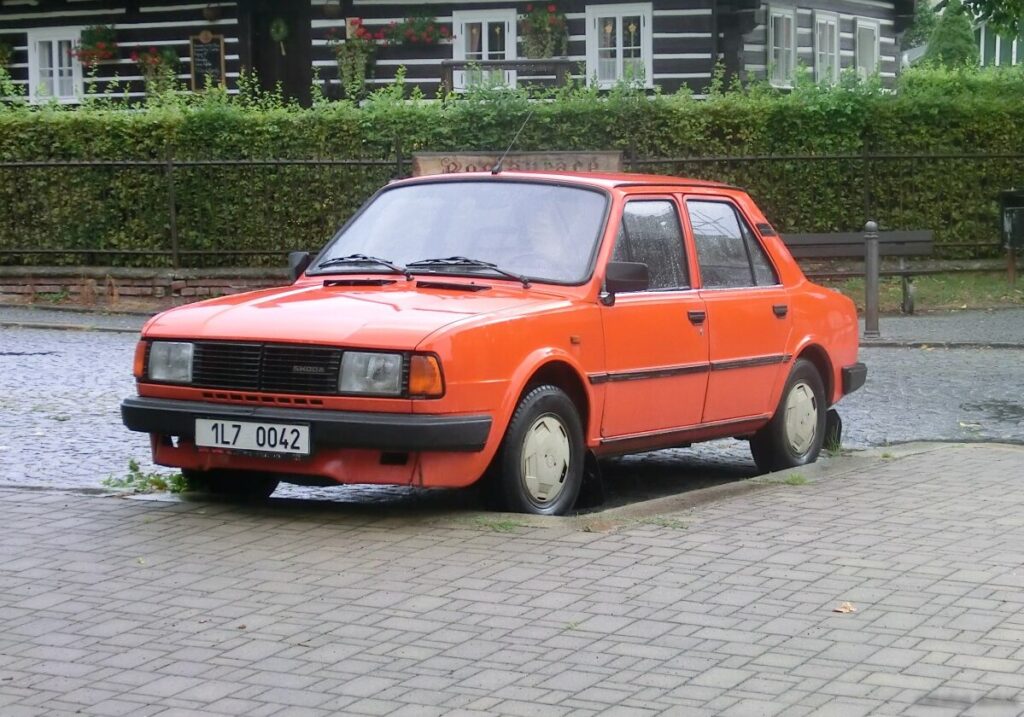
The Skoda 105 and 120, internally designated the 742 series, represented a significant step forward for the Czech automaker during their period under state ownership. Produced from 1976 to 1990, these rear-engined sedans were the mainstay of Skoda’s production, primarily serving the Eastern European market but also finding limited export success, including a small presence in Western Europe and even some in North America through grey market imports. The 1.0 105 S and L variants, producing 46 horsepower, occupied the entry-level position within the 105/120 range, offering basic transportation with a focus on affordability and durability. They were positioned below the more powerful 120S and 120L models, and significantly below the sporting 130 series.
Technical Specifications
| Brand | Skoda |
| Model | 105, 120 |
| Generation | 105, 120 (742) |
| Type (Engine) | 1.0 105 S,L (46 Hp) |
| Start of Production | 1976 |
| End of Production | 1990 |
| Powertrain Architecture | Internal Combustion Engine |
| Body Type | Sedan |
| Seats | 5 |
| Doors | 4 |
| Fuel Type | Petrol (Gasoline) |
| Power | 46 Hp |
| Engine Model/Code | 742.10 |
| Engine Aspiration | Naturally Aspirated |
| Engine Oil Capacity | 4 l (4.23 US qt | 3.52 UK qt) |
| Coolant Capacity | 11.5 l (12.15 US qt | 10.12 UK qt) |
| Fuel Tank Capacity | 36 l (9.51 US gal | 7.92 UK gal) |
Powertrain & Engine Architecture
The heart of the Skoda 105 and 120 was a water-cooled, overhead valve (OHV) four-cylinder engine. The 1.0-liter (988cc) engine, designated 742.10, produced 46 horsepower at 5,200 rpm and 58 lb-ft of torque at 3,400 rpm. This engine was a development of earlier Skoda designs, featuring a relatively simple construction for ease of maintenance and reliability. Fuel delivery was handled by a single, two-barrel Jikov carburetor. The engine utilized a pushrod valvetrain, a cost-effective solution common in vehicles of this era. The engine was mounted longitudinally in the rear of the vehicle, driving the rear wheels. The transmission was a four-speed manual, although a five-speed manual was available on some later models and the 120L. The ‘S’ and ‘L’ trims generally came equipped with the four-speed. The automatic transmission, while offered, was relatively rare and typically found in export models, utilizing a three-speed torque converter design. This automatic was not known for its performance or efficiency, but offered a level of convenience uncommon in vehicles of this class.
Driving Characteristics
The 1.0-liter engine in the 105 S and L provided adequate, but not exhilarating, performance. Acceleration was leisurely, with a 0-60 mph time estimated around 18-20 seconds. Top speed was approximately 85 mph, though sustaining that speed for extended periods was not advisable. The four-speed manual transmission offered a reasonable spread of gears, but the engine lacked the torque to make frequent downshifts unnecessary. The automatic transmission further diminished performance, resulting in sluggish acceleration and a noticeable lack of responsiveness. Handling was typical of rear-engined cars of the period – exhibiting a tendency towards oversteer if pushed hard. However, for everyday driving, the 105/120 offered a comfortable and predictable ride. The steering was light, but lacked precision. The rear engine placement did contribute to a somewhat noisy cabin, with engine sounds readily audible.
Equipment & Trim Levels
The Skoda 105 S and L were relatively spartan in their standard equipment. The ‘S’ trim was the more basic of the two, featuring vinyl upholstery, simple steel wheels, and minimal chrome trim. The ‘L’ trim added cloth upholstery, more extensive chrome detailing, and often included features like a heated rear window and a more comprehensive instrument cluster. Optional extras included a radio, upgraded seats, and a sunroof. Interior design was functional rather than stylish, with a focus on durability. The dashboard was typically constructed from hard plastic, and the controls were straightforward and easy to use. The 105/120 offered a reasonably spacious interior for its size, comfortably accommodating five passengers.
Chassis & Braking
The Skoda 105 and 120 utilized a traditional body-on-frame construction, providing a robust and durable chassis. Suspension consisted of independent trailing arms at the rear and MacPherson struts at the front. The rear suspension geometry was designed to mitigate the handling challenges associated with the rear-engine layout. Braking systems varied depending on the model year and trim level. Early models typically featured drum brakes on all four wheels. Later models, particularly the 120L, often received front disc brakes, improving stopping performance. The 105 S and L generally retained drum brakes all around. Steering was a recirculating ball system, providing light but imprecise control. Stabilizer bars were not standard on the base 105 S, but were often included on the 120L and as an optional extra on other trims.
Market Reception & Comparison
The Skoda 105 and 120 were primarily intended for the Eastern European market, where they were valued for their affordability, reliability, and practicality. Western European reception was more muted, with the cars often perceived as being outdated and lacking in refinement compared to contemporary offerings from Western manufacturers. The 1.0-liter engine was often criticized for its lack of power, particularly when compared to the more potent 1.2-liter engines found in the 120S and 130 series. Fuel economy was reasonable for the time, averaging around 35-40 mpg. Reliability was generally good, thanks to the engine’s simple design and robust construction. However, maintenance could be challenging due to the rear-engine layout and the limited availability of spare parts in some markets. Compared to rivals like the Fiat 127 or Renault 5, the Skoda 105/120 offered a more spacious interior but lacked the modern features and driving dynamics of those front-wheel-drive competitors.
Legacy
The Skoda 105 and 120 represent a significant chapter in the history of the Czech automotive industry. While not renowned for performance or innovation, these cars provided reliable and affordable transportation for millions of people in Eastern Europe and beyond. The 1.0-liter engine, while modest in output, proved to be durable and relatively trouble-free. Today, the Skoda 105/120 has gained a following among classic car enthusiasts, particularly those interested in Eastern European automotive history. Parts availability can be a challenge, but a dedicated community of owners and restorers exists. The 1.0-liter variants, while less desirable than the more powerful models, remain affordable and offer a unique glimpse into a bygone era of automotive engineering. Their simple mechanics make them relatively easy to maintain for those with some mechanical aptitude, ensuring that these Czech classics will continue to grace the roads for years to come.