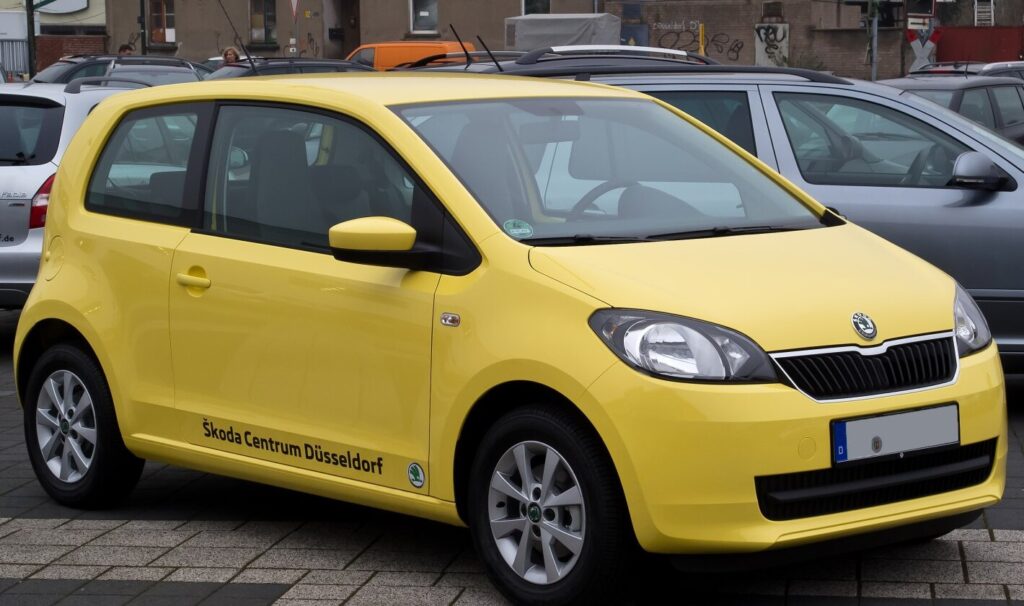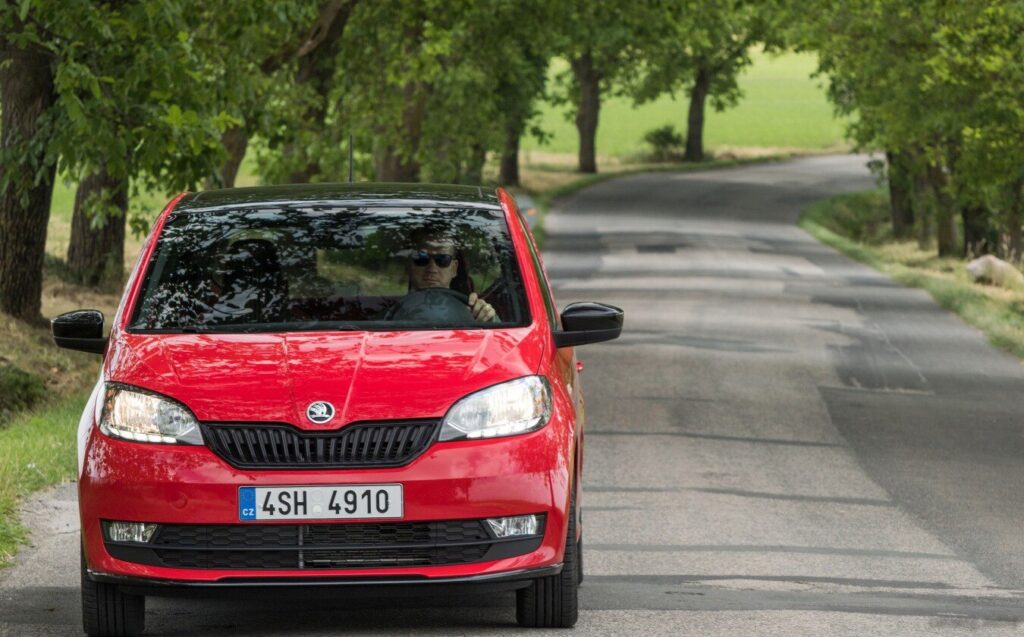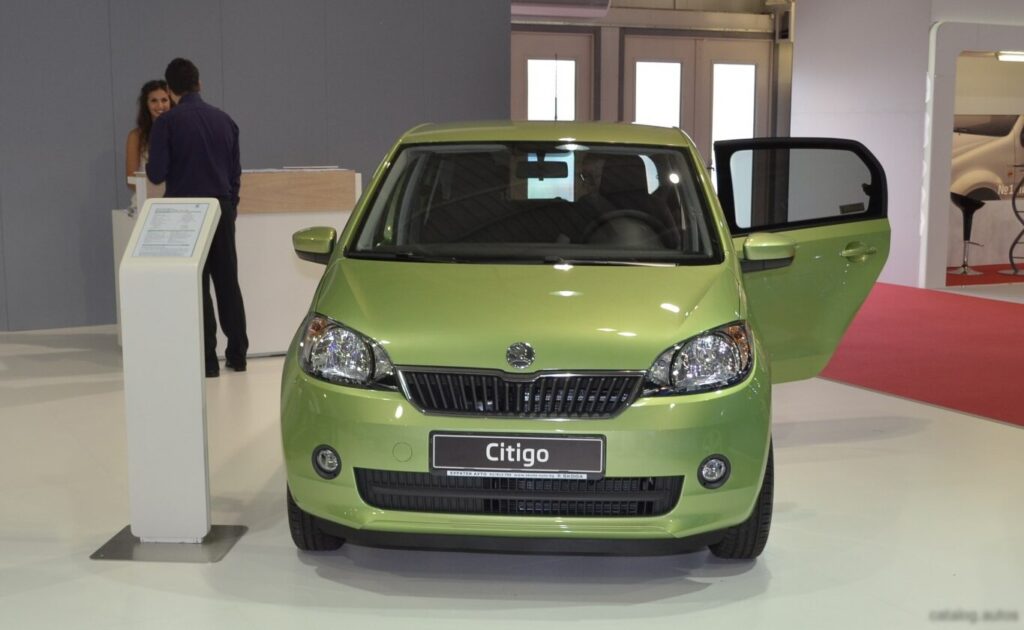
The Skoda Citigo, specifically the five-door 1.0-liter (60 horsepower) automatic variant, was a city car produced by the Czech manufacturer Skoda Auto between October 2011 and 2017. Part of the Volkswagen Group’s New Small Family (NSF) project, alongside the Volkswagen up! and SEAT Mii, the Citigo represented Skoda’s entry into the ultra-compact car segment. This particular engine and transmission combination was positioned as the entry-level automatic offering, aimed at drivers prioritizing ease of use and fuel efficiency over outright performance. It was built on the 1HX0/A3 platform.
Technical Specifications
| Brand | Skoda |
| Model | Citigo |
| Generation | Citigo (5-door) |
| Type (Engine) | 1.0 (60 Hp) Automatic |
| Start of production | October, 2011 |
| End of production | 2017 |
| Powertrain Architecture | Internal Combustion engine |
| Body type | Hatchback |
| Seats | 4 |
| Doors | 5 |
| Fuel consumption (urban) | 5.3 l/100 km (44.4 US mpg, 53.3 UK mpg, 18.9 km/l) |
| Fuel consumption (extra urban) | 3.9 l/100 km (60.3 US mpg, 72.4 UK mpg, 25.6 km/l) |
| Fuel consumption (combined) | 4.4 l/100 km (53.5 US mpg, 64.2 UK mpg, 22.7 km/l) |
| CO2 emissions | 103 g/km |
| Fuel Type | Petrol (Gasoline) |
| Acceleration 0 – 100 km/h | 15.3 sec |
| Acceleration 0 – 62 mph | 15.3 sec |
| Acceleration 0 – 60 mph | 14.5 sec |
| Maximum speed | 160 km/h (99.42 mph) |
| Emission standard | Euro 5 |
| Weight-to-power ratio | 15.5 kg/Hp, 64.4 Hp/tonne |
| Weight-to-torque ratio | 9.8 kg/Nm, 101.9 Nm/tonne |
| Power | 60 Hp @ 5000-6000 rpm |
| Power per litre | 60.1 Hp/l |
| Torque | 95 Nm @ 3000-4300 rpm (70.07 lb.-ft. @ 3000-4300 rpm) |
| Engine layout | Front, Transverse |
| Engine Model/Code | CHYA |
| Engine displacement | 999 cm3 (60.96 cu. in.) |
| Number of cylinders | 3 |
| Engine configuration | Inline |
| Fuel injection system | Multi-port manifold injection |
| Engine aspiration | Naturally aspirated engine |
| Engine oil capacity | 3.4 l (3.59 US qt | 2.99 UK qt) |
| Coolant capacity | 4.2 l (4.44 US qt | 3.7 UK qt) |
| Kerb Weight | 932 kg (2054.71 lbs.) |
| Max. weight | 1290 kg (2843.96 lbs.) |
| Max load | 358 kg (789.25 lbs.) |
| Trunk (boot) space – minimum | 251 l (8.86 cu. ft.) |
| Trunk (boot) space – maximum | 959 l (33.87 cu. ft.) |
| Fuel tank capacity | 35 l (9.25 US gal | 7.7 UK gal) |
| Length | 3563 mm (140.28 in.) |
| Width | 1645 mm (64.76 in.) |
| Height | 1478 mm (58.19 in.) |
| Wheelbase | 2420 mm (95.28 in.) |
| Front track | 1428 mm (56.22 in.) |
| Rear track | 1424 mm (56.06 in.) |
| Minimum turning circle | 9.8 m (32.15 ft.) |
| Drivetrain Architecture | Front wheel drive |
| Number of gears | 5 |
| Gearbox type | Automatic transmission |
| Front suspension | Independent, McPherson with coil spring and anti-roll bar |
| Rear suspension | Semi-dependent beam with stabilizer |
| Front brakes | Ventilated discs |
| Rear brakes | Disc |
| Assisting systems | ABS (Anti-lock braking system) |
| Steering type | Steering rack and pinion |
| Power steering | Electric |
| Tires size | 165/70 R14 |
| Wheel rims size | 5.0J x 14 |
Powertrain & Engine Architecture
The heart of this Citigo variant is the CHYA engine, a 999cc three-cylinder petrol engine. This engine utilizes a naturally aspirated configuration and multi-point fuel injection. The three-cylinder layout, while offering inherent packaging advantages, is known for its slightly rougher operation compared to four-cylinder engines. The CHYA engine produces 60 horsepower at 5000-6000 rpm and 95 Nm (70 lb-ft) of torque between 3000 and 4300 rpm. Paired with this engine is a five-speed automatic transmission. This transmission, while providing convenience, isn’t known for its particularly quick shifts or sporty feel; it prioritizes smooth operation and fuel economy. The engine’s relatively low output meant the automatic transmission was tuned for efficiency rather than performance.
Driving Characteristics
The 1.0-liter automatic Citigo delivers a decidedly unhurried driving experience. Acceleration from 0-60 mph takes around 14.5 seconds, and top speed is limited to 99.42 mph. The automatic transmission’s gear ratios are optimized for fuel efficiency, resulting in a noticeable lack of urgency when accelerating. Compared to the manual transmission version of the same engine, the automatic feels significantly slower. The automatic also lacks the engine braking benefits of a manual gearbox. However, in typical urban environments, the Citigo’s modest power output is sufficient for navigating city streets and parking. The light steering and compact dimensions make it easy to maneuver in tight spaces.
Equipment & Trim Levels
The 1.0-liter automatic Citigo typically came with a fairly basic level of equipment. Standard features generally included power steering, ABS brakes, front airbags, and a basic audio system. Higher trim levels, such as the ‘Elegance’ or ‘Sport’ offered options like alloy wheels, air conditioning, electric windows, and a more sophisticated audio system with Bluetooth connectivity. Interior upholstery was typically cloth, with a functional, if somewhat spartan, dashboard layout. The five-door configuration provided improved rear passenger access compared to the three-door model.
Chassis & Braking
The Citigo’s chassis is designed for simplicity and cost-effectiveness. The front suspension utilizes a McPherson strut setup with a coil spring and anti-roll bar, while the rear suspension employs a semi-independent torsion beam. This configuration provides a reasonable balance between ride comfort and handling. Brakes are disc brakes on all four wheels, providing adequate stopping power for the car’s weight and performance. ABS (Anti-lock Braking System) is standard, enhancing safety during emergency braking situations.
Market Reception & Comparison
The Skoda Citigo 1.0 automatic was generally well-received as an affordable and practical city car. Critics praised its fuel efficiency and ease of driving, but noted its lack of performance. Compared to the manual transmission version, the automatic suffered from slower acceleration and reduced fuel economy. Within the Volkswagen Group’s NSF family, the Citigo offered a more affordable alternative to the Volkswagen up! and SEAT Mii, while still providing a similar level of practicality and reliability. The 1.8L TDI and 1.2L TSI engines offered in the up! and Mii provided significantly more performance, but at a higher price point.
Legacy
The Skoda Citigo, and specifically the 1.0-liter automatic variant, has proven to be a relatively reliable vehicle. The CHYA engine is known for its durability, and the automatic transmission, while not particularly sophisticated, is generally dependable. On the used car market, these Citigos are often sought after as affordable and economical runabouts. However, potential buyers should be aware of the car’s limited performance and basic equipment levels. Regular maintenance, including oil changes and timing belt replacements (if applicable), is crucial for ensuring long-term reliability.