
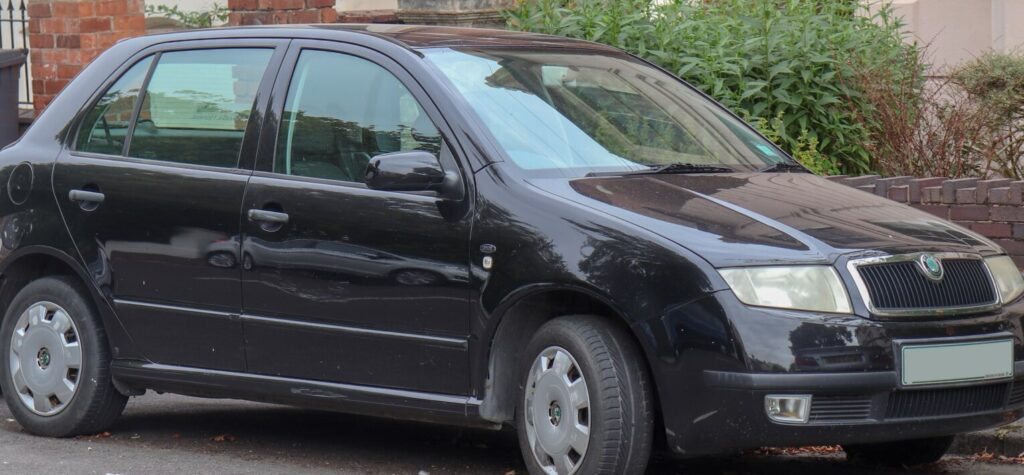
The Skoda Fabia I (6Y) 1.2 HTP, producing 64 horsepower, was a key entry-level offering in Skoda’s lineup from January 2003 to July 2004. Positioned within the first generation Fabia (6Y) platform – shared with the Volkswagen Polo Mk4 and SEAT Ibiza Mk2 – this variant aimed to provide affordable and economical transportation. The 1.2 HTP engine was a significant development for Skoda, representing a move towards smaller, more fuel-efficient engines. This model was primarily sold in European markets, where smaller displacement engines were favored due to tax regulations and fuel costs.
Technical Specifications
| Brand | Skoda |
| Model | Fabia |
| Generation | Fabia I (6Y) |
| Type (Engine) | 1.2 HTP (64 Hp) |
| Start of production | January, 2003 |
| End of production | July, 2004 |
| Powertrain Architecture | Internal Combustion engine |
| Body type | Hatchback |
| Seats | 5 |
| Doors | 5 |
| Fuel consumption (urban) | 7.6 l/100 km (30.9 US mpg, 37.2 UK mpg, 13.2 km/l) |
| Fuel consumption (extra urban) | 5.1 l/100 km (46.1 US mpg, 55.4 UK mpg, 19.6 km/l) |
| Fuel consumption (combined) | 5.9 l/100 km (39.9 US mpg, 47.9 UK mpg, 16.9 km/l) |
| Fuel Type | Petrol (Gasoline) |
| Acceleration 0 – 100 km/h | 15.9 sec |
| Acceleration 0 – 62 mph | 15.9 sec |
| Acceleration 0 – 60 mph | 15.1 sec |
| Maximum speed | 160 km/h (99.42 mph) |
| Weight-to-power ratio | 16.6 kg/Hp, 60.4 Hp/tonne |
| Weight-to-torque ratio | 9.5 kg/Nm, 105.7 Nm/tonne |
| Power | 64 Hp @ 5400 rpm |
| Power per litre | 53.4 Hp/l |
| Torque | 112 Nm @ 3000 rpm (82.61 lb.-ft. @ 3000 rpm) |
| Engine layout | Front, Transverse |
| Engine Model/Code | AZQ |
| Engine displacement | 1198 cm3 (73.11 cu. in.) |
| Number of cylinders | 3 |
| Engine configuration | Inline |
| Cylinder Bore | 76.5 mm (3.01 in.) |
| Piston Stroke | 86.9 mm (3.42 in.) |
| Compression ratio | 10.5:1 |
| Number of valves per cylinder | 4 |
| Fuel injection system | Multi-port manifold injection |
| Engine aspiration | Naturally aspirated engine |
| Valvetrain | OHC |
| Engine oil capacity | 2.8 l (2.96 US qt | 2.46 UK qt) |
| Coolant capacity | 5.1 l (5.39 US qt | 4.49 UK qt) |
| Kerb Weight | 1060 kg (2336.9 lbs.) |
| Max. weight | 1575 kg (3472.28 lbs.) |
| Max load | 515 kg (1135.38 lbs.) |
| Trunk (boot) space – minimum | 260 l (9.18 cu. ft.) |
| Trunk (boot) space – maximum | 1015 l (35.84 cu. ft.) |
| Fuel tank capacity | 45 l (11.89 US gal | 9.9 UK gal) |
| Length | 3960 mm (155.91 in.) |
| Width | 1645 mm (64.76 in.) |
| Height | 1450 mm (57.09 in.) |
| Wheelbase | 2462 mm (96.93 in.) |
| Front track | 1435 mm (56.5 in.) |
| Rear track | 1424 mm (56.06 in.) |
| Drivetrain Architecture | Front wheel drive |
| Number of gears | 5 |
| Gearbox type | Manual transmission |
| Front suspension | Coil spring |
| Rear suspension | Coil spring |
| Front brakes | Disc |
| Rear brakes | Drum |
| Assisting systems | ABS (Anti-lock braking system) |
| Steering type | Steering rack and pinion |
| Power steering | Hydraulic |
| Tires size | 165/70 R14 |
| Wheel rims size | 14 |
Powertrain & Engine Architecture
The heart of this Fabia variant is the 1.2-liter, three-cylinder AZQ engine. This engine, part of Skoda’s HTP (High Torque Performance) family, was designed to offer a balance of fuel efficiency and acceptable performance. The AZQ featured multi-point fuel injection and a single overhead camshaft (OHC) valvetrain. The three-cylinder configuration, while inherently unbalanced, was mitigated through the use of balance shafts. The engine’s 1198 cc displacement produced 64 horsepower at 5400 rpm and 82.6 lb-ft of torque at 3000 rpm. The engine was paired with a five-speed manual transmission, which was the standard offering for this trim level. The transmission was chosen for its simplicity and cost-effectiveness, contributing to the overall affordability of the vehicle.
Driving Characteristics
The 1.2 HTP-powered Fabia was not known for its blistering acceleration. The 0-60 mph time of around 15.1 seconds reflects its focus on economy rather than speed. However, the engine proved surprisingly tractable in urban environments, with adequate torque for everyday driving. The five-speed manual transmission allowed drivers to keep the engine in its optimal power band, but frequent downshifts were often necessary when overtaking or climbing hills. Compared to the more powerful 1.4-liter or diesel variants, the 1.2 HTP felt noticeably slower, but it offered a smoother and quieter driving experience. The gear ratios were optimized for fuel efficiency, resulting in a relatively high final drive ratio.
Equipment & Trim Levels
The 1.2 HTP Fabia typically came with a basic level of equipment. Standard features generally included power steering, central locking, front airbags, and an adjustable steering column. Interior upholstery was typically cloth, and the dashboard featured a simple, functional design. Optional extras included air conditioning, electric windows, and a radio/CD player. The trim level was generally considered the entry point to the Fabia range, appealing to budget-conscious buyers. Higher trim levels offered more luxurious features, such as alloy wheels, upgraded interior trim, and additional safety equipment.
Chassis & Braking
The Fabia I utilized a relatively simple chassis design. Front suspension consisted of coil springs and independent suspension, while the rear featured a torsion beam axle with coil springs. Brakes were disc brakes on the front wheels and drum brakes on the rear. ABS (Anti-lock Braking System) was standard equipment, providing enhanced safety in emergency braking situations. The suspension was tuned for comfort rather than sporty handling, providing a compliant ride on most road surfaces. Stabilizer bars were present, but were relatively thin compared to those found on higher-performance models.
Market Reception & Comparison
The 1.2 HTP Fabia was generally well-received as an affordable and economical city car. Critics praised its fuel efficiency and low running costs, but noted its lack of outright performance. Compared to the 1.4-liter and diesel variants, the 1.2 HTP offered lower purchase price but compromised on power and refinement. The 1.4-liter engine provided a noticeable performance boost, while the diesel models offered superior fuel economy and torque. However, the 1.2 HTP remained a popular choice for buyers who prioritized affordability and low running costs.
Legacy
The 1.2 HTP engine, despite some early reliability concerns related to timing chain issues, became a mainstay in the Skoda and Volkswagen lineups for many years. The Fabia I 1.2 HTP, while not a performance icon, provided reliable and economical transportation for a large number of drivers. In the used car market today, these models are typically very affordable, making them attractive to first-time car buyers or those seeking a cheap and cheerful runabout. Maintenance costs are generally low, but potential buyers should be aware of the potential for timing chain wear and ensure that regular servicing has been carried out.
