
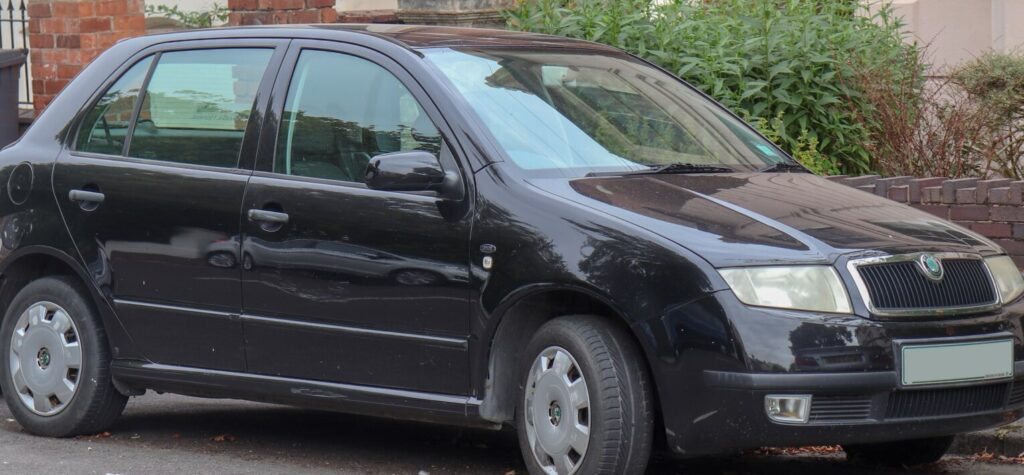
The Skoda Fabia I (6Y) 1.4, producing 68 horsepower, was a key entry point into the first generation Fabia lineup, manufactured between August 1999 and May 2004. Positioned as the base model, it aimed to provide affordable and practical transportation within the European market. The 6Y Fabia represented Skoda’s first completely new model following its acquisition by the Volkswagen Group, built on the Volkswagen A05 (Polo) platform – internally designated as the 1HX0/A3 platform. This variant was particularly significant as it showcased Skoda’s ability to deliver a modern, well-engineered vehicle at a competitive price point, establishing the brand as a viable alternative to established European automakers.
Technical Specifications
| Brand | Skoda |
| Model | Fabia |
| Generation | Fabia I (6Y) |
| Type (Engine) | 1.4 (68 Hp) |
| Start of production | August, 1999 |
| End of production | May, 2004 |
| Powertrain Architecture | Internal Combustion engine |
| Body type | Hatchback |
| Seats | 5 |
| Doors | 5 |
| Fuel consumption (urban) | 9.4 l/100 km (25 US mpg, 30.1 UK mpg, 10.6 km/l) |
| Fuel consumption (extra urban) | 5.5 l/100 km (42.8 US mpg, 51.4 UK mpg, 18.2 km/l) |
| Fuel consumption (combined) | 6.9 l/100 km (34.1 US mpg, 40.9 UK mpg, 14.5 km/l) |
| Fuel Type | Petrol (Gasoline) |
| Acceleration 0 – 100 km/h | 15 sec |
| Acceleration 0 – 62 mph | 15 sec |
| Acceleration 0 – 60 mph | 14.3 sec |
| Maximum speed | 162 km/h (100.66 mph) |
| Weight-to-power ratio | 15.7 kg/Hp, 63.8 Hp/tonne |
| Weight-to-torque ratio | 8.9 kg/Nm, 112.7 Nm/tonne |
| Power | 68 Hp @ 5000 rpm |
| Power per litre | 48.7 Hp/l |
| Torque | 120 Nm @ 2500 rpm (88.51 lb.-ft. @ 2500 rpm) |
| Engine layout | Front, Transverse |
| Engine Model/Code | AME |
| Engine displacement | 1397 cm3 (85.25 cu. in.) |
| Number of cylinders | 4 |
| Engine configuration | Inline |
| Cylinder Bore | 75.5 mm (2.97 in.) |
| Piston Stroke | 78 mm (3.07 in.) |
| Compression ratio | 10.5:1 |
| Number of valves per cylinder | 2 |
| Fuel injection system | Multi-port manifold injection |
| Engine aspiration | Naturally aspirated engine |
| Valvetrain | OHC |
| Engine oil capacity | 4 l (4.23 US qt | 3.52 UK qt) |
| Coolant capacity | 6 l (6.34 US qt | 5.28 UK qt) |
| Kerb Weight | 1065 kg (2347.92 lbs.) |
| Max. weight | 1550 kg (3417.17 lbs.) |
| Max load | 485 kg (1069.24 lbs.) |
| Trunk (boot) space – minimum | 260 l (9.18 cu. ft.) |
| Trunk (boot) space – maximum | 1015 l (35.84 cu. ft.) |
| Fuel tank capacity | 45 l (11.89 US gal | 9.9 UK gal) |
| Length | 3960 mm (155.91 in.) |
| Width | 1645 mm (64.76 in.) |
| Height | 1450 mm (57.09 in.) |
| Wheelbase | 2462 mm (96.93 in.) |
| Front track | 1435 mm (56.5 in.) |
| Rear (Back) track | 1424 mm (56.06 in.) |
| Drivetrain Architecture | The Internal combustion engine (ICE) drives the front wheels of the vehicle. |
| Drive wheel | Front wheel drive |
| Number of gears and type of gearbox | 5 gears, manual transmission |
| Front suspension | Coil spring |
| Rear suspension | Coil spring |
| Front brakes | Disc |
| Rear brakes | Drum |
| Assisting systems | ABS (Anti-lock braking system) |
| Steering type | Steering rack and pinion |
| Power steering | Hydraulic Steering |
| Tires size | 165/70 R14; 185/60 R14 |
| Wheel rims size | 5J x 14; 6J x 14 |
Powertrain & Engine Architecture
The Fabia 1.4 utilized the Volkswagen Group’s AME engine code, a naturally aspirated, inline-four cylinder petrol engine displacing 1397cc. This engine featured a single overhead camshaft (OHC) operating two valves per cylinder. Fuel delivery was managed by a multi-port fuel injection system, a common setup for engines of this era. The AME engine was known for its simplicity and relative reliability, though it wasn’t a powerhouse. The engine’s 10.5:1 compression ratio was fairly standard for the time, aiming for a balance between efficiency and performance. The 68 horsepower output was achieved at 5000 rpm, while peak torque of 120 Nm (88.51 lb-ft) arrived at 2500 rpm. The engine was transversely mounted in the front of the vehicle, driving the front wheels. The standard transmission was a five-speed manual gearbox, although a four-speed automatic transmission was also offered, albeit less commonly.
Driving Characteristics
The 1.4 68 hp Fabia, particularly when equipped with the four-speed automatic transmission, offered a decidedly unhurried driving experience. Acceleration from 0-60 mph took around 14.3 seconds, and top speed was limited to 100.66 mph. The automatic transmission, while providing convenience, noticeably dulled performance compared to the manual version. Gear ratios were optimized for fuel economy rather than spirited driving. In real-world conditions, overtaking maneuvers required careful planning, and the engine could feel strained when climbing hills or carrying a full load. However, the engine was reasonably smooth and quiet for its class, and the automatic transmission provided seamless shifts. The focus was clearly on providing a comfortable and economical ride rather than outright performance.
Equipment & Trim Levels
The base-level 1.4 Fabia typically came with a modest level of standard equipment. This included power steering, central locking, front airbags, and an adjustable steering column. Interior upholstery was typically a basic cloth material. Optional extras included air conditioning, electric windows, and a radio/cassette player. Higher trim levels, such as the Classic and Comfort, added features like alloy wheels, upgraded interior trim, and more sophisticated audio systems. The 1.4 served as the foundation for these upgrades, offering buyers a cost-effective entry point into the Fabia range.
Chassis & Braking
The Fabia 1.4 featured a relatively simple chassis setup. Front suspension utilized coil springs and independent suspension, while the rear employed a torsion beam axle with coil springs. This configuration provided a comfortable ride, although handling wasn’t particularly sharp. Brakes were disc brakes on the front wheels and drum brakes on the rear, a common setup for vehicles in this price segment. ABS (Anti-lock Braking System) was standard, enhancing safety. The steering was a rack and pinion system with hydraulic power assistance, providing light and easy steering feel.
Market Reception & Comparison
The Skoda Fabia 1.4 was generally well-received by automotive critics as a value-for-money proposition. It offered a practical and reliable package at a competitive price point. However, the 1.4 engine was often criticized for its lack of power, particularly when paired with the automatic transmission. Compared to other engines in the Fabia lineup, such as the 1.9 TDI diesel or the more powerful 1.6 petrol, the 1.4 offered significantly less performance. Fuel economy was a strong point, however, making it an attractive option for budget-conscious buyers. The 1.9 TDI, while more expensive, offered superior fuel economy and torque, while the 1.6 provided a noticeable performance boost.
Legacy
The Skoda Fabia I 1.4, while not the most exciting variant in the range, proved to be a reliable and durable vehicle. The AME engine, despite its modest power output, was generally known for its longevity. Today, these cars are relatively common on the used car market, often representing an affordable and practical transportation option. Maintenance costs are generally low, thanks to the engine’s simplicity and the widespread availability of spare parts. While not a collector’s item, the Fabia 1.4 remains a testament to Skoda’s ability to deliver a well-engineered and affordable vehicle, helping to establish the brand’s reputation for value and reliability.
